Showing posts with label NF-18-02. Show all posts

Wednesday, June 20, 2018

Representing the conventional 'top predators', Mitch Rider from the UM Shark Lab joins the #NF1802 blog

One of our graduate students, Mitch Rider, joins us for another post #ontheblog!

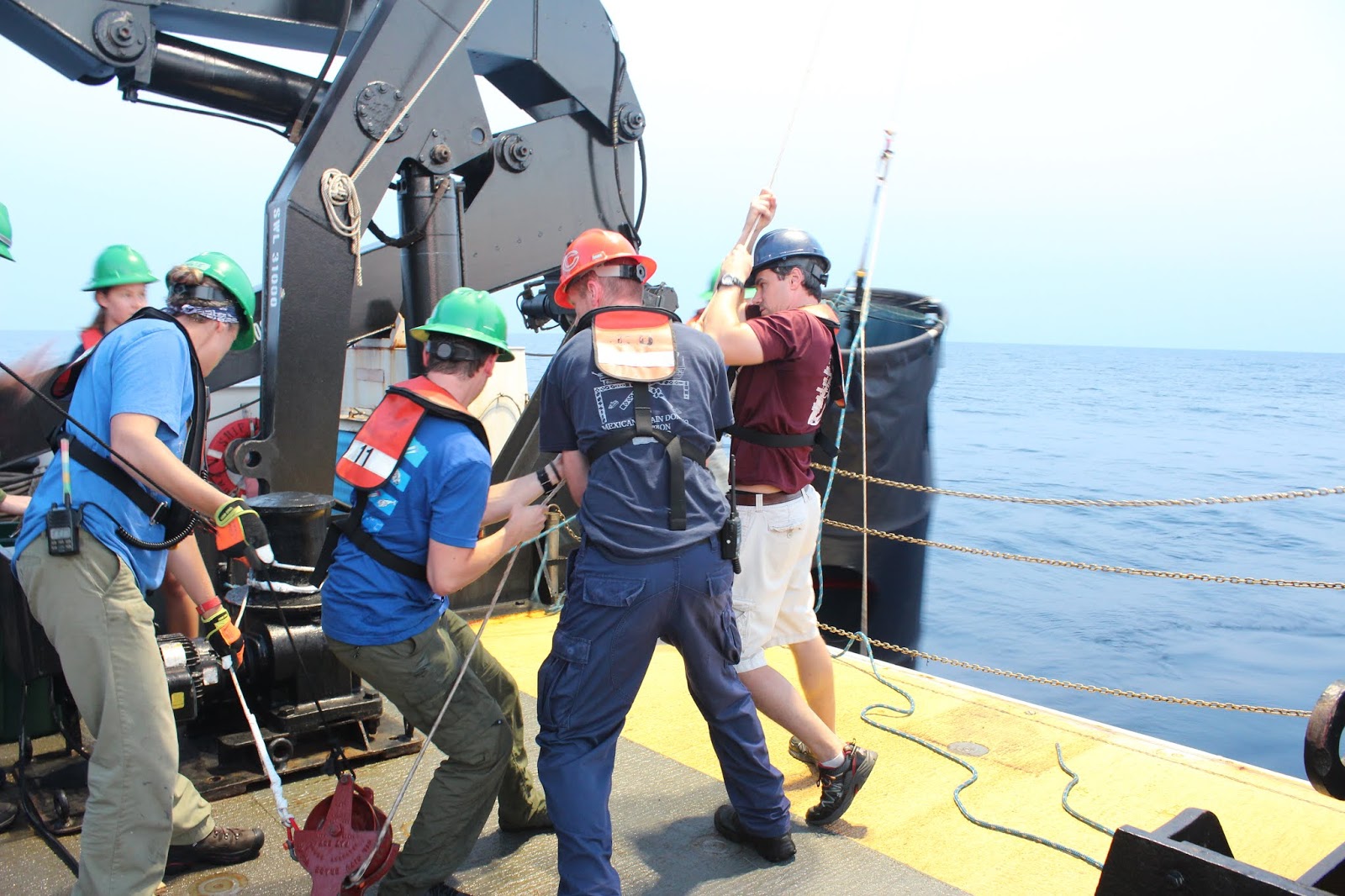
Mitch, John and Chief Survey Tech deploy the CTD  rosette
"My name is Mitchell Rider and I am currently a Master’s Student at the Rosenstiel School of Marine and Atmospheric Science in Miami, FL. I work as a Laboratory Technician in the FORCES Lab tracking eddies using satellite imagery supporting the MBON project, while my graduate research investigates shark movement ecology in relation to urbanization. I was very fortunate to have the opportunity to join the lab on this cruise.
Mitch discovers plankton!
My goals were to gain experience working in the open sea (since shark tagging trips last up to six hours) and to participate in the process of taking plankton samples. One of the most significant things I experienced was sorting through plankton samples collected from bongo and neuston nets. I was fascinated to find a plethora of organisms I have never seen before in addition to the larval forms of fish that I am very familiar with such as mahi-mahi, pufferfish, and lionfish. I was most excited in my newfound ability to identify larval bluefin tuna since that was one of the target species of this cruise. I would like to thank the FORCES Lab and the crew of the Nancy Foster for this opportunity to participate in the RESTORE NF1802 Cruise. This experience opened my eyes to a different field of study that is both fascinating and worth looking into for a future career as a marine scientist.
Zooplankton typically encountered in the Gulf of Mexico in May! Magnification is 10x
Sarah, Raul and Mitch with the plankton net


Survey track for leg 2 aboard NOAA Ship Nancy Foster #NF1802

Mitch in his Shark-Life. Image by M. Bernanke
"As I mentioned before, my work as a lab technician for the FORCES Lab consists of tracking and measuring the sizes of mesoscale and submesoscale eddies along the Florida Channel. This entails running through daily chlorophyll and sea surface temperature satellite imagery and identifying potential eddies. In addition, I am also pursuing my Master of Science degree at RSMAS where my research is investigating the relationship between shark movement and boat traffic. This is achieved
through analyzing the residency patterns of sharks detected on our acoustic receiver array in relation to boat passages that are recorded using passive acoustic hydrophones or ‘underwater listening stations'".

If you are interested in more shark-y research, check out the UM Shark Lab on FB!


"The National Marine Sanctuaries serve as sentinel sites for monitoring marine biodiversity of the nation’s coastal, shelf and deep-sea ecosystems. The Sanctuaries MBON project includes Monterey Bay, Flower Garden Banks and Florida Keys ecosystems to assess: 1) the deep sea (pelagic realm and seabed); 2) continental shelves; 3) estuaries and nearshore regions; and 4) coral reefs." (source: MBON website)

Tuesday, June 19, 2018

A better late than never post for #NF1802, Dr. Stukel #ontheblog

Stukel sets up the satellite-tracker inside the buoys
Although NF1802 has come to an end, we will continue to post for the rest of the summer! Stay tuned!

Today, Dr. Mike Stukel joins us once again on the blog! Mike is an Assistant Professor at Florida State University and one of the PIs on our joint NOAA RESTORE Science project. His PhD students, Tom and Taylor joined him in this survey.


“I study the intersection of plankton ecology and biogeochemistry.  I have a fascination for all of the microscopic critters (plankton) that drift constantly with the currents of the open ocean.  Much of my research focuses on either the role of plankton in converting carbon dioxide to organic matter and then storing that organic matter in the deep ocean (a process referred to as the biological pump) or determining how changes in the planktonic ecosystem affect the availability of prey for fish and other large organisms. During this project, my research goal is to understand how biogeochemical and ecological interactions at the base of the food web affect the survival of larval tuna.
The golden tufts in the bottom left are Trichodesmium, the long organism in the middle is a chaetognath, and many of the out-of-focus blobs are copepods
Specifically, I'm interested in two questions:

  1. What processes supply nutrients to the algae at the base of the food web (upwelling that introduces deep nutrients to the surface ocean or nitrogen fixation that converts abundant nitrogen gas into plankton fuel)?  
  2. How does the structure of the planktonic food web affect the efficiency with which primary production is converted to zooplankton biomass (i.e. fish food)?  
Illustration by Sabine and Baxter

On this cruise, one of my lab’s goals is to make simultaneous measurements of nitrate uptake and nitrogen fixation in tuna spawning habitat."

Mike looks for microscopic organisms in between stations
Stukel and the team during sediment trap operations on the back-deck
If you are a teacher or student and want to learn more about plankton, check out Mike's lab's website and this link and has lesson plan too!) developed by Ms. Colleen Miks.

Friday, May 25, 2018

PhD student Rachel Thomas on the blog!

Rachel filters water collected at 500 m in the GOM
Rachel Thomas from Florida State University's Earth Ocean and Atmospheric Sciences Department is a doctoral student in the Knapp Lab and she is our guest-blogger today sharing a bit of her research and cruise goals:

"My personal goal on this cruise is to be able to identify bluefin tuna through a microscope. I’ve never seen fish larvae before, so everything the “fish team” brings up in the nets is new and exciting to me! Most of my previous work is involved in the Southern Ocean, where there are unused nutrients in the surface ocean. This gives us a unique ability to look at how phytoplankton are reacting to different physiological stresses, such as light and nutrient availability."
One of these nutrients, is Nitrate (NO3) which is a form of dissolved inorganic nitrogen that is utilized by phytoplankton in the ocean (Malerba et al 2012). One of the aspects of our project (NF1704 NF1802 is to examine the dynamics between these inorganic compounds at different depths of the surface water column (0-500 m).

Typical nitrate vertical profile comparison, (modified from A. Nahian Avro)
T. Kelly and Rachel Thomas recover the CTD rosette 
"The Gulf of Mexico has a very different light regime compared to the Southern Ocean, and little to no nitrate in the surface waters. Our research team hopes to explore how these contrasts are expressed in the isotopic composition of subsurface nitrate in the Gulf of Mexico. We will also use the isotopic composition of subsurface nitrate in the Gulf of Mexico to understand the nutrient sources for primary productivity fueling bluefin tuna growth in surface waters." 

Click here for last year's blog post from Rachel's experiences during NF1704.

A bit of trivia: the Southern Ocean is the fourth largest of the world's ocean basins and extends to Antarctica. Psst, how many oceans are there? (click here for an answer)

Rachel Thomas and Alanna Mnich ready to deploy an SVP drifter on the fan tail

Wednesday, May 16, 2018

Today on the blog: Kiana returns!

Kiana rinses the Bongo-90cm 
Today, one of our youngest scientists, Ms. Kiana Ford shares a brief post. This is Kiana’s second cruise aboard Nancy Foster and has been volunteering in our lab since January 2017. She is now a Senior at the University of Miami's RSMAS and got back from an amazing semester abroad with the UGalapagos & Isabella Oceanographic Institute in Ecuador just a few days before the ship started its journey.

Image may contain: swimming, outdoor and nature
Kiana makes friends with the locals in the Galapagos, Ecuador
Kiana shared with our blog “my goal for the cruise is to help find some bluefin tuna! I would also like to be comfortable jumping into any science role during the cruise, from deploying nets on the back deck to running the computer programs in the dry lab. My favorite experiences from participating in the oceanographic surveys is to get to know other scientists and crew members, and seeing how everyone contributes to some aspect of the expedition. My research goals when I return to land is to complete my senior thesis examining larval lobster populations collected in southern Cuba during NF-16-02-03. This summer I am eager to begin my internship with  Harbor Wildwatch, a non-profit organization in Gig Harbor, WA. They organize outreach events to educate the public on marine and environmental topics." 
Thanks Kiana! She disembarked during our port-stop in Pensacola, but we will see you soon in the NOAA FORCES Lab in the Fall semester.