Showing posts with label algae. Show all posts

Tuesday, June 19, 2018

A better late than never post for #NF1802, Dr. Stukel #ontheblog

Stukel sets up the satellite-tracker inside the buoys
Although NF1802 has come to an end, we will continue to post for the rest of the summer! Stay tuned!

Today, Dr. Mike Stukel joins us once again on the blog! Mike is an Assistant Professor at Florida State University and one of the PIs on our joint NOAA RESTORE Science project. His PhD students, Tom and Taylor joined him in this survey.


“I study the intersection of plankton ecology and biogeochemistry.  I have a fascination for all of the microscopic critters (plankton) that drift constantly with the currents of the open ocean.  Much of my research focuses on either the role of plankton in converting carbon dioxide to organic matter and then storing that organic matter in the deep ocean (a process referred to as the biological pump) or determining how changes in the planktonic ecosystem affect the availability of prey for fish and other large organisms. During this project, my research goal is to understand how biogeochemical and ecological interactions at the base of the food web affect the survival of larval tuna.
The golden tufts in the bottom left are Trichodesmium, the long organism in the middle is a chaetognath, and many of the out-of-focus blobs are copepods
Specifically, I'm interested in two questions:

  1. What processes supply nutrients to the algae at the base of the food web (upwelling that introduces deep nutrients to the surface ocean or nitrogen fixation that converts abundant nitrogen gas into plankton fuel)?  
  2. How does the structure of the planktonic food web affect the efficiency with which primary production is converted to zooplankton biomass (i.e. fish food)?  
Illustration by Sabine and Baxter

On this cruise, one of my lab’s goals is to make simultaneous measurements of nitrate uptake and nitrogen fixation in tuna spawning habitat."

Mike looks for microscopic organisms in between stations
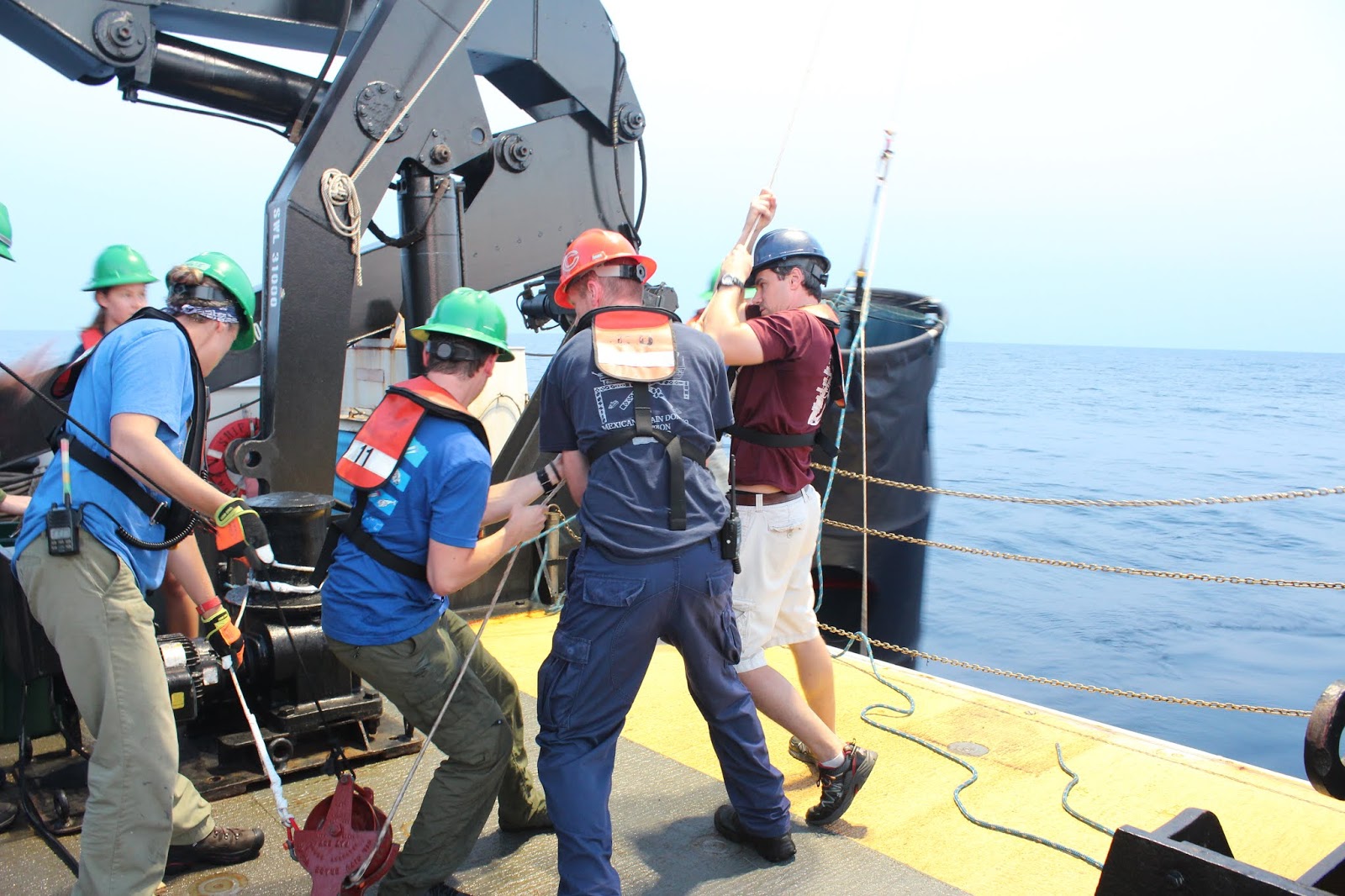
Stukel and the team during sediment trap operations on the back-deck
If you are a teacher or student and want to learn more about plankton, check out Mike's lab's website and this link and has lesson plan too!) developed by Ms. Colleen Miks.

Tuesday, May 23, 2017

Featured Scientist: Meet Mike!

This year's voyage is the first of two annual research surveys in the Gulf of Mexico for the NOAA RESTORE Act Science Program. Our project, "Research, observation, and monitoring to support long-term sustainability in the GoM ecosystem, including fish stocks, fish habitat, and fishing industries," is in collaboration with some new partners to the FORCES Lab. Read on and get introduced to the project's PI from Florida State University, Mike Stukel!

Mike prepares sample bottles to be loaded into the sediment trap
My name is Mike Stukel, and I am an assistant professor at Florida State University. I am a plankton ecologist and biogeochemist in the FSU Plankton Ecology and Biochemistry Lab. I study the role that some of the smallest organisms in the ocean play in the global carbon cycle and their role in removing carbon dioxide from the atmosphere. On this cruise, I am studying the role that different nutrients play in limiting the primary production of phytoplankton. These tiny algae are responsible for half of the world’s photosynthesis and half of the oxygen that you breathe. Their photosynthesis also supports the entire marine ecosystem of the open ocean Gulf of Mexico. One of my goals in this project is to quantify the food web pathways that partition this phytoplankton production between either the biological pump (which transports atmospheric CO2 into the deep ocean where it can be stored for centuries) or higher trophic levels including larval tuna. 

Mike and Tom (R) with their double-decker water filtrations!
My goal for this cruise is to understand the base of the food web that supports larval tuna.  In particular, I am interested in whether the algae responsible for photosynthesis are ultimately getting their nutrients from upwelling that brings nutrient-rich deep water into the sunlit surface zone or whether special phytoplankton (called Nitrogen-fixers) are creating their own nutrients from the nitrogen gas that is abundant in the atmosphere and ocean.  Answering this question is important to understanding whether or not total productivity in the Gulf of Mexico will decrease due to climate change.

Mike deploys the drifter array in the wee hours of the morning


Thursday, June 23, 2016

Parrotfish: Coral Reef Vegetarians

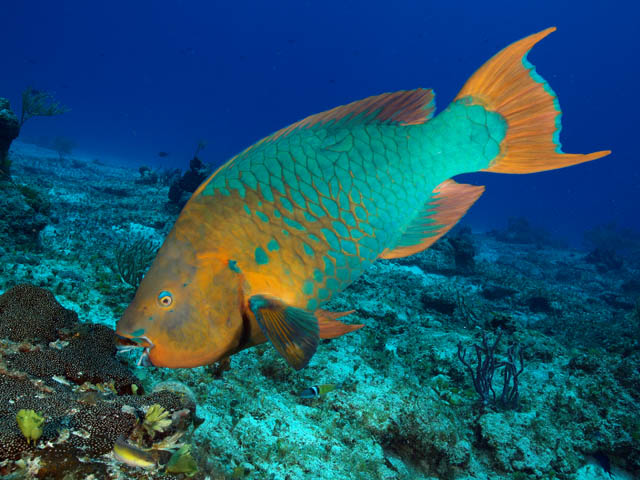
A rainbow parrotfish grazing on algae in the Caribbean
Photo source: CFMC, caribbeanfmc.com/fmp_reef_fish.html
Parrotfish are one of the most universally recognized reef fish, with their bright colors and beautiful varieties. If you've ever been snorkeling or SCUBA diving on a reef, you've probably easily spotted parrotfish swimming around, biting off pieces of coral - wait, biting coral? Isn't that bad for it? Aren't corals endangered?

Believe it or not, this "grazing" behavior is actually really good for coral reefs! Parrotfish are herbivores, which means that they eat only plant matter, not other fish, and when you see them biting at the coral, they are actually eating the algae that are growing there. This allows the living part of coral reefs, the polyps, to expand and grow, making the reef bigger and stronger. Without the parrotfish to remove the algae, the polyps would be smothered and eventually die! 

Parrotfish (along with snapper) for
sale in a Caribbean grocery store
Parrotfish are also important sources of food for many Caribbean islands. In the US Virgin Islands, the people of St. Croix especially love fishing and eating parrotfish. Managers must carefully assess the health of the parrotfish stock, due to this fishing demand.

On Leg 3 of our cruise, we are specifically targeting parrotfish larvae for the first time! We want to know where these fish are being spawned, retained, and/or transported, and what differences exist between the St. Thomas/St. John and St. Croix populations.

In the Virgin Islands, we mainly find two genera of parrotfish: Sparisoma and Scarus. Within these genera are more than a dozen different species, like midnight, rainbow, stoplight, queen, and princess parrotfish. Our taxonomists look at the fish's body shape, pigment patterns, and number of fin rays to determine which genus they find. Unfortunately we can't identify all these species at the larval stage with only a microscope (keep reading to find out how we can!). 

Taxonomists carefully collect the sample after a net tow and keep it on ice, then pick through the sample under a microscope, looking for fish larvae - live and on the ship! If we find any parrotfish larvae, they are identified to genus, measured, and then preserved based on the type of future analysis to be conducted. Some larvae are frozen in liquid nitrogen (about -340° F!) so that we can measure their stable carbon and nitrogen isotopes. Other larvae are preserved in refrigerated ethanol to keep their DNA pristine, which can be sequenced to identify the species of each fish, and what population it belongs to!
The two main genera in the Caribbean: Sparisoma (top), ~9mm SL, and Scarus (bottom), ~7mm SL.
Can you spot the differences between the two genera? (HINT: look at the pigments!)
So far, we've found over 300 parrotfish larvae in our samples! We can't wait to get back to the lab to see how many more we caught, and to discover more about the ecology and biology of these beautiful fish!