Showing posts with label plankton. Show all posts

Monday, July 23, 2018

For the first time, Rasmus joins us on the blog!

Rasmus and Nancy
My name is Rasmus Swalethorp and I am a postdoctoral researcher at Scripps Institution of Oceanography, UC San Diego. I am a biological oceanographer with a particular interest in the ecology of planktonic organisms. Up until now most of my research has been done in the Arctic and Antarctic and this was my first research cruise to the Gulf of Mexico.
Photo by Leif Toudal Pedersen
Fishing for copepods in the sea ice in the Artic Ocean
Compared to the polar seas it was astounding to see the number of planktonic species that lived in the Gulf. While, I am used to only seeing about tens of different species of fish larvae or copepods (small planktonic crustaceans), in the Gulf I was amazed to see hundreds. This high species richness leads to very complex ecosystems that my colleagues and I are working hard to disentangle!

A lovely bluefin tuna (Thunnus thynnus) larvae collected during our survey

This is the second cruise aimed at understanding what makes up a good habitat for larval Bluefin tuna (BFT) to survive and grow. We want to be able to tell where to find these habitats and how much will be available in the future ocean. Much of my research has focused on baby fishes, the larval period of a fish’s life. This is the time when fish, are the most vulnerable to starvation and predation. Therefore, it is also considered to be the period most critical to recruitment: which is the number of fish that make it to adulthood and reproduce themselves someday. Understanding what is needed for a larval fish to survive is of particularly importance to management of commercially exploited fish such as Bluefin tuna.

https://commons.wikimedia.org/wiki/File:Tuna_Sushi.jpg

After all what would the world be without sushi?

That’s where my expertise comes at play. I study what they eat. The more the larvae eat, the faster they can grow to improve their hunting capabilities and to avoid being eaten themselves. So, how do we determine a good larval tuna habitat? First, we need to know how much food is available to the larvae, and then which sources of nutrients are sustaining the food chain sustaining the larvae.
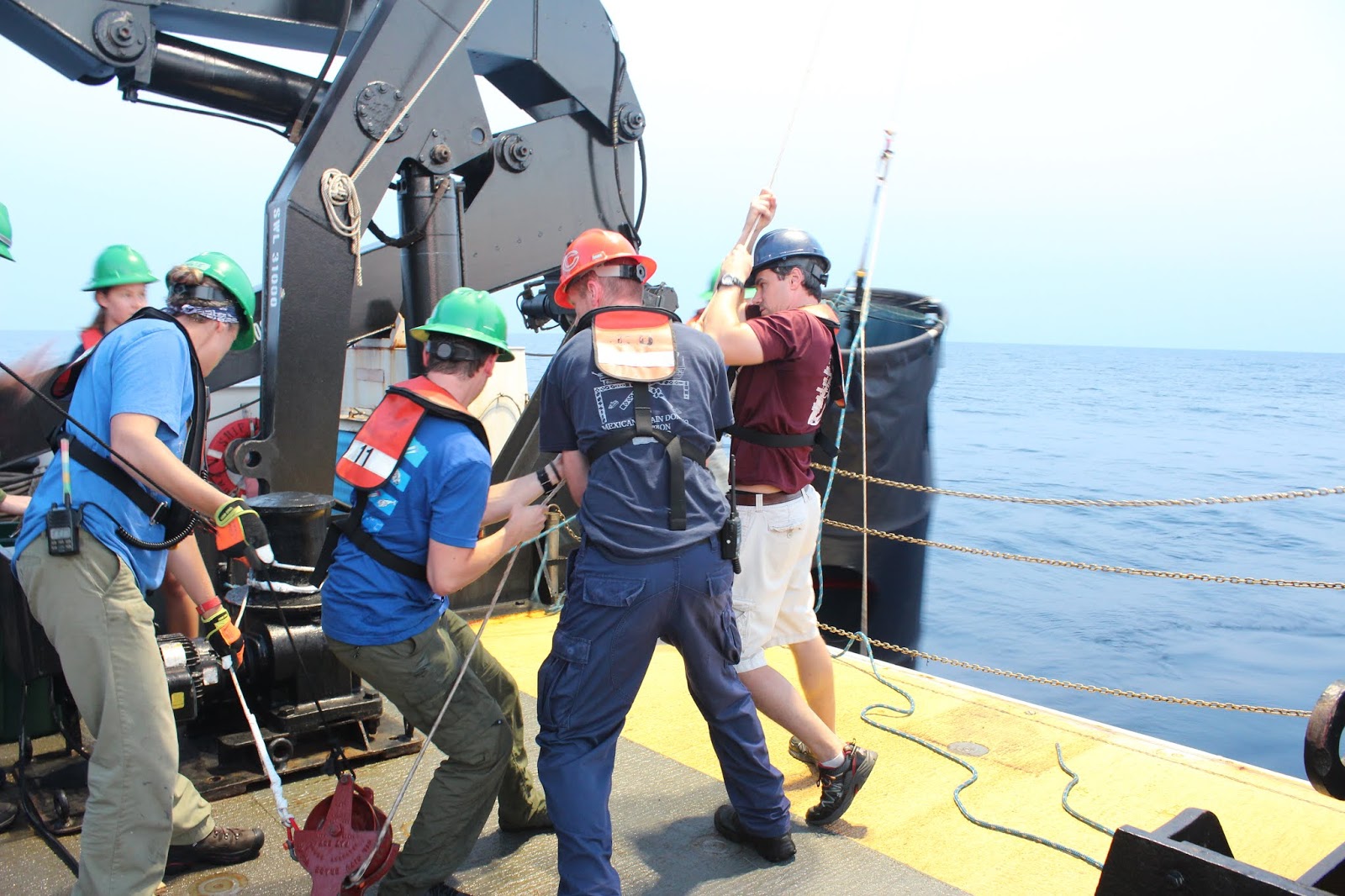
Mike L. and Ramus recover and rinse the ring-net
that has sampled the zooplankton (prey of BFT)
You may imagine that these guys are just little eating machines consuming everything available around them. But despite being ferocious predators, we have found that they are actually quite picky with what they eat. So to determine the availability of larval tuna “food,” we first need to figure out what the larvae are actually eating. This is done through meticulously by dissecting the tiny stomach and intestine of the larvae under a microscope to analyze their diet. As many of the prey are crustaceans, they are difficult to digest, (imagine digesting a crab with its shell, ouch!), so we can identify the species and size based on the undigested remains. By comparing this diet information with what is collected in our zooplankton nets we can see which zooplankton the larvae prefer to eat and how much food is available to them.

We are also studying their feeding habits by looking at their Nitrogen (N) signature. What is a Nitrogen signature? We look at the two naturally occurring isotopes of N (that is different variants of N). This is done in specific amino acids, the building blocks of proteins that make up the body tissues of the fish larvae. The less common 15N isotope is heavier than the common 14N. This weight difference means that 15N assimilated from the food is moved around the larval body and ultimately excreted as waste products at a slower speed relative to 14N. As a result there is a buildup of 15N compared to 14N in the larvae relative to their food.
http://ian.umces.edu/enewsletter/article/525/identifying_nitrogen_sources_in_the_choptank_river/
Nitrogen atoms
Because we know the amount of 15N in the prey, and that the buildup increases at a constant rate for each level of the food chain, from algae to herbivorous zooplankton to carnivorous fish, we can determine how high up the food chain the larvae are.

Some larger zooplankton collected by our ring net
This method gives information on what the larvae have been feeding on the past days to weeks, while looking at the stomach contents only tells us what they have eaten over the last few hours. Also this method gives us clues on other potential preys, such as smaller unicellular protozooplankton that have soft bodies and are rapidly digested and therefore cannot be seen in the stomachs analyzed under the microscope. By looking at 15N we can also tell from where the N is coming from that is taken up by the algae at the bottom of the food chain. We can see this by looking at certain amino acids in the larval tuna where there is no buildup of 15N. Therefore, these amino acids reflects the composition of the N taken up by the algae so if e.g., there is very little 15N compared to 14N it means that the plants are taking up N2 from the atmosphere, and if there is more it means they are taking up Nitrate brought up from the deep.
I am now back in the lab and I can’t wait to start analyzing all the tuna larvae we collected to unravel the secrets of their diet.

http://www.chemistryjokes.com/jokes/what-do-you-call-an-acid-with-an-attitude/


Tuesday, June 19, 2018

A better late than never post for #NF1802, Dr. Stukel #ontheblog

Stukel sets up the satellite-tracker inside the buoys
Although NF1802 has come to an end, we will continue to post for the rest of the summer! Stay tuned!

Today, Dr. Mike Stukel joins us once again on the blog! Mike is an Assistant Professor at Florida State University and one of the PIs on our joint NOAA RESTORE Science project. His PhD students, Tom and Taylor joined him in this survey.


“I study the intersection of plankton ecology and biogeochemistry.  I have a fascination for all of the microscopic critters (plankton) that drift constantly with the currents of the open ocean.  Much of my research focuses on either the role of plankton in converting carbon dioxide to organic matter and then storing that organic matter in the deep ocean (a process referred to as the biological pump) or determining how changes in the planktonic ecosystem affect the availability of prey for fish and other large organisms. During this project, my research goal is to understand how biogeochemical and ecological interactions at the base of the food web affect the survival of larval tuna.
The golden tufts in the bottom left are Trichodesmium, the long organism in the middle is a chaetognath, and many of the out-of-focus blobs are copepods
Specifically, I'm interested in two questions:

  1. What processes supply nutrients to the algae at the base of the food web (upwelling that introduces deep nutrients to the surface ocean or nitrogen fixation that converts abundant nitrogen gas into plankton fuel)?  
  2. How does the structure of the planktonic food web affect the efficiency with which primary production is converted to zooplankton biomass (i.e. fish food)?  
Illustration by Sabine and Baxter

On this cruise, one of my lab’s goals is to make simultaneous measurements of nitrate uptake and nitrogen fixation in tuna spawning habitat."

Mike looks for microscopic organisms in between stations
Stukel and the team during sediment trap operations on the back-deck
If you are a teacher or student and want to learn more about plankton, check out Mike's lab's website and this link and has lesson plan too!) developed by Ms. Colleen Miks.

Wednesday, May 16, 2018

Today on the blog: Kiana returns!

Kiana rinses the Bongo-90cm 
Today, one of our youngest scientists, Ms. Kiana Ford shares a brief post. This is Kiana’s second cruise aboard Nancy Foster and has been volunteering in our lab since January 2017. She is now a Senior at the University of Miami's RSMAS and got back from an amazing semester abroad with the UGalapagos & Isabella Oceanographic Institute in Ecuador just a few days before the ship started its journey.

Image may contain: swimming, outdoor and nature
Kiana makes friends with the locals in the Galapagos, Ecuador
Kiana shared with our blog “my goal for the cruise is to help find some bluefin tuna! I would also like to be comfortable jumping into any science role during the cruise, from deploying nets on the back deck to running the computer programs in the dry lab. My favorite experiences from participating in the oceanographic surveys is to get to know other scientists and crew members, and seeing how everyone contributes to some aspect of the expedition. My research goals when I return to land is to complete my senior thesis examining larval lobster populations collected in southern Cuba during NF-16-02-03. This summer I am eager to begin my internship with  Harbor Wildwatch, a non-profit organization in Gig Harbor, WA. They organize outreach events to educate the public on marine and environmental topics." 
Thanks Kiana! She disembarked during our port-stop in Pensacola, but we will see you soon in the NOAA FORCES Lab in the Fall semester.

Sunday, May 6, 2018

NF1802! May the tuna be found today!

Fish eggs
Hello and welcome back to another year of our Nancy Foster Chronicles! This time we are well into Episode 2 of our NOAA RESTORE Project "Bluefin Tuna Ecology." Please check out last year's posts particularly the Return of the tuna!

Top: NOAA Shiptracker map of transit
around Florida
Bottom: Four NOAA Ships meet off the
Dry Tortugas!
Our survey started in Jacksonville, FL, and did a fun U-shaped track around the Florida Peninsula until we reached our study destination: the grand Gulf of Mexico. We even sailed past several other NOAA ships doing work in the area (NOAA Ship party!) to include the NOAA Ships Okeanos Explorer (EX), Oregon II (R2), and the Pisces (PI)! The NOAA Ships fleet support science in multiple fields including oceanographic, fisheries, and atmospheric research.

Join us for another adventure on NOAA Ship Nancy Foster!
It's been a week already, and we are now in the Northern Gulf of Mexico searching for the elusive bluefin tuna larvae. They have been hiding from us, but we are relentless and will keep searching! Our strategy is to target some favorable habitat which is usually in between oceanographic features.

I hope you learn something new during our journey and feel free to ask questions!


Monday, June 19, 2017

We are back home! Last post from the Chief Sci


Scientists and crew sign the NF1703/04 NOAA Corps flag 
First of all thank you for following our research expedition by reading our blog! My name is Estrella Malca and I was the chief scientist for this survey (NF1704) aboard the NOAA Ship Nancy Foster. What does that mean? Each project has a designated person that takes a leading role on the logistical, scientific and reporting aspect of the entire survey. 
One last selfie!
Estrella (Chief Sci) and Samantha (Senior survey tech)

I love to figure out the 'tetris' of things, so this year's cruise has been challenging but fun! Why challenging? Well, usually we have 6 months+ to prepare for our surveys: buying equipment, supplies, assigning scientists and volunteers to participate, and most importantly, securing any relevant permits as well as communicating with the ship's officers and crew about the multiple operational aspects of our project at sea. However, because of our very recent NOAA RESTORE project selected for funding, we had just two months to get a brand new project planned, signed and delivered on time! Without the rest of the science team, there is no way we can come out here and successfully achieve all of our research goals and deliverables!


We had the pleasure to continue to collaborate with several of our partners and also obtained new research connections!

NF1704 Leg 1 scientists
NF1704 Leg 2 scientists

Estrella and Niki deploy our very last satellite tracked drifter

Here is a list of our NF1704 accomplishments!! We were quite busy this  past month as you can see!


ü  500++ Tunas collected, more than 600 specimens individually measured at sea
ü  90 CTD casts: Depths were (300m, 500m, 1500m, and 2500m). The sensors we used on the CTD included temperature, oxygen, salinity, chlorophyll-a and CDOM, conductivity, PAR.
ü  Continuous measurements of currents (ADCP) from Key West to Progreso and to Miami
ü  Continuous measurement of flow through (TSG) from Key West to Progreso and to Miami
ü  7 SVP Drifters were deployed
ü  546 Flow cytometry samples (phytoplankton, bacteria, water column abundance)
ü  72 Elemental Nitrogen (N2)-fixing organism samples
ü  6 casts with PAR (Photosynthetically-Active Radiation) sensor
ü  207 Microbial Abundances and Biomass samples
ü  95 Sediment Trap Flux samples
ü  78 Thorium concentration profiles (dissolved + particulate)
ü  354 Primary Production and Nitrate Uptake
ü  226 Deckboard Incubations for nitrogen utilization rates
ü  120 Shipboard Nitrate Concentrations
ü  57 Deckboard Incubations for δ15N.
ü  130 Nutrient Profiles for NO3- + NO2,-PO43- and isotope analyses (δ15N and δ18O)
ü  95 Mesozooplankton Biomass and Grazing
ü  48 Growth and Grazing Rate Profiles (8 experiments x 6 depths)
ü  279 Phytoplankton Pigments fluorometric Chla,
ü  210 High-performance liquid chromatography  samples
ü  19 ring net tows (100m)
ü  136 net tows (25m): 120 Bongo-90 (240 jars) & 16 Mini-bongo net tows
ü  16 Mesozooplankton and 16 microzooplankton samples
ü  120 Live-sorted plankton samples
ü  95 specimens selected for genetic analysis
*   40+ Open House attendees. Our outreach event welcomed our scientific counterparts, students, professors, and fishermen in Progresso, Mexico

We hope that our projects will fill in a lot of the gaps about the biogeochemical ecosystem in the Gulf of Mexico as it relates to bluefin tuna research for the Western Atlantic stock. Our results will be shared with local and regional stakeholders like NOAA, ICCAT, among others. Soon, we will get started working up the data! Stay tuned and read our posts!


Group selfie, navigating into to the port of Miami

Friday, June 9, 2017

Featured Scientist: Karen Selph

Karen in the lab-van whispering to the flow cytometer!
Hello blog, today Dr. Karen Selph from the University of Hawaii at Manoa shares some of her expert insight into the nutrient-limited world! Karen shared with the blog just a few of the multiple experiments she carried out while on board the NOAA Ship Nancy Foster during NF1704 as part of our NOAA RESTORE project. Karen’s main focus was collecting phytoplankton to analyze with a “flow cytometer” – a machine that tells us how many phytoplankton are out there and gives us a rough idea of their types.
In addition, she measured water column light levels used for photosynthesis by phytoplankton with a photosynthetically-active radiation (PAR) sensor that was attached to the CTD rosette. Karen shared with the blog: "The 6 casts that we performed will yield invaluable information on the light regime during the cruise." 
"The nutrient limiting phytoplankton growth in the Gulf of Mexico is nitrogen.  Nitrogen has many forms, and most phytoplankton can only use reduced inorganic forms (e.g., nitrate (NO3), ammonium (NH4)).  However, some phytoplankton can use nitrogen gas (N2), which is in abundant supply.  This is quite a trick, as the chemistry involved is anaerobic (no or low oxygen) and phytoplankton produce oxygen! 
Karen and Lucy carry out one of the PAR casts


On this cruise, we collected many samples to figure out which of the larger nitrogen-fixing organisms that might be present – in particular, Trichodesmium (usually a bane to those who study zooplankton, as it can clog their nets!!).   Additionally, to assess the base line N-isotopic value for Trichodesmium, we collected samples for stable nitrogen isotope analyses.  We even analyzed a sample of Sargassum to figure out its isotopic signature with respect to the other nitrogen-fixing players in the GOM.  Once we get back to the lab, we will also examine our samples under the microscope looking for the presence of other nitrogen-fixers – some diatoms and other species harbor symbionts capable of this remarkable feat!"
The dynamic duo, Tom and Karen processed hundreds of samples during the survey


Shaun, Karen's travel companion, makes some new friends

Saturday, June 3, 2017

Featured scientist: Loni Mnich

We are wrapping up this year's survey!... but we still have a few more posts from our scientists and will give you the numbers (eventually!)!

Rinsing down the bongo net

Meet our newest UMiami RSMAS marine science graduate, Alanna (Loni) Mnich! Loni has been a volunteer at the FORCES Lab and she shares some of her experiences on her first research survey aboard the NOAA Ship Nancy Foster.

Decked out with safety gear, ready for deployment

She shared with the blog: “My goal for this cruise is get my first at sea experience. I hope to gain a better understanding through practice of field research concepts and learn more about plankton and the early life stages of fish that I can then apply in the lab and in future studies. I am excited to see some cool organisms over the course of this cruise!

“I have been in the FORCES lab at NOAA for about a year and a half. My experience there began with sorting plankton that was collected on other oceanographic cruises, so I am excited to participate in the collection stage now. During the past months I have focused on cephalopod paralarvae as the subject of my undergraduate senior thesis, which I hope to expand into a publication.
Loni takes command of the Bongo and Ring net tows in the dry lab

"Over the course of this cruise I have gained significant hands on experience in plankton collection and processing, including deploying the bongo net, driving the bongo, fixing samples, as well as deploying the CTD. I will soon be able to apply these skills if I get an opportunity to participate in another cruise (hopefully in late July!). Through the rest of the summer, I will be back in the FORCES lab, likely sorting plankton from the cruise and continuing my previous work with cephalopods. In the future, I would like to gain more hands on lab and field experience and I also plan on attending graduate school to expand my studies."

Thursday, May 25, 2017

Featured Scientist: Meet Jennifer!

Today's featured scientist is a recent graduate from University of California - San Diego, Jennifer Beatty! She is a research assistant at the Scripps Institution of Oceanography. Read on to find out her goals for this survey in her own words!


Jennifer fixes a sample collected in the GOM
"The lab I'm involved with studies the interaction of phytoplankton and zooplankton, which are the lowest levels of marine food webs. Phytoplankton are essentially the plants of the sea, while zooplankton are the animal plankton that eat them. The way these two interact changes in different parts of the ocean, which impacts the dynamics of organisms further up the food web, including bluefin tuna larvae! During this cruise, we are hoping to get an idea of what is happening at these lower food web levels to illuminate what conditions are optimal for larval bluefin tuna.


Processing the ring net in the wetlab
"My primary goal for this cruise is to gain field experience at sea. I've worked with samples in the lab, but I wanted to see where they come from and how they are collected. Additionally, I wanted to taste what research at sea is like because I plan to pursue a graduate degree in marine science. Before I head there, I'd like to have a better idea if I prefer research dependent on field work or prefer to stay in the lab."

Friday, May 12, 2017

Return of the Tuna!

And....we're back! Back in the Gulf of Mexico (GoM), on the hunt for larval bluefin tuna (BFT)! The next two legs of our survey will be focused on finding patches of bluefin larvae (Thunnus thynnus), and studying the biogeochemical habitat in which we find them. We are joined by some familiar collaborators from the University of Miami-RSMAS, El Colegio de la Frontera Sur (ECOSUR), and the Spanish Institute of Oceanography (IEO), as well as some new team members!

A glimpse of some of the new equipment we'll be using!
Why is this important? Well, you may know that BFT are one of the mostly highly sought after fish in the commercial industry, as they are large, delicious, and highly valuable. But this also means that they are being over exploited - which means that the levels at which they are currently fished are not sustainable long-term. Atlantic BFT are highly migratory species (HMS), distributed throughout the northern Atlantic Ocean. However, they migrate south to the GoM and the Mediterranean Sea to spawn only once a year during the summer months.

The FORCES lab studies the early life stages of tunas in order to tell their "origin story." Why do the adults travel miles and miles to this specific area? Are there certain oceanic features that provide a protective nursery habitat for the larvae and increase their chances for survival? Are there certain biochemical gradients in these waters that help the larvae grow faster or more fit for surviving the pelagic environment? How will forecasted changes in this environment affect larvae in the coming decades?

LOTS of water filtration will be involved!
We are incredibly excited to be embarking upon a brand new set of surveys with several new partners in order to start to answer some of these questions.  We even more thrilled that our new research team was selected as one of the few projects funded by the NOAA RESTORE Act Science Program! This Science Program funds "research, observation, and monitoring to support long-term sustainability in the GoM ecosystem, including fish stocks, fish habitat, and fishing industries" (for more on the program, click here). The FORCES Lab at the NOAA Southeast Fisheries Science Center teamed up with Scripps Institute of Oceanography, Florida State University, and the University of Hawaii at Manoa to examine the "Effects of nitrogen sources and plankton food web dynamics on habitat quality for larval BFT."  Together, we will use net tows, satellite data, oceanographic models, and drifters, to find patches of bluefin tuna larvae in the GoM and then we will follow these patches over the next few days. Every day we will sample (around the clock!) the in situ conditions and characteristics of the patch, in order to obtain a bottom-up understanding of BFT recruitment in the GoM. We will share with you more as we keep drifting with the tunas!

We can't wait to share this new journey with you!

Don't worry, we'll still show you loads of sunsets at sea


Wednesday, May 3, 2017

Outreach & Education in St. Croix

Students from St. Croix 7th Day Adventist School pose in front of the Nancy Foster in Frederiksted, St. Croix

One of our favorite parts of our annual surveys is being able to pull into port and welcome local students on board for a small glimpse into what we do at sea. We know this can be inspirational for many young people who may be interested in pursuing a marine science career, and we greatly value these events during our port visits. It isn't often your school field trip takes you on board a NOAA research vessel!

This year, we pulled into St. Croix, the southernmost of the U.S. Virgin Islands. We welcomed two groups on board, and, with the help of the Nancy Foster's NOAA Corps officers, shared what life and research is like at sea.

Students from the AZ Academy try their hand at sorting plankton under the microscope in the ship's wet lab
We were first visited by an all-female group of students from the AZ Academy, who are part of a community transfer project entitled "Diving for Debris," part of the "Pride in Our Seas, Pride in Ourselves" project at the University of the Virgin Islands, and funded by the NOAA Marine Debris Program. Two-thirds of our own science team was comprised of women - we truly value supporting young women who have an interest in science. These ladies have bright futures ahead of them! 

Students from the AZ Academy work together to match larval fish photos with their adult counterparts


Students from St. Croix 7th Day Adventist School check out plankton under the microscope
Our second group of students joined us from the St. Croix 7th Day Adventist School in Christiansted, who work with the outreach and education specialists at the VI-EPSCoR program. 22 students and 3 teachers toured the ship, visited the wet lab, and examined larval fish and plankton samples under the microscope. These middle and high school students were high-energy, and some wanted to stay on the ship and sail with us!

ENS Keith Hanson shows students from St. Croix 7th Day Adventist School the steering controls on the bridge

Saturday, April 22, 2017

Coral Reef Fish in USVI: Where do they come from?

Figure showing the dominant flow modes a) cyclonic
 and b) anticyclonic flows around St. Croix
(Source: AMSEAS Model)
If you've ever been to the Caribbean, you've seen white sand beaches and clear blue waters - perfect for snorkeling and SCUBA diving to see the coral reef systems beneath the surface. These reefs demonstrate incredible diversity of fish, crustaceans, cephalopods, and many other organisms. As larval fish biologists and oceanographers, we are interested in where coral reef fish spawn, and the oceanographic processes that transport larvae to their ultimate settling location, the coral reefs.

Though the US Virgin Islands are relatively small, the oceanographic features surrounding them can be quite complex. The southern-most island, St. Croix, is geographically isolated 50km from the northern islands by a 4000m-deep trough, and we hypothesize
that its position affects how waters flow into and around the northern islands (St. Thomas and St. John).

We devised a sampling plan which should help us understand the flow near the shelf break south of St. Thomas and St. John, specifically if there is connectivity between inshore and offshore areas, or if there is a barrier between them.

L-R: Sennai, Jess, Tanya, and Dan throw SVP drifters off the stern.


Our stations are positioned at inshore, slope, and offshore locations:
A plankton sample!
Photo credit: LTJG Norton
  • Oceanographic Eulerian data: ADCP, CTD, and XBTs will provide data on the temperature, salinity, and velocities of the water column being sampled. With water velocities we will be able to calculate potential vorticity, which will give us an idea of the ability of the flow to spin. These instruments sample from the surface to the ocean floor! Our Eulerian metrics are important to better understand the physical nature of the inshore and offshore environments where our fish larvae live. 
  • Oceanographic Lagrangian data: SVP and biodegradable drifters will be deployed at each segment on the transects, and will transmit through satellite a time series of speed and direction of the currents. We are deploying the drifters in pairs to be able to compute relative dispersion, which is a measurement of the separation of two surface particles (e.g. larvae) drifting in the ocean. Our Lagrangian metrics are important to better understand the inshore and offshore transport of our fish larvae. 
  • Biological data: Bongo plankton nets will be towed, sampling from the surface to the ocean floor. Fish larvae from these samples will give us an idea as to what species of reef fish are spawning in these areas. These biological metrics are also important to quantify how the nature and transport within inshore and offshore environments affect fish larvae.  
  • Oceanographic data: ADCP, CTD, and XBTs will provide data on the temperature, salinity, and potential vorticity of the water column being sampled. These instruments sample from the surface to the ocean floor!
The CTD is brought back on the ship by ST Stephanie
Photo credit: LTJG Norton

We are very excited to see the results of this study! Upon completion, we will be able to better understand the specific mechanisms which drive interactions between fisheries and the environment in the USVI, and hopefully be able to gauge the effectiveness of current fisheries management strategies, while developing methods for improvement. 

Monday, April 17, 2017

Welcome Aboard NF-17-03!

Welcome back to another exciting year at sea!

NOAA Ship Nancy Foster in Brewers Bay, St. Thomas, USVI
The FORCES Lab at the NOAA Southeast Fisheries Science Center (SEFSC) invites you to join us again as we board the Nancy Foster and experience the wonder of the marine world! The 2017 survey begins in the Caribbean Sea around the stunning islands of the US and British Virgin Islands. We will continue our historical sampling grid from previous years, collecting water and plankton samples.We will also seek out information about the cross-shelf transport of water and planktonic organisms around these islands, and hopefully capture spawning events of commercially valuable reef fish. We are pleased to be sailing with collaborators from NOAA Atlantic Oceanographic and Meteorological Laboratory (AOML), University of Miami (RSMAS), University of the Virgin Islands (UVI), City University of New York (CUNY), University of Puerto Rico-Mayaguez (UPRM), University of South Florida (USF), and USVI Department of Planning and Natural Resources (DPNR). 

Later, the Foster will make her triumphant return to the Gulf of Mexico, going on the hunt for recently spawned patches of larval bluefin tuna! We have many new and exciting sampling schemes planned for this portion of our survey that we look forward to sharing. 

From L-R: Scientists Sarah (UVI), Giovanni (UPRM), Jason (RSMAS), Kristen (UVI),
Jess (CUNY), & Tanya (CUNY) enjoy the view as we set sail from Old San Juan, Puerto Rico

Once again, we'd like to offer a glimpse into what life on a research vessel is like, as well as introduce our incredible collaborators, veteran researchers, and up-and-coming young scientists. We hope you'll join us!

Check out posts from last year's cruise blog!

Friday, June 24, 2016

Another Year Complete!

A post-storm sunset captured from the beach in St. Croix, while the Foster (far left) is docked in port
Another cruise is in the books! We can't believe it's over already! This year's cruise was defined by balancing new sampling techniques and research goals with familiar methods and regions.

We made history by becoming the first federal vessel to dock in Havana, Cuba, since the restoration of diplomatic relations between the two countries, but also returned to the familiar U.S. Virgin Islands, where we sampled for the 7th year. We updated our usual pre-determined sampling plan in order to explore the dynamics of ever-changing mesoscale eddies, yet maintained the integrity of historical sampling sites. We welcomed new faces on board, including Cuban observers, and rekindled relationships with colleagues from years past.

Some final stats for Legs 1, 2, and 3 combined:
Sarah and Alexis rinse down the S25 net
  • CTD casts = 121
  • S10/S25 net tows = 105
  • Bongo tows = 41
  • Neuston tows = 17
  • MOCNESS = 74
  • mini-Bongo tows = 66
  • drifters deployed = 13
  • plankton samples collected = over 500!
  • countries visited = 4 (U.S., Cuba, Mexico, Jamaica)
  • collaborating countries = 7 (U.S., Mexico, Cuba, Japan, Spain, France, Dominican Republic)
  • collaborating institutions = 15
We still have lots of work left to do - unloading the ship, unpacking, cleaning, and repairing all our gear, sorting over 500 plankton samples, identifying larval fish, processing CTD files, running chlorophyll and isotope samples, and more! While we get back to work, check out some of our final images and videos from the last leg of the cruise, and be sure to check back for more next year!

Thanks for reading and sharing in our NF-16-02 adventures!
Leg 3! L-R: Omar, Trika, Sennai, Dan, Alexis, Aras, Mara, Ryan, Alex, Kathryn, Sarah, Adrianne, Angela, LaTreese


Aras patiently filters the mini-Bongo sample through find mesh funnels
Time-lapse: MOCNESS retrieval! 
(Video by Mara Duke)
Time-lapse: S25 tow - this was in very shallow water so you can see the ocean floor!
(Video by Mara Duke)

Adrianne and Angela deploy the CTD while ST Nick directs the winch operator
Ryan takes water samples from the CTD rosette bottles (top), then treats them so the
oxygen concentration can be measured back in the lab (bottom).
Omar (L) rinses the S25 neuston net, while Adrianne and Kathryn hold it steady.
Safety first! Everyone wears hard hats and PFDs, and are tethered to the deck with a safety line.

Day Shift Rules! Mara, Sarah, Sennai, and Alexis take a selfie in their safety gear.

Night Shift makes you crazy! LaTreese, Adrianne, Alex, Omar, Angela, Aars, & Kathryn started work at midnight everyday!

We're done! See you next year!!