Showing posts with label scholar. Show all posts

Friday, June 16, 2017

Featured today: LTJG Niki Norton

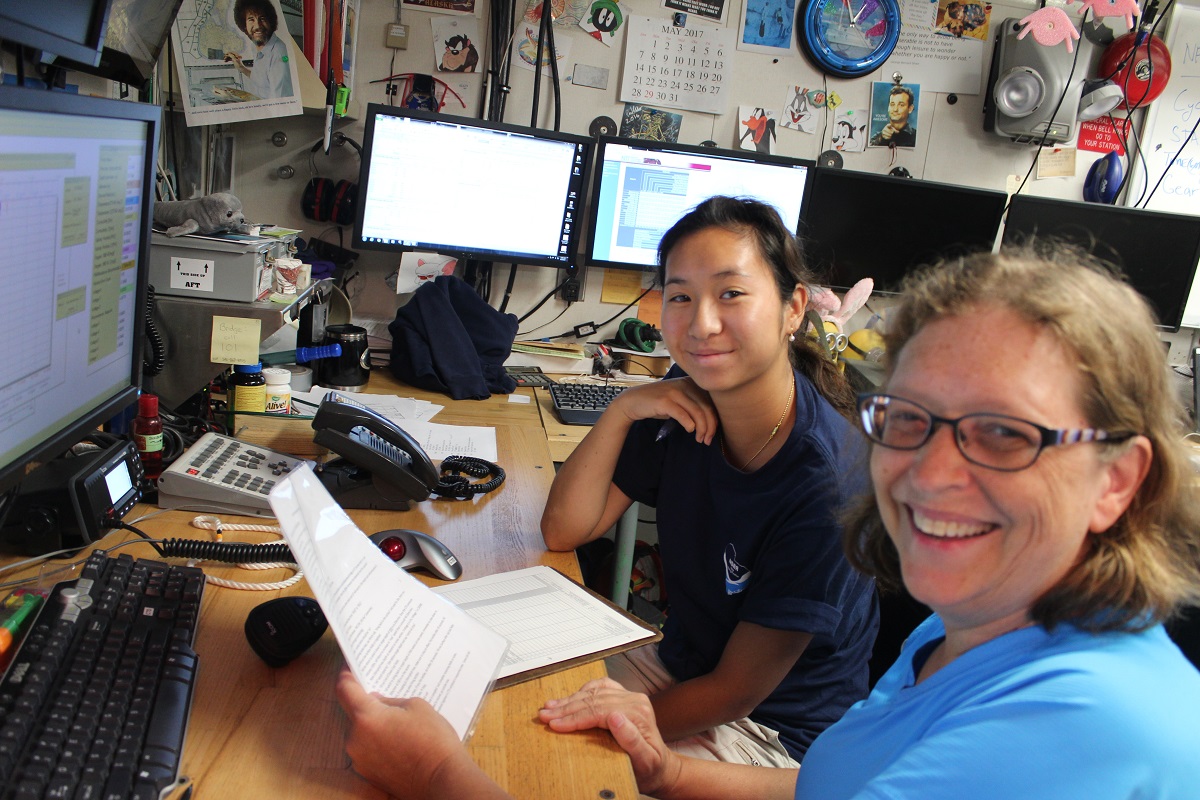
Today’s post features LTJG Nikita "Niki" Norton, and officially welcomes her to the FORCES Lab family! Niki is the current "Florida Bay Operations Officer," replacing LTJG Aras Zygas.  As a part of the NOAA Commissioned Officer Corps, she operates sampling platforms to facilitate scientific research and provides logistical and administrative support to NOAA’s mission.  She shared with the blog: 
Niki  records the flowmeter data into our logsheets
"For the last three years, I was assigned to the NOAA Ship Bell M. Shimada out of Newport, Oregon, conducting fisheries surveys from Vancouver, Canada all the way down to San Diego, CA.  Along with the responsibilities of being Navigation Officer and Medical Person in Charge, my primary duty was to “drive” the 210’ Fisheries Survey Vessel every day for 200+ days a year

Niki and Loni on the back deck, waiting to deploy the CTD
"Many of the sampling techniques that are routinely performed by research groups on the West Coast to collect plankton are exactly the same as those conducted by the FORCES lab to collect larval fish! 

"This included Bongos, Neustons, MOCNESS, and CTDs on many of the projects.  We performed extensive mid-water stern trawls with a net the size of a football field to catch fish like Pacific hake and sardine. We followed and tagged endangered Resident Killer Whale pods and acoustically monitored beaked whales at 4000m depth.  The remainder of the year, the ship completed Remotely Operated Vehicle (ROV) transects and hydrographic missions in the Farallons and Channel Islands.
Niki and Estrella deploy a satellite tracked drifter
"While many of the operations may be the same, this new job with the Southeast Fisheries Science Center is quite different - as is the scenery!  Rather than the whipping cold wind of the Pacific Northwest, the hot sun in the Caribbean and Gulf of Mexico is one of my favorite parts of the job. With the FORCES Lab, I get to work "on deck" to deploy and recover gear, wash down nets, assist with station planning, and see the plankton and water samples we catch up close! 
NOAA Ship Nancy Foster, Brewers Bay, USVI

"When I am not underway as a scientist, I work in the office to ensure that the lab has everything they need logistically to sail each year by assisting with cruise planning and administrative budgeting.  Now that the first year of sampling has come to a close, I am very excited to see what new projects I will get to be a part of and hope to use my background in reef fish ecology and microbiology to explore new research with the FORCES lab – while getting ready for next year!"
Girl Power! The women behind the science in NF1703!
Top (L-R): Sarah H., Niki, Trika, Sarah P.
Bottom (L-R): Kristen, Vanessa, Jess, Alexis
Niki on the bridge

Thursday, June 1, 2017

Featured Scientist: Lucy Fitzgerald


Hi everyone, I'm Lucy Fitzgerald, a rising senior and a marine science/biology major at Eckerd College in St. Petersburg, FL. Though I've logged plenty of lab time, this is my first experience on a research vessel. This trip is the beginning of my NOAA Hollings internship at the SEFSC FORCES Lab in Miami. I've been on the night shift and am learning the ropes with tasks such as deploying nets and the CTD, logging data, and tracking the SVP drifter buoy. I have also gotten to see a lightning storm at night, fabulous sunrises, and tons of plankton!
My goal is to learn about the upstream process of collecting specimens before working with them in the lab this summer, looking at the age and growth of billfish. As an undergrad, I'm trying to figure out what field of research I want to go into before applying to graduate school.

Karen and Lucy send the CTD to 300m in the GOM
Lucy learns about the array recovery from Tom and Becca
I don't have a specific research focus yet but my research experience has been primarily with paralarval squid, Doryteuthis pealeii, and looking at the effects of hypoxia on the boundary layer of the egg capsules as well as hatching rates/cues last summer and winter at the Woods Hole Oceanographic Institution. I have also looked at the population genetics of the brown Sargassum snail and bandtooth conger eel in the western Atlantic.
Being out in the open water where these species live brings a whole new perspective to my work in the lab!