Showing posts with label otoliths. Show all posts

Thursday, June 1, 2017

Featured Scientist: Lucy Fitzgerald


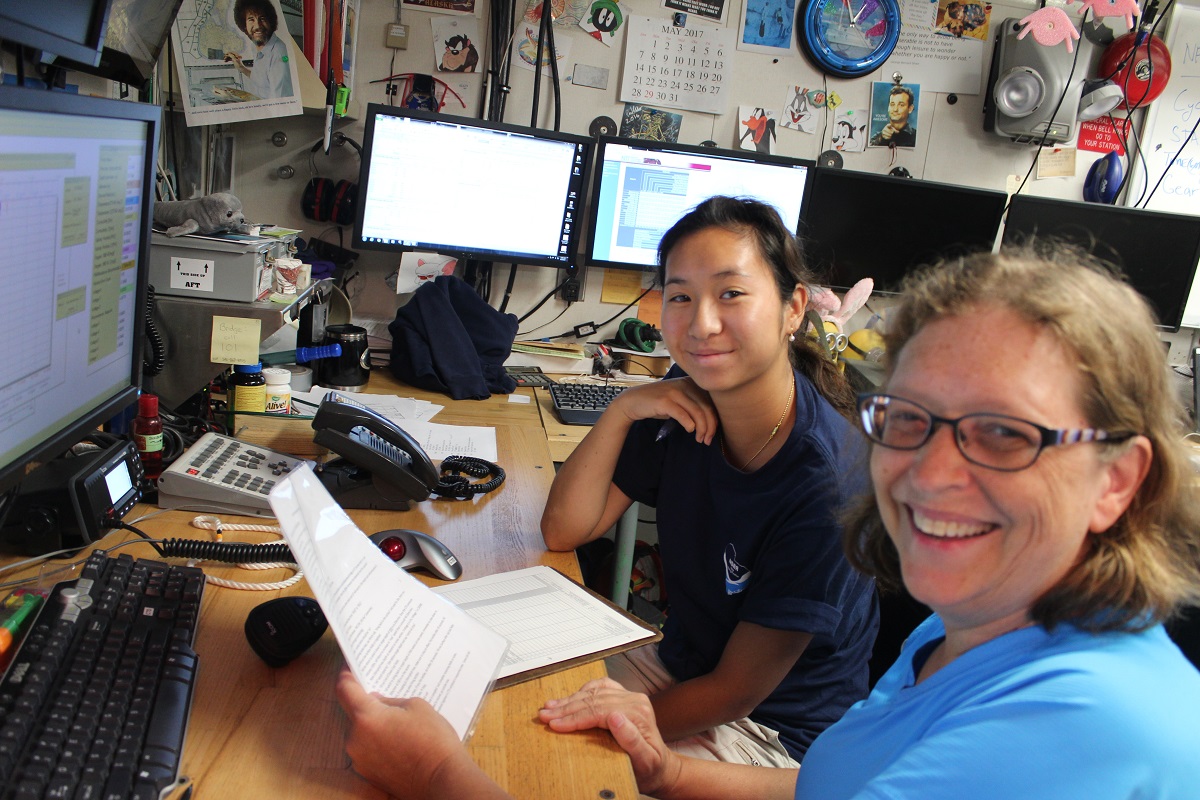
Hi everyone, I'm Lucy Fitzgerald, a rising senior and a marine science/biology major at Eckerd College in St. Petersburg, FL. Though I've logged plenty of lab time, this is my first experience on a research vessel. This trip is the beginning of my NOAA Hollings internship at the SEFSC FORCES Lab in Miami. I've been on the night shift and am learning the ropes with tasks such as deploying nets and the CTD, logging data, and tracking the SVP drifter buoy. I have also gotten to see a lightning storm at night, fabulous sunrises, and tons of plankton!
My goal is to learn about the upstream process of collecting specimens before working with them in the lab this summer, looking at the age and growth of billfish. As an undergrad, I'm trying to figure out what field of research I want to go into before applying to graduate school.

Karen and Lucy send the CTD to 300m in the GOM
Lucy learns about the array recovery from Tom and Becca
I don't have a specific research focus yet but my research experience has been primarily with paralarval squid, Doryteuthis pealeii, and looking at the effects of hypoxia on the boundary layer of the egg capsules as well as hatching rates/cues last summer and winter at the Woods Hole Oceanographic Institution. I have also looked at the population genetics of the brown Sargassum snail and bandtooth conger eel in the western Atlantic.
Being out in the open water where these species live brings a whole new perspective to my work in the lab!

Wednesday, May 31, 2017

Featured Scientist: Meet Jason!

Today's featured scientist is Jason Mostowy - read on for more about his cruise and future goals!


My name is Jason, I graduated from the University of  Miami in 2015 with a B.S. in Biology/Marine Science, and I've been working as a research tech in the FORCES Lab since 2013.

Larval lionfish (Pterois volitans/miles)
Image credit: FORCES
My main work for the lab involves processing the zooplankton samples we collect on cruises like this one - meticulously removing fish larvae and other target organisms, fitting the results into our considerable database, and dissecting larval fish for otoliths (earstones, used for ageing studies), gut contents, or genetic analysis projects. I'm also currently working on a project to characterize the larval distribution of the highly invasive Indo-Pacific lionfish (Pterois volitans/miles) in the tropical western Atlantic. Gaining a better understanding of the early life ecology of this harmful species will help scientists better predict levels of lionfish population replenishment, which in turn can be used to determine where and how often lionfish removal efforts should be performed.

Jason sorts through plankton search for tunas


Jason rinses down the Bongo-90 with
Sarah and Lulu during night shift
This is my third year sailing aboard the Foster. I love working in the field, especially the many perks that come with going to sea - the chances to practice and expand my scientific skill set, the opportunities to get to know other scientists from a variety of disciplines, the stewards rescuing me from my unfortunate cooking for a few weeks, etc. It's been a long cruise for me; I first embarked way back on April 13th, and by the time we reach port on June 2nd I'll have spend 35 of the last 48 days at sea!

This fall - after what I hope will be a commensurately long and relaxing stint on solid ground over the summer - I plan to start graduate school where I will continue to study the factors that mediate the distribution and survival of larval fish in the GOM and Caribbean.

Monday, May 29, 2017

Featured Scientist: Jose Quintanilla

Our annual surveys would not be possible without our wonderful collaborators from around the world. We'll dedicate several future blog posts to highlight these individuals, so that you can learn more about them, their research, and the valuable contributions they make to the survey. You can find previous posts here. Today we feature Jose Quintanilla from IEO!
Deploying the Bongo-90 in the GOM


My name is Jose Mª Quintanilla Hervás. I am one of the scientists in the Larval Ecology Group belonging to the Spanish Institute of Oceanography (IEO), which is the public organization that carries out research in the oceans of Spain. For the last decade, my research has been focused on larval growth of different species in the Mediterranean sea (such as sardines, anchovy, bluefin tuna) and how it is influenced by environmental and trophic variables.

Jose searches for the elusive bluefin tuna in the plankton sample
Dr. Quintanilla fractions mesozooplankton in the wetlab
This is my first time in this survey in the GOM. I'm very pleased to take part in it and to have the opportunity to continue the collaboration with our colleges from NOAA in order to improve our knowledge of bluefin tuna larval ecology from a multidisciplinary point of view in the framework of ECOLATUN project. One of my main interests is to establish a robust criteria for age reading of bluefin tuna larvae in order to be able to compare growth patterns of populations from Mediterranean and GOM and try to the determine the most important factors related with different growth rates in both areas taking into account that growth is one of the most important factors in larval survival and, therefore, in the recruitment and viability of the species.

Jose discusses his otolith research back in the Malaga, Spain
Nowadays, our group is interested in the study of the potential effect of larvae feeding behaviour on their growth based on Stable Isotope Analysis (SIA) and Compound Specific Isotope Analysis (CSIA)

Friday, May 27, 2016

Chasing Eddies!

As Leg 2 begins, we are extremely excited to begin sampling a mesoscale eddy located south of Cuba! Oceanographic features like these eddies can be very important habitats for larval fish, and we want to explore why and how this changes for different fish species.

NOAA Ship Tracker shows the Foster's unusual track line.
Scientists deployed XBTs en route in order to find the eddy.
There are four major ways mesoscale eddies can affect larval fish:
  1. Larval distribution – baby fish can get caught in the eddy circulation (entrained) or be transported by eddies to other bodies of water.
  2. Eddies also impact how much and what types of prey are available for the larvae to eat, which can in turn affect fish growth.
  3. Larval fish can move up and down in the water column depending on the time of day (diel vertical migration), and this behavior may be impacted by eddy circulation patterns.
  4. In addition to active transport, eddies also generate thermal variations in the environment that affect biological rates.
Left: one of many XBTs deployed on Leg 2
Right: Physical oceanographer Ryan Smith gets real-time
temperature data from an XBT.

On this leg of our survey, our station plan will be very different from our approach on Leg 1, as we'll be employing an "adaptive sampling" strategy. Usually we spend weeks before the cruise planning our sampling stations, however, mesoscale eddies are very dynamic oceanographic features, constantly changing and evolving, so we'll need to modify our sampling plan on the fly based on real-time analysis of the data we observe. In order to find the boundaries and "center" of our target eddy, we will consult daily satellite imagery and altimetry data, as well as our own in situ measurements of ocean currents and temperature. We'll also use hull-mounted and acoustic Doppler current profilers (ADCP) to determine the upper ocean current velocity, and temperature profiles from conductivity, temperature, depth (CTD) casts and expendable bathythermograph (XBTs) deployments to analyze the upper ocean thermal structure. All of these data together will help us to target the center of these circulation features, where we'll begin our sampling! Following this we will also sample along the edge of the eddy circulation (at its frontal boundary), and finally we will sample an area of common water outside of the eddy for comparison. 

While adaptive sampling can mean managing a lot of different types of data in real-time, it is extremely rewarding when the clues that the data provide direct you to the target area you are looking to sample!

Left: Scientist Cati Mena and Professor David Lindo prepare to deploy an XBT!
Right: David shoots an XBT off the stern - see it mid-air!

Plankton sample collection is only the first step! Once we get back on land, we’ll spend months sorting through samples, removing and identifying fish larvae and their prey. Then some of those fish larvae will be measured, their guts dissected (using VERY tiny tools!), and their otoliths (ear stones that have marks like tree rings!) analyzed to determine the growth and age of the fish. Finally, all of this information will be combined with the physical oceanographic data (which also has to analyzed) in order to answer our questions. It will be a lot of work but worth it when we get to present the final results and conclusions!


Images of the many steps of plankton processing: a. Unsorted plankton takes patience and a trained eye to find all the larval fish! How many can you spot? b. Once sorted, larvae must be identified - these are baby blackfin tuna. c. Individual fish can have their guts analyzed - check out how full this baby swordfish is! d. Otoliths can tell you how old a baby fish is, if you have a powerful enough microscope, that is. This otolith is less than 1mm in diameter!