Showing posts with label USVI. Show all posts

Saturday, April 22, 2017

Coral Reef Fish in USVI: Where do they come from?

Figure showing the dominant flow modes a) cyclonic
 and b) anticyclonic flows around St. Croix
(Source: AMSEAS Model)
If you've ever been to the Caribbean, you've seen white sand beaches and clear blue waters - perfect for snorkeling and SCUBA diving to see the coral reef systems beneath the surface. These reefs demonstrate incredible diversity of fish, crustaceans, cephalopods, and many other organisms. As larval fish biologists and oceanographers, we are interested in where coral reef fish spawn, and the oceanographic processes that transport larvae to their ultimate settling location, the coral reefs.

Though the US Virgin Islands are relatively small, the oceanographic features surrounding them can be quite complex. The southern-most island, St. Croix, is geographically isolated 50km from the northern islands by a 4000m-deep trough, and we hypothesize
that its position affects how waters flow into and around the northern islands (St. Thomas and St. John).

We devised a sampling plan which should help us understand the flow near the shelf break south of St. Thomas and St. John, specifically if there is connectivity between inshore and offshore areas, or if there is a barrier between them.

L-R: Sennai, Jess, Tanya, and Dan throw SVP drifters off the stern.


Our stations are positioned at inshore, slope, and offshore locations:
A plankton sample!
Photo credit: LTJG Norton
  • Oceanographic Eulerian data: ADCP, CTD, and XBTs will provide data on the temperature, salinity, and velocities of the water column being sampled. With water velocities we will be able to calculate potential vorticity, which will give us an idea of the ability of the flow to spin. These instruments sample from the surface to the ocean floor! Our Eulerian metrics are important to better understand the physical nature of the inshore and offshore environments where our fish larvae live. 
  • Oceanographic Lagrangian data: SVP and biodegradable drifters will be deployed at each segment on the transects, and will transmit through satellite a time series of speed and direction of the currents. We are deploying the drifters in pairs to be able to compute relative dispersion, which is a measurement of the separation of two surface particles (e.g. larvae) drifting in the ocean. Our Lagrangian metrics are important to better understand the inshore and offshore transport of our fish larvae. 
  • Biological data: Bongo plankton nets will be towed, sampling from the surface to the ocean floor. Fish larvae from these samples will give us an idea as to what species of reef fish are spawning in these areas. These biological metrics are also important to quantify how the nature and transport within inshore and offshore environments affect fish larvae.  
  • Oceanographic data: ADCP, CTD, and XBTs will provide data on the temperature, salinity, and potential vorticity of the water column being sampled. These instruments sample from the surface to the ocean floor!
The CTD is brought back on the ship by ST Stephanie
Photo credit: LTJG Norton

We are very excited to see the results of this study! Upon completion, we will be able to better understand the specific mechanisms which drive interactions between fisheries and the environment in the USVI, and hopefully be able to gauge the effectiveness of current fisheries management strategies, while developing methods for improvement. 

Tuesday, April 18, 2017

Leading Off

This type of buoy will be attached to the mooring
The first event or "op" of the survey was deploying a mooring! Moorings are devices that are usually hooked up to stationary wire that is secured to the sea floor. This mooring will serve as an anchor for the University of the Virgin Island’s real-time oceanographic data buoy. This buoy is part of the larger CariCOOS System (Caribbean Coastal Ocean Observing System), which conducts operational oceanography and ocean observing.

This buoy will be positioned on the northwest shelf of St. Thomas, and will collect real time measurements of:
  • air temperature
  • wind speed & direction
  • wave height & direction
  • sea temperature 
  • salinity
  • density
  • velocity of ocean currents
  • turbidity
  • chlorophyll
  • dissolved oxygen 

Officers, crew, and scientists work together to deploy the mooring, chain, and floats.
The chain was snaked back and forth on deck to allow safe deployment. 

The floats will help divers attach the buoy to the chains.
With the crew of the Nancy Foster, we were able to deploy the 2,500-pound (1,134 kg) concrete anchor and 300-foot chain, which will be paired with the oceanographic buoy by local divers later this month. Deployments like these can be very dangerous, so the scientists, crew, and officers had several safety meetings to devise the safest technique for deployment. The anchor was deployed by one of the ship's cranes, and the chain was carefully arranged on deck so that it smoothly and safely fed into the water once the anchor was dropped. Each person involved had a specific role and position on deck. Check out a video of the deployment below!


You can find historic data collected by the buoy available at CariCOOS.org.


Monday, April 17, 2017

Welcome Aboard NF-17-03!

Welcome back to another exciting year at sea!

NOAA Ship Nancy Foster in Brewers Bay, St. Thomas, USVI
The FORCES Lab at the NOAA Southeast Fisheries Science Center (SEFSC) invites you to join us again as we board the Nancy Foster and experience the wonder of the marine world! The 2017 survey begins in the Caribbean Sea around the stunning islands of the US and British Virgin Islands. We will continue our historical sampling grid from previous years, collecting water and plankton samples.We will also seek out information about the cross-shelf transport of water and planktonic organisms around these islands, and hopefully capture spawning events of commercially valuable reef fish. We are pleased to be sailing with collaborators from NOAA Atlantic Oceanographic and Meteorological Laboratory (AOML), University of Miami (RSMAS), University of the Virgin Islands (UVI), City University of New York (CUNY), University of Puerto Rico-Mayaguez (UPRM), University of South Florida (USF), and USVI Department of Planning and Natural Resources (DPNR). 

Later, the Foster will make her triumphant return to the Gulf of Mexico, going on the hunt for recently spawned patches of larval bluefin tuna! We have many new and exciting sampling schemes planned for this portion of our survey that we look forward to sharing. 

From L-R: Scientists Sarah (UVI), Giovanni (UPRM), Jason (RSMAS), Kristen (UVI),
Jess (CUNY), & Tanya (CUNY) enjoy the view as we set sail from Old San Juan, Puerto Rico

Once again, we'd like to offer a glimpse into what life on a research vessel is like, as well as introduce our incredible collaborators, veteran researchers, and up-and-coming young scientists. We hope you'll join us!

Check out posts from last year's cruise blog!

Thursday, June 23, 2016

Parrotfish: Coral Reef Vegetarians

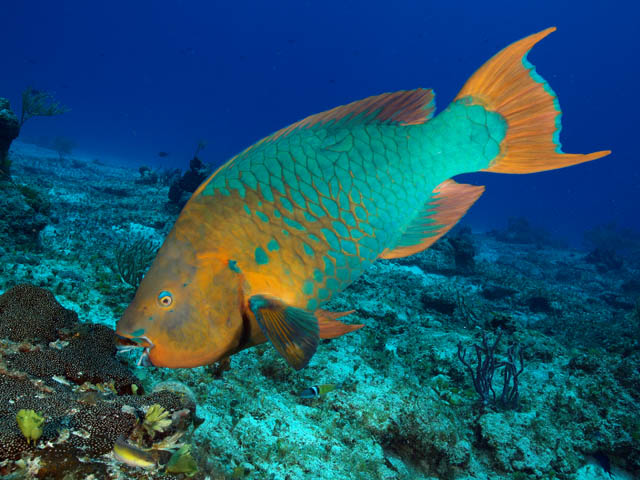
A rainbow parrotfish grazing on algae in the Caribbean
Photo source: CFMC, caribbeanfmc.com/fmp_reef_fish.html
Parrotfish are one of the most universally recognized reef fish, with their bright colors and beautiful varieties. If you've ever been snorkeling or SCUBA diving on a reef, you've probably easily spotted parrotfish swimming around, biting off pieces of coral - wait, biting coral? Isn't that bad for it? Aren't corals endangered?

Believe it or not, this "grazing" behavior is actually really good for coral reefs! Parrotfish are herbivores, which means that they eat only plant matter, not other fish, and when you see them biting at the coral, they are actually eating the algae that are growing there. This allows the living part of coral reefs, the polyps, to expand and grow, making the reef bigger and stronger. Without the parrotfish to remove the algae, the polyps would be smothered and eventually die! 

Parrotfish (along with snapper) for
sale in a Caribbean grocery store
Parrotfish are also important sources of food for many Caribbean islands. In the US Virgin Islands, the people of St. Croix especially love fishing and eating parrotfish. Managers must carefully assess the health of the parrotfish stock, due to this fishing demand.

On Leg 3 of our cruise, we are specifically targeting parrotfish larvae for the first time! We want to know where these fish are being spawned, retained, and/or transported, and what differences exist between the St. Thomas/St. John and St. Croix populations.

In the Virgin Islands, we mainly find two genera of parrotfish: Sparisoma and Scarus. Within these genera are more than a dozen different species, like midnight, rainbow, stoplight, queen, and princess parrotfish. Our taxonomists look at the fish's body shape, pigment patterns, and number of fin rays to determine which genus they find. Unfortunately we can't identify all these species at the larval stage with only a microscope (keep reading to find out how we can!). 

Taxonomists carefully collect the sample after a net tow and keep it on ice, then pick through the sample under a microscope, looking for fish larvae - live and on the ship! If we find any parrotfish larvae, they are identified to genus, measured, and then preserved based on the type of future analysis to be conducted. Some larvae are frozen in liquid nitrogen (about -340° F!) so that we can measure their stable carbon and nitrogen isotopes. Other larvae are preserved in refrigerated ethanol to keep their DNA pristine, which can be sequenced to identify the species of each fish, and what population it belongs to!
The two main genera in the Caribbean: Sparisoma (top), ~9mm SL, and Scarus (bottom), ~7mm SL.
Can you spot the differences between the two genera? (HINT: look at the pigments!)
So far, we've found over 300 parrotfish larvae in our samples! We can't wait to get back to the lab to see how many more we caught, and to discover more about the ecology and biology of these beautiful fish! 

Tuesday, June 21, 2016

Featured Scientists: Dan Otis and Alexis Sabine!

Today's post features two cruise veterans who joined us on the USVI Leg on last year's cruise, Dan Otis and Alexis Sabine! We are thrilled to welcome both of them back, and want to share a little more about them with you.

Dan uses a special camera to measure light reflected
from the ocean surface.
Dr. Dan Otis is a post-doc at the Institute for Marine Remote Sensing at the University of South Florida. "On land, I spend most of my time in the office downloading and processing satellite imagery of the ocean. However, it's great to get out to sea and take samples. While on cruise, I measure the color of the water using a special camera. The camera tells us how much light of each wavelength is being reflected from the ocean surface. This provides a great comparison to the satellite and allows us to calibrate sensors and develop new algorithms.

"I also filter lots of seawater on cruise to see what is absorbing and reflecting light. Both dissolved substances and particles like phytoplankton affect light in the ocean, so measuring what is actually in the water helps us interpret what we see from the satellite."

We are lucky to have Dan's expertise on board, as his optics studies bring in instruments and techniques new to our lab! Dan also has a great sense of humor and keeps us laughing all through shift! 

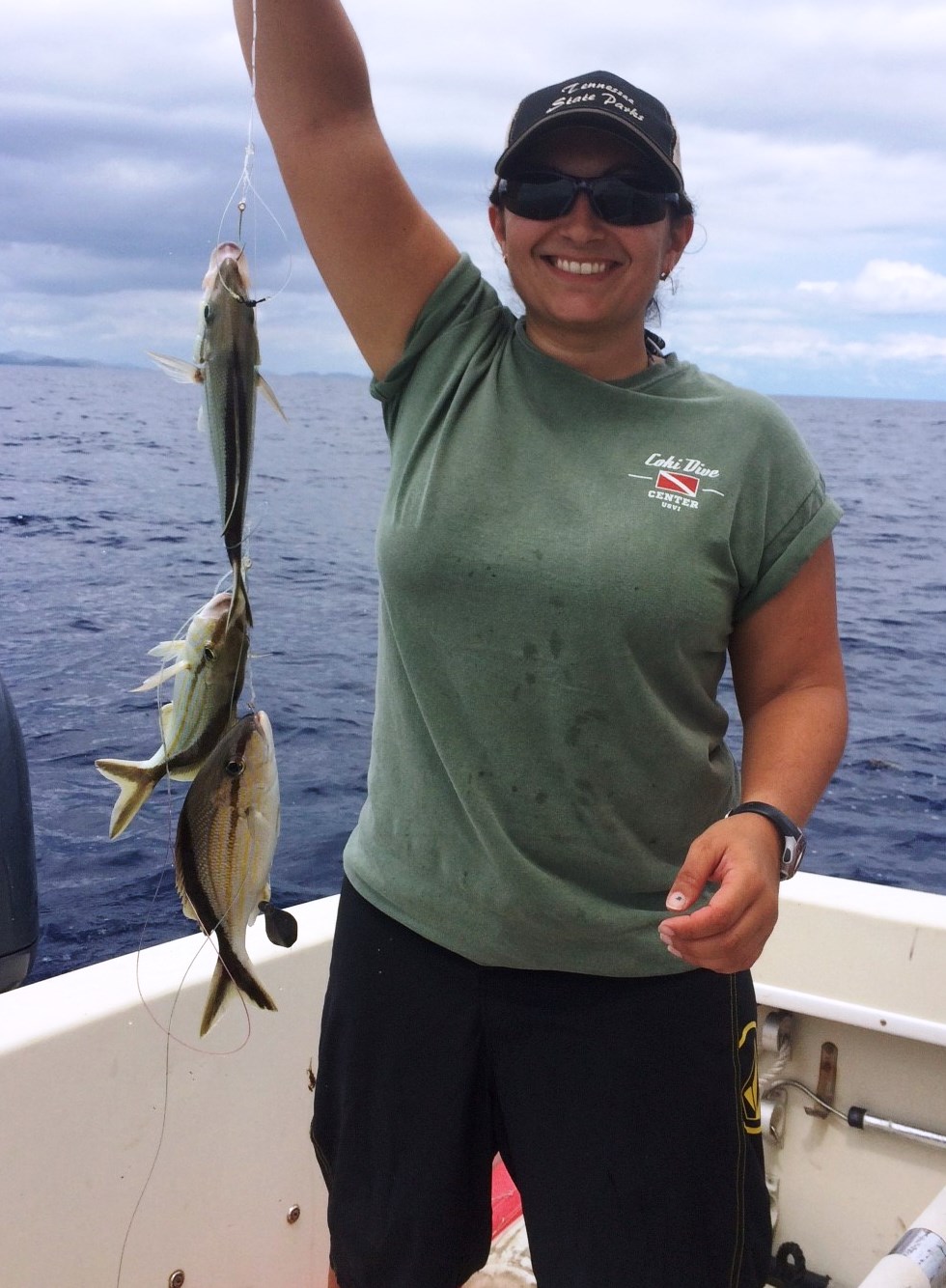
Alexis Sabine is a Fisheries Biologist at the US Virgin Islands Department of Planning and Natural Resources (DPNR), Division of Fish and Wildlife (DFW). "At the DFW, I help manage and conserve the marine and fisheries resources of the US Virgin Islands. My job consists of a variety of activities pertaining to research, monitoring, and management of the local marine environment. I am very lucky to get to do fieldwork in the beautiful tropical seas of the USVI, which includes “work” such as handline fishing for reef fish and SCUBA diving to survey fish and their associated habitats. I am based on the island of St. Thomas so most of my work is focused on the northern islands of St. Thomas and St. John, but the entire territory is managed as a whole since all the islands share the same resources.


Alexis collects reef fish during a SEAMAP sampling
project in the USVI
"I work on various projects that involve collection and management of commercial landings data and related fisheries-dependent surveys, as well as fisheries-independent assessments of populations of fish and other commercially important species in the USVI. Another large component of my job is to carry out projects that support and enhance recreational sport fish opportunities for Virgin Islanders. My work in this aspect involves deploying and monitoring Fish Aggregating Devices, which function by attracting pelagic sport fish species to anchored surface and submerged buoys. FADs have the dual benefit of alleviating some of the fishing pressure that nearshore reefs experience as well as reducing the effort anglers must expend in order to locate fish. I am also involved with maintaining public boating facilities such as recreational moorings and boat ramps and will hopefully soon be deploying some new artificial reefs around the US Virgin Islands.

"I am grateful to have participated in my first research cruise on the Nancy Foster last year, and am excited to be returning for the USVI leg this year as well. Last year I became familiar with the biological and physical techniques used on the cruise, such as the mighty MOCNESS net tows. This year I am looking forward to applying these techniques again, becoming more adept at identifying larval fish, sharing my personal knowledge about the local waters and fisheries, and learning more about the research projects being done by the different agencies represented aboard the ship. I am also looking forward to bringing this knowledge back to St. Thomas with me and sharing it with my colleagues at the Division of Fish and Wildlife."

Welcome back to the Foster, Alexis! She is incredibly passionate about her work, and not a shift goes by without intense discussions about collaborations and ideas for future projects. We love working with you throughout the year, and hope to continue to do so for many years to come!
Dan and Alexis pose on the back deck with the their Day Shift partners: L-R Mara, Sennai, Sarah, Dan, Alexis

Wednesday, June 15, 2016

Return to the Virgin Islands

While Legs 1 and 2 of NF1602 involved updated collection strategies, adaptive sampling, new techniques, and historic port stops, Leg 3 brings us back to some welcome familiar territory, the U.S. and British Virgin Islands! The partners at AOML/PHOD and NMFS/SEFSC have sampled these regions from 2007-2011, and again in 2015. 

Brewers Bay, St. Thomas, USVI

A plankton sample is preserved
This year, the research collaboration will focus on surveying the oceanographic conditions (using CTD, ADCP, and drifter data), larval reef fish populations (with neuston and MOCNESS net tows), and zooplankton concentrations (mini-bongo) across the coastal shelf of the U.S. Virgin Islands and the surrounding region. Data collected will help us understand the connectivity and variation in the transport and supply of reef fish larvae between managed and non-managed areas in the Virgin Islands. 

Scientist Kathryn sorts a fresh sample
We'll be sorting our plankton samples live on board, like on Legs 1 and 2. This way, we can get real-time information on fish species of interest, and freeze samples immediately so we can conduct DNA and isotope analyses on the samples. Nitrogen isotopes in these samples provide definitive biological linkages and trophic structure comparisons between fish populations. We are especially targeting larval parrotfish. These colorful species are fished locally, especially in St. Croix, USVI. From an ecosystem standpoint, herbivorous parrotfish are valuable grazers on coral reefs, feeding on competitive algae which can inhibit coral recruitment.
The two genera of parrotfish larvae we are interested in: left, Sparisoma sp., and right, Scarus sp.
We have many new faces on board this leg, so stayed tuned for some spotlights on our guest scientists and their research! For now, here's a sneak peak at what we've been up to so far...


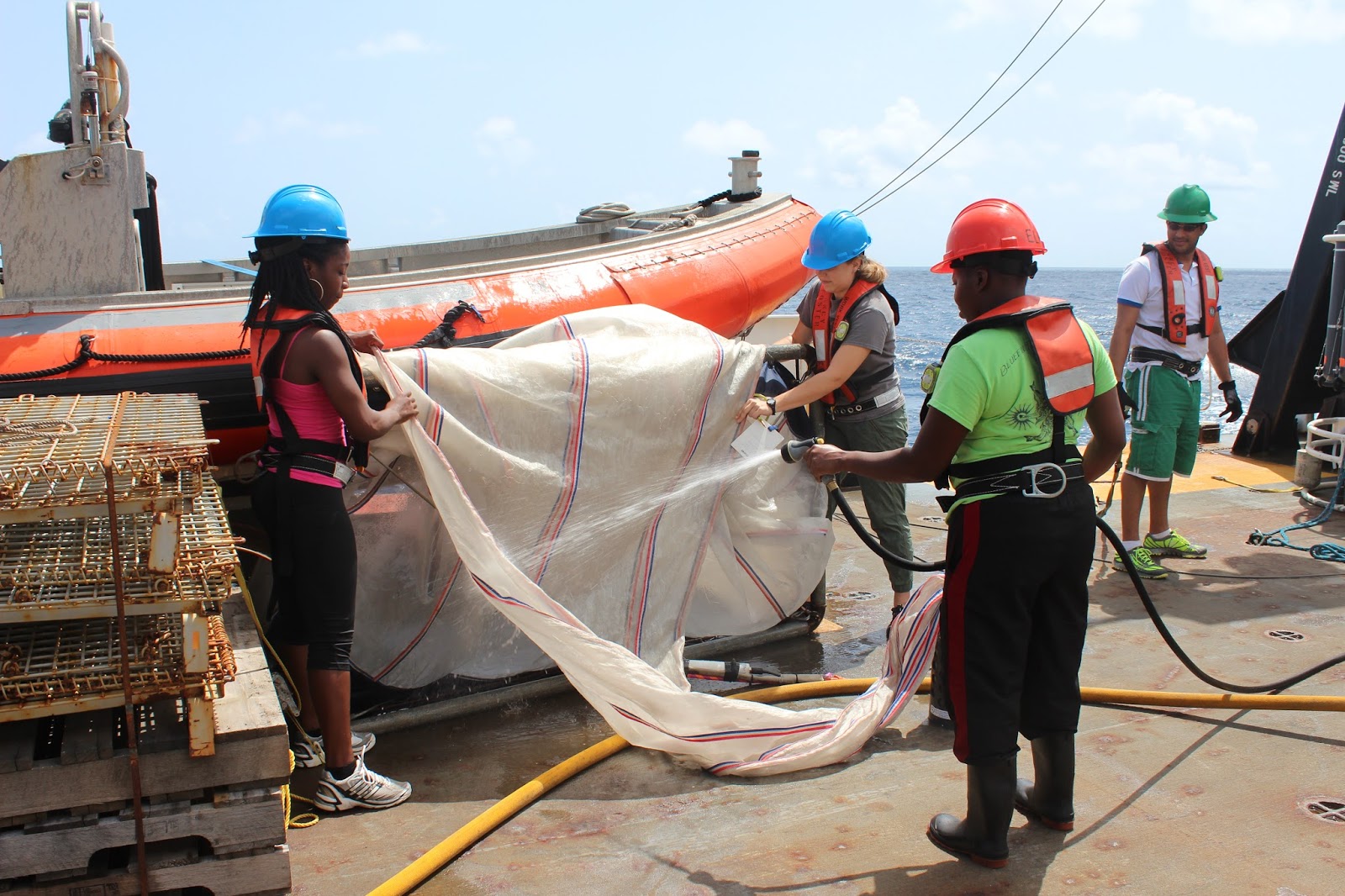
Scientists Adrianne, Kathryn, and LaTreese rinse down the "S25" neuston net
Scientist Dan takes light measurements for his optics study
Oceanographer Ryan takes water samples from the CTD
Scientist Mara preserves a microzooplankton sample from the mini-bongo