Showing posts with label Leg 3. Show all posts

Tuesday, June 6, 2017

Featured Scientist: Michael Landry

As we wrap up this year's survey, the first of two annual research surveys in the Gulf of Mexico for the NOAA RESTORE Act Science Program, we'd like you to get to know the PI from Scripps Institution of Oceanography, Professor Mike Landry! Read on as he describes his research and our cruise goals in his own words!

"I am a biological oceanographer. I have been on many ocean research expeditions over the years (since the 1970s), but never on a cruise in the Gulf of Mexico, never on a NOAA ship and never with fisheries scientists trying to understand a specific fisheries-related problem. So this particular cruise is special and a new learning experience in many respects. At the same time, it is also familiar. What we have investigated on past expeditions is how plankton food webs in different areas of the oceans function under different environmental conditions in order to understand the “rules” of why systems vary and how they respond to change. Our hope in this project is to apply the techniques that we have developed and the results from past experiences to characterize the unique aspects of the Gulf of Mexico habitat that lead to rapid growth and success of larval bluefin tuna (why do momma tunas migrate vast distances to spawn in only few small places in the ocean?) so that fisheries scientists might be better able to predict how they might be affected by future ocean changes.

Above: Groups of water bottles to
be sent to different depths
Below: Our filtration set up -
6 bottles at once!
"In this project, we are taking two approaches to studying food-web relationship and rates. One is experimental, involving direct measurements of community composition, productivity and nutrient uptake by phytoplankton, the microscopic plants of the sea. We also measure the consumption (grazing) of phytoplankton by zooplankton, the slightly larger but still pretty small protozoa and small animals that comprise the first 2-3 steps of the ocean food web. This is the “what is there,” "what are they doing,” and “how fast are they doing it” part of the study. Phytoplankton often go through one or two generations (cell divisions) per day, and they get eaten almost as fast as as they divide, so the tricky part of these experiments is separating the two rates (production growth and grazing loss) that are going on at the same time. We have a technique for this, which involves dilution of the grazing impact (using filtered water, changing the encounter frequency of predators and prey) in some of our experimental bottles. It is also important that we run our experiments under natural conditions of underwater light and temperature, so all of our experimental bottles that contain the plankton that we collected at different depths are put in net bags and attached at same depth to a line underneath a free-floating drifter float that we track by satellite for a day before picking up and exchanging bottles for a new batch of experiments. After a lot of filtering, preservation or freezing, and later analysis in our lab on shore, we should have a pretty good picture of how productivity and nutrients are moving through various routes in the food web to get to the specific zooplankton prey that bluefin tuna larvae like to eat.

Tom (L) and Mike (R) attach bottles to the sediment trap array

Mike (L) and Aki (R) hunt for BFT using microscopes onboard
"In the second approach to this study, we will use the tuna larvae themselves to tell us where they reside in the food web and what is the main source of nutrients (nitrogen) for primary production. This information resides in the nitrogen isotopic composition of the amino acids that make up the proteins of the tuna larva muscle tissue, which varies with the source of nitrogen (N2 gas for nitrogen fixation versus nitrate from deep water upwelling) and the number of predator-prey steps that the nitrogen has taken to get to the larvae, starting from phytoplankton. This sounds complicated, but the isotope analysis is easier to do than all of the experiments that are needed to assemble the food-web picture. One of our goals is to see if results from these two approaches agree, which has never been done before for any system because the isotope approach is so new. If this works out, it would validate using the isotopes in future studies, or also to look at changes in food-web structure and nitrogen sources that may have already occurred with climate change, using the muscle tissues of fish samples that have been taken in the past and preserved in museum collections."

Thursday, June 1, 2017

Featured Scientist: Lucy Fitzgerald


Hi everyone, I'm Lucy Fitzgerald, a rising senior and a marine science/biology major at Eckerd College in St. Petersburg, FL. Though I've logged plenty of lab time, this is my first experience on a research vessel. This trip is the beginning of my NOAA Hollings internship at the SEFSC FORCES Lab in Miami. I've been on the night shift and am learning the ropes with tasks such as deploying nets and the CTD, logging data, and tracking the SVP drifter buoy. I have also gotten to see a lightning storm at night, fabulous sunrises, and tons of plankton!
My goal is to learn about the upstream process of collecting specimens before working with them in the lab this summer, looking at the age and growth of billfish. As an undergrad, I'm trying to figure out what field of research I want to go into before applying to graduate school.

Karen and Lucy send the CTD to 300m in the GOM
Lucy learns about the array recovery from Tom and Becca
I don't have a specific research focus yet but my research experience has been primarily with paralarval squid, Doryteuthis pealeii, and looking at the effects of hypoxia on the boundary layer of the egg capsules as well as hatching rates/cues last summer and winter at the Woods Hole Oceanographic Institution. I have also looked at the population genetics of the brown Sargassum snail and bandtooth conger eel in the western Atlantic.
Being out in the open water where these species live brings a whole new perspective to my work in the lab!

Wednesday, May 31, 2017

Featured Scientist: Meet Jason!

Today's featured scientist is Jason Mostowy - read on for more about his cruise and future goals!


My name is Jason, I graduated from the University of  Miami in 2015 with a B.S. in Biology/Marine Science, and I've been working as a research tech in the FORCES Lab since 2013.

Larval lionfish (Pterois volitans/miles)
Image credit: FORCES
My main work for the lab involves processing the zooplankton samples we collect on cruises like this one - meticulously removing fish larvae and other target organisms, fitting the results into our considerable database, and dissecting larval fish for otoliths (earstones, used for ageing studies), gut contents, or genetic analysis projects. I'm also currently working on a project to characterize the larval distribution of the highly invasive Indo-Pacific lionfish (Pterois volitans/miles) in the tropical western Atlantic. Gaining a better understanding of the early life ecology of this harmful species will help scientists better predict levels of lionfish population replenishment, which in turn can be used to determine where and how often lionfish removal efforts should be performed.

Jason sorts through plankton search for tunas


Jason rinses down the Bongo-90 with
Sarah and Lulu during night shift
This is my third year sailing aboard the Foster. I love working in the field, especially the many perks that come with going to sea - the chances to practice and expand my scientific skill set, the opportunities to get to know other scientists from a variety of disciplines, the stewards rescuing me from my unfortunate cooking for a few weeks, etc. It's been a long cruise for me; I first embarked way back on April 13th, and by the time we reach port on June 2nd I'll have spend 35 of the last 48 days at sea!

This fall - after what I hope will be a commensurately long and relaxing stint on solid ground over the summer - I plan to start graduate school where I will continue to study the factors that mediate the distribution and survival of larval fish in the GOM and Caribbean.

Thursday, May 25, 2017

Featured Scientist: Meet Jennifer!

Today's featured scientist is a recent graduate from University of California - San Diego, Jennifer Beatty! She is a research assistant at the Scripps Institution of Oceanography. Read on to find out her goals for this survey in her own words!


Jennifer fixes a sample collected in the GOM
"The lab I'm involved with studies the interaction of phytoplankton and zooplankton, which are the lowest levels of marine food webs. Phytoplankton are essentially the plants of the sea, while zooplankton are the animal plankton that eat them. The way these two interact changes in different parts of the ocean, which impacts the dynamics of organisms further up the food web, including bluefin tuna larvae! During this cruise, we are hoping to get an idea of what is happening at these lower food web levels to illuminate what conditions are optimal for larval bluefin tuna.


Processing the ring net in the wetlab
"My primary goal for this cruise is to gain field experience at sea. I've worked with samples in the lab, but I wanted to see where they come from and how they are collected. Additionally, I wanted to taste what research at sea is like because I plan to pursue a graduate degree in marine science. Before I head there, I'd like to have a better idea if I prefer research dependent on field work or prefer to stay in the lab."

Friday, June 24, 2016

Another Year Complete!

A post-storm sunset captured from the beach in St. Croix, while the Foster (far left) is docked in port
Another cruise is in the books! We can't believe it's over already! This year's cruise was defined by balancing new sampling techniques and research goals with familiar methods and regions.

We made history by becoming the first federal vessel to dock in Havana, Cuba, since the restoration of diplomatic relations between the two countries, but also returned to the familiar U.S. Virgin Islands, where we sampled for the 7th year. We updated our usual pre-determined sampling plan in order to explore the dynamics of ever-changing mesoscale eddies, yet maintained the integrity of historical sampling sites. We welcomed new faces on board, including Cuban observers, and rekindled relationships with colleagues from years past.

Some final stats for Legs 1, 2, and 3 combined:
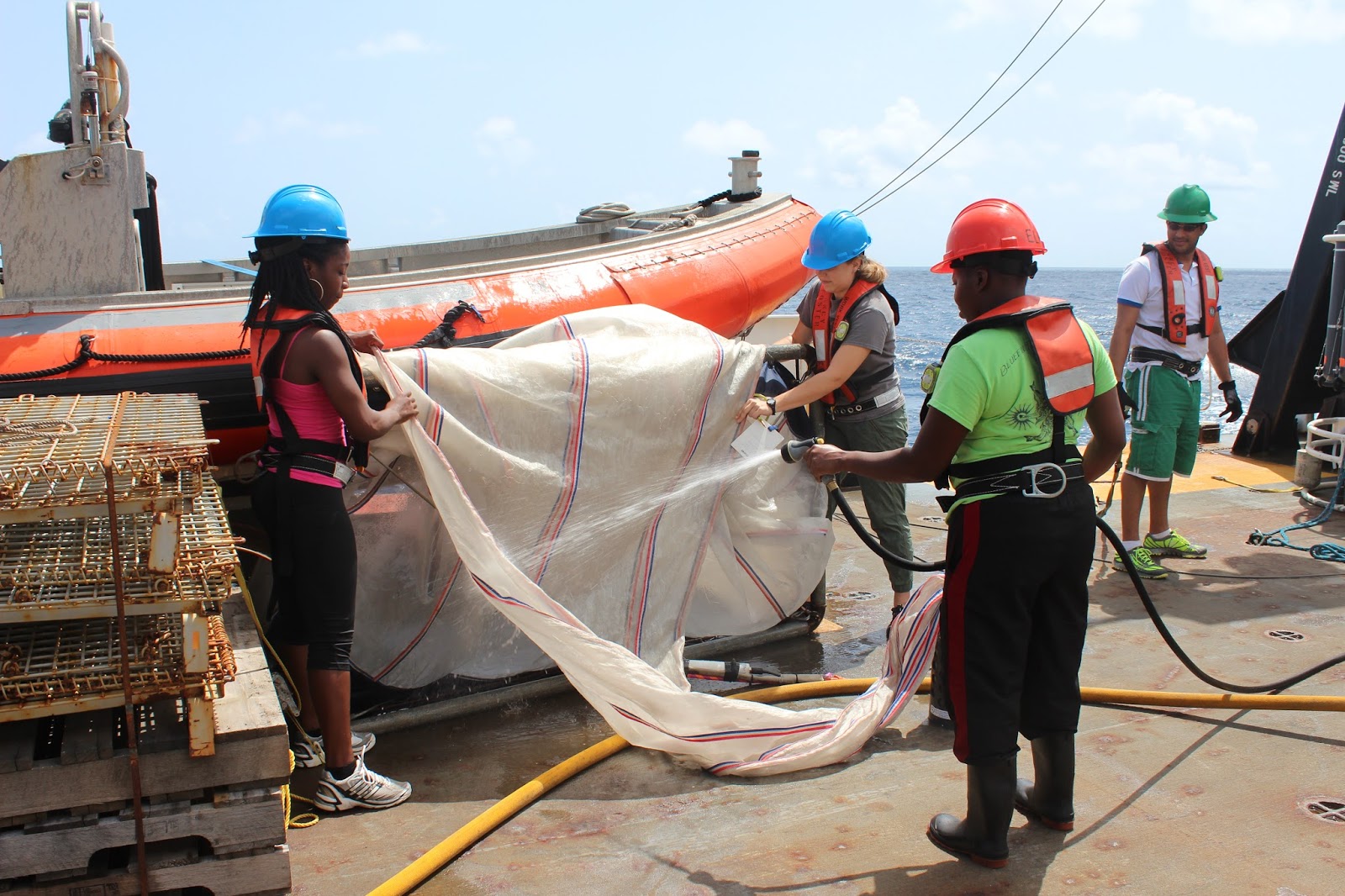
Sarah and Alexis rinse down the S25 net
  • CTD casts = 121
  • S10/S25 net tows = 105
  • Bongo tows = 41
  • Neuston tows = 17
  • MOCNESS = 74
  • mini-Bongo tows = 66
  • drifters deployed = 13
  • plankton samples collected = over 500!
  • countries visited = 4 (U.S., Cuba, Mexico, Jamaica)
  • collaborating countries = 7 (U.S., Mexico, Cuba, Japan, Spain, France, Dominican Republic)
  • collaborating institutions = 15
We still have lots of work left to do - unloading the ship, unpacking, cleaning, and repairing all our gear, sorting over 500 plankton samples, identifying larval fish, processing CTD files, running chlorophyll and isotope samples, and more! While we get back to work, check out some of our final images and videos from the last leg of the cruise, and be sure to check back for more next year!

Thanks for reading and sharing in our NF-16-02 adventures!
Leg 3! L-R: Omar, Trika, Sennai, Dan, Alexis, Aras, Mara, Ryan, Alex, Kathryn, Sarah, Adrianne, Angela, LaTreese


Aras patiently filters the mini-Bongo sample through find mesh funnels
Time-lapse: MOCNESS retrieval! 
(Video by Mara Duke)
Time-lapse: S25 tow - this was in very shallow water so you can see the ocean floor!
(Video by Mara Duke)

Adrianne and Angela deploy the CTD while ST Nick directs the winch operator
Ryan takes water samples from the CTD rosette bottles (top), then treats them so the
oxygen concentration can be measured back in the lab (bottom).
Omar (L) rinses the S25 neuston net, while Adrianne and Kathryn hold it steady.
Safety first! Everyone wears hard hats and PFDs, and are tethered to the deck with a safety line.

Day Shift Rules! Mara, Sarah, Sennai, and Alexis take a selfie in their safety gear.

Night Shift makes you crazy! LaTreese, Adrianne, Alex, Omar, Angela, Aars, & Kathryn started work at midnight everyday!

We're done! See you next year!!

Thursday, June 23, 2016

Parrotfish: Coral Reef Vegetarians

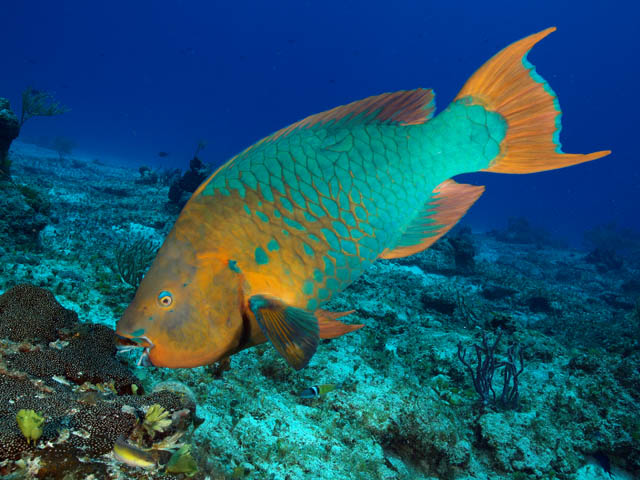
A rainbow parrotfish grazing on algae in the Caribbean
Photo source: CFMC, caribbeanfmc.com/fmp_reef_fish.html
Parrotfish are one of the most universally recognized reef fish, with their bright colors and beautiful varieties. If you've ever been snorkeling or SCUBA diving on a reef, you've probably easily spotted parrotfish swimming around, biting off pieces of coral - wait, biting coral? Isn't that bad for it? Aren't corals endangered?

Believe it or not, this "grazing" behavior is actually really good for coral reefs! Parrotfish are herbivores, which means that they eat only plant matter, not other fish, and when you see them biting at the coral, they are actually eating the algae that are growing there. This allows the living part of coral reefs, the polyps, to expand and grow, making the reef bigger and stronger. Without the parrotfish to remove the algae, the polyps would be smothered and eventually die! 

Parrotfish (along with snapper) for
sale in a Caribbean grocery store
Parrotfish are also important sources of food for many Caribbean islands. In the US Virgin Islands, the people of St. Croix especially love fishing and eating parrotfish. Managers must carefully assess the health of the parrotfish stock, due to this fishing demand.

On Leg 3 of our cruise, we are specifically targeting parrotfish larvae for the first time! We want to know where these fish are being spawned, retained, and/or transported, and what differences exist between the St. Thomas/St. John and St. Croix populations.

In the Virgin Islands, we mainly find two genera of parrotfish: Sparisoma and Scarus. Within these genera are more than a dozen different species, like midnight, rainbow, stoplight, queen, and princess parrotfish. Our taxonomists look at the fish's body shape, pigment patterns, and number of fin rays to determine which genus they find. Unfortunately we can't identify all these species at the larval stage with only a microscope (keep reading to find out how we can!). 

Taxonomists carefully collect the sample after a net tow and keep it on ice, then pick through the sample under a microscope, looking for fish larvae - live and on the ship! If we find any parrotfish larvae, they are identified to genus, measured, and then preserved based on the type of future analysis to be conducted. Some larvae are frozen in liquid nitrogen (about -340° F!) so that we can measure their stable carbon and nitrogen isotopes. Other larvae are preserved in refrigerated ethanol to keep their DNA pristine, which can be sequenced to identify the species of each fish, and what population it belongs to!
The two main genera in the Caribbean: Sparisoma (top), ~9mm SL, and Scarus (bottom), ~7mm SL.
Can you spot the differences between the two genera? (HINT: look at the pigments!)
So far, we've found over 300 parrotfish larvae in our samples! We can't wait to get back to the lab to see how many more we caught, and to discover more about the ecology and biology of these beautiful fish! 

Wednesday, June 22, 2016

Featured Scientist: Angela Ferrá-Elías!

Today's featured scientist, and final guest post for NF1602, is Angela Ferrá-Elías, from the University of Puerto Rico at Mayaguez! Angela is new to our cruise team, but quickly became one of us - we have loved sailing with her! Read more about her research and passion for her field!

Angela presents her research at the American
Meteorological Society Annual Meeting
"¡Saludos! My name is Angela Ferrá-Elías, a graduate student from the Marine Science Department at the University of Puerto Rico at Mayaguez (UPRM). Since I was 10 years old, I have been in love with the weather, ocean and the atmospheric phenomena. It was at this age, while attending 6th grade in elementary school, that I said, “when I grow up, I want to be a meteorologist”. This has been my dream since then and pursuing this dream, I completed a degree in physical science and a curricular sequence in Atmospheric Science and Meteorology in May 2013. During my years as an undergrad student I worked as a summer intern in the Geological and Environmental Remote Sensing Laboratory (GERS Lab) with Dr. Fernando Gilbes in the Geology Department at UPRM. Through these internships I combined my knowledge in meteorology with oceanography and remote sensing techniques. These opportunities opened my way to graduate studies in Physical Oceanography and with these opportunities came a new passion... the oceanography.

"As a masters graduate student I’m trying to focus my research and studies experience in the relationship and interaction of the ocean and the atmosphere. My research focus is based in the detection of mesoscale eddies in the eastern Caribbean Sea using sea water bio-optical properties. The objective is to identify if some bio-optical parameters are goods trackers for mesoscale eddies.

L: Angela deploys a CTD with Omar; R: Angela and Aras rinse down the mini-bongo net

"Because of my type of research I’m always behind the computer working but I really like and enjoy going out and doing some field work! This is why this experience aboard the NOAA Ship Nancy Foster is so exciting for me…. I’m going out! Finally, I have the opportunity to be in the field and learn new things. Even if I have experience working with the CTD, the best way to learn is by practicing and with this opportunity I definitely have much more experience.

Meteorology and Climate Change
workshop at US Fish & Wildlife
Service, Cabo Rojo, PR
"In my free time I enjoy going to the beach, doing some snorkeling, watching tv series and “dormir” (sleep)! But I also enjoy educating. This is why I work as marine educator in Sea Grant Puerto Rico and outreach coordinator in AECiMa (Asociación de Estudiantes de Ciencias Marinas). With all the experience and the knowledge obtained in this oceanographic expedition I definitely have more outreach activities to coordinate in my beautiful Puerto Rico. 

"Thanks for this amazing opportunity aboard the NOAA Ship Nancy Foster!" 

Thanks for reading all about our amazing guest scientists from NF1602! Keep checking back this week for some fun microscopic critters, and our final cruise post! 


Tuesday, June 21, 2016

Featured Scientists: Dan Otis and Alexis Sabine!

Today's post features two cruise veterans who joined us on the USVI Leg on last year's cruise, Dan Otis and Alexis Sabine! We are thrilled to welcome both of them back, and want to share a little more about them with you.

Dan uses a special camera to measure light reflected
from the ocean surface.
Dr. Dan Otis is a post-doc at the Institute for Marine Remote Sensing at the University of South Florida. "On land, I spend most of my time in the office downloading and processing satellite imagery of the ocean. However, it's great to get out to sea and take samples. While on cruise, I measure the color of the water using a special camera. The camera tells us how much light of each wavelength is being reflected from the ocean surface. This provides a great comparison to the satellite and allows us to calibrate sensors and develop new algorithms.

"I also filter lots of seawater on cruise to see what is absorbing and reflecting light. Both dissolved substances and particles like phytoplankton affect light in the ocean, so measuring what is actually in the water helps us interpret what we see from the satellite."

We are lucky to have Dan's expertise on board, as his optics studies bring in instruments and techniques new to our lab! Dan also has a great sense of humor and keeps us laughing all through shift! 

Alexis Sabine is a Fisheries Biologist at the US Virgin Islands Department of Planning and Natural Resources (DPNR), Division of Fish and Wildlife (DFW). "At the DFW, I help manage and conserve the marine and fisheries resources of the US Virgin Islands. My job consists of a variety of activities pertaining to research, monitoring, and management of the local marine environment. I am very lucky to get to do fieldwork in the beautiful tropical seas of the USVI, which includes “work” such as handline fishing for reef fish and SCUBA diving to survey fish and their associated habitats. I am based on the island of St. Thomas so most of my work is focused on the northern islands of St. Thomas and St. John, but the entire territory is managed as a whole since all the islands share the same resources.


Alexis collects reef fish during a SEAMAP sampling
project in the USVI
"I work on various projects that involve collection and management of commercial landings data and related fisheries-dependent surveys, as well as fisheries-independent assessments of populations of fish and other commercially important species in the USVI. Another large component of my job is to carry out projects that support and enhance recreational sport fish opportunities for Virgin Islanders. My work in this aspect involves deploying and monitoring Fish Aggregating Devices, which function by attracting pelagic sport fish species to anchored surface and submerged buoys. FADs have the dual benefit of alleviating some of the fishing pressure that nearshore reefs experience as well as reducing the effort anglers must expend in order to locate fish. I am also involved with maintaining public boating facilities such as recreational moorings and boat ramps and will hopefully soon be deploying some new artificial reefs around the US Virgin Islands.

"I am grateful to have participated in my first research cruise on the Nancy Foster last year, and am excited to be returning for the USVI leg this year as well. Last year I became familiar with the biological and physical techniques used on the cruise, such as the mighty MOCNESS net tows. This year I am looking forward to applying these techniques again, becoming more adept at identifying larval fish, sharing my personal knowledge about the local waters and fisheries, and learning more about the research projects being done by the different agencies represented aboard the ship. I am also looking forward to bringing this knowledge back to St. Thomas with me and sharing it with my colleagues at the Division of Fish and Wildlife."

Welcome back to the Foster, Alexis! She is incredibly passionate about her work, and not a shift goes by without intense discussions about collaborations and ideas for future projects. We love working with you throughout the year, and hope to continue to do so for many years to come!
Dan and Alexis pose on the back deck with the their Day Shift partners: L-R Mara, Sennai, Sarah, Dan, Alexis

Friday, June 17, 2016

Featured Scientists: LaTreese Denson and Sennai Habtes!

Today we'd like to introduce you to two collaborators that we've had the pleasure of working with for many years, LaTreese Denson and Sennai Habtes! 

LaTreese first teamed up with the FORCES lab in the summer of 2009 when she completed her Hollings Scholar internship in Miami. We were thrilled when she returned to Miami last year to start her PhD at the UM Rosenstiel School for Marine and Atmospheric Science (RSMAS), funded by the NOAA LMRCSC Fellowship! 
LaTreese shared with us about herself: "Since this is my first year, I currently take classes and experiment with data (e.g., fish abundance, environmental indices, etc ) and different population estimation models to help figure out what I will be using for my dissertation. At this point I basically sit inside all day and read. On the cruise, I am hoping to get more experience with data collection methods for the ecology of larval fish so that I have a better understanding of the quality of the data that is available for my population models. I also just want to be outside/at-sea.

Her research: "I am interested in modeling fish populations and the effect oceanography may have on their dynamics. Modeling fish populations and estimating their abundance is like putting together one of those insane 1000 piece puzzles with a three year old. The pieces might be everywhere or even missing, there is probably a lot of jamming of miss match pieces together and you won't finish it as soon as you thought but eventually you get close to putting the edges of the puzzle together. In the end its great because even those small steps are huge when you consider the magnitude of the problem."

We love LaTreese's passion and curiosity for marine science! Be sure to check out her personal blog as well, where she's currently sharing her own experiences on the Nancy Foster!

Dr. Sennai Habtes has been an honorary member of the FORCES lab since 2009 when he participated in the Spring SEAMAP plankton survey, and then throughout his PhD studies on larval bluefin tuna. He is now an Assistant Research Professor of Biological Oceanography at the Center for Marine and Environmental Studies (CMES) at the University of the Virgin Islands (UVI).

Read more about Sennai's research! "As a professor at UVI, my time is split evenly between research, teaching, and running the Coastal Oceanography lab for UVI-CMES. My research falls primarily within the fields of fisheries oceanography and zooplankton ecology and is focused on using time series data to study patterns in, and impacts to marine organisms in tropical and subtropical regions. This often requires the development and analysis of data products from satellite, airborne and in-situ oceanographic sensors to understand large marine ecosystems at synoptic spatial and longer temporal scales. Here at UVI I am interested in studying the physical processes and environmental variability in coastal and pelagic ecosystems surrounding the Virgin Islands and Puerto Rico, and to determine how these factors affect the abundance and distribution of marine organisms. In particular I am interested in larval fish and zooplankton, which are important life stages for most commercial and recreational fisheries. This information can be used to develop better tools for ecosystem based management and fisheries decision support systems. The Coastal Oceanography Lab or “Ocean Lab,”  is involved in a range of oceanographic research activities surrounding the USVI, including management of two coastal ocean buoy systems which are part of the CARICOOS buoy network, deployment and recovery for a host of oceanographic sensors used in conjunction with marine research for the Virgin Islands Experimental Program to Stimulate Competitive Research (VI-EPSCoR), and a time-series of zooplankton and oceanographic data used as part of an ecosystem analysis project within Brewers Bay, on St. Thomas. In addition I teach courses on Ecological Research Methods for the Masters for Marine and Environmental Studies program at UVI and a course in oceanography for the undergraduate BS/BA programs in Marine Biology and Environmental Sciences for UVI."

Goals for this cruise: "Beyond simply getting to interact with the cool and amazing scientists in the FORCES lab at NOAA SEFSC and Physical Oceanography Division at NOAA AOML, I am collecting zooplankton in conjunction with the surveys on larval reef fish to understand how oceanographic conditions affect patterns in zooplankton abundance, distribution, and community composition. In addition this data can be used to understand over time if there are changes in Caribbean zooplankton communities and to asses how this may impact larval fish habitat suitability and survival."
Sennai is excited for the waterspout that came near the ship!

We are grateful for the time we've had with LaTreese and Sennai, and look forward to collaborating with them for many years to come!

Thursday, June 16, 2016

Featured Scientists: Adrianne Wilson and Mara Duke!

We are extremely lucky to have so many partners and collaborators from around the country and globe - over the next few posts we'd like to introduce you to some of them that have joined us for Leg 3! First up, we have two graduate students who are spending some of their summers with us, Adrianne Wilson and Mara Duke! 


Adrianne Wilson is a Master's student at Florida A&M University. She is currently working on her M.S. in Environmental Science with a concentration in marine and estuarine studies. Her Master's thesis focuses on larval fish assemblages in the Gulf of Mexico. Adrianne is doing a summer internship in the FORCES lab in Miami, and we are thrilled she was able to join us for a leg of the cruise! During these two weeks at sea Adrianne hopes to learn more about the methods behind larval fish sampling, gain research cruise experience, meet cool scientists and study fish all day!


Mara Duke is a graduate student in the Masters of Marine and Environmental Science Program at University of the Virgin Islands. Her thesis research is on the connection between water quality and abundance and distribution of zooplankton in Brewers Bay in St Thomas, USVI. This is Mara's first cruise, and she hopes to gain her "sea legs" and experience on an oceanographic vessel!

Both Adrianne and Mara have already showed how valuable they are as scientists on board, and we can't wait to see what is in store for these awesome young researchers! 


via GIPHY
(Mara is preparing the plankton collected in the MOCNESS for preservation in ethanol)

Wednesday, June 15, 2016

Return to the Virgin Islands

While Legs 1 and 2 of NF1602 involved updated collection strategies, adaptive sampling, new techniques, and historic port stops, Leg 3 brings us back to some welcome familiar territory, the U.S. and British Virgin Islands! The partners at AOML/PHOD and NMFS/SEFSC have sampled these regions from 2007-2011, and again in 2015. 

Brewers Bay, St. Thomas, USVI

A plankton sample is preserved
This year, the research collaboration will focus on surveying the oceanographic conditions (using CTD, ADCP, and drifter data), larval reef fish populations (with neuston and MOCNESS net tows), and zooplankton concentrations (mini-bongo) across the coastal shelf of the U.S. Virgin Islands and the surrounding region. Data collected will help us understand the connectivity and variation in the transport and supply of reef fish larvae between managed and non-managed areas in the Virgin Islands. 

Scientist Kathryn sorts a fresh sample
We'll be sorting our plankton samples live on board, like on Legs 1 and 2. This way, we can get real-time information on fish species of interest, and freeze samples immediately so we can conduct DNA and isotope analyses on the samples. Nitrogen isotopes in these samples provide definitive biological linkages and trophic structure comparisons between fish populations. We are especially targeting larval parrotfish. These colorful species are fished locally, especially in St. Croix, USVI. From an ecosystem standpoint, herbivorous parrotfish are valuable grazers on coral reefs, feeding on competitive algae which can inhibit coral recruitment.
The two genera of parrotfish larvae we are interested in: left, Sparisoma sp., and right, Scarus sp.
We have many new faces on board this leg, so stayed tuned for some spotlights on our guest scientists and their research! For now, here's a sneak peak at what we've been up to so far...


Scientists Adrianne, Kathryn, and LaTreese rinse down the "S25" neuston net
Scientist Dan takes light measurements for his optics study
Oceanographer Ryan takes water samples from the CTD
Scientist Mara preserves a microzooplankton sample from the mini-bongo