Showing posts with label collaboration. Show all posts

Tuesday, June 19, 2018

A better late than never post for #NF1802, Dr. Stukel #ontheblog

Stukel sets up the satellite-tracker inside the buoys
Although NF1802 has come to an end, we will continue to post for the rest of the summer! Stay tuned!

Today, Dr. Mike Stukel joins us once again on the blog! Mike is an Assistant Professor at Florida State University and one of the PIs on our joint NOAA RESTORE Science project. His PhD students, Tom and Taylor joined him in this survey.


“I study the intersection of plankton ecology and biogeochemistry.  I have a fascination for all of the microscopic critters (plankton) that drift constantly with the currents of the open ocean.  Much of my research focuses on either the role of plankton in converting carbon dioxide to organic matter and then storing that organic matter in the deep ocean (a process referred to as the biological pump) or determining how changes in the planktonic ecosystem affect the availability of prey for fish and other large organisms. During this project, my research goal is to understand how biogeochemical and ecological interactions at the base of the food web affect the survival of larval tuna.
The golden tufts in the bottom left are Trichodesmium, the long organism in the middle is a chaetognath, and many of the out-of-focus blobs are copepods
Specifically, I'm interested in two questions:

  1. What processes supply nutrients to the algae at the base of the food web (upwelling that introduces deep nutrients to the surface ocean or nitrogen fixation that converts abundant nitrogen gas into plankton fuel)?  
  2. How does the structure of the planktonic food web affect the efficiency with which primary production is converted to zooplankton biomass (i.e. fish food)?  
Illustration by Sabine and Baxter

On this cruise, one of my lab’s goals is to make simultaneous measurements of nitrate uptake and nitrogen fixation in tuna spawning habitat."

Mike looks for microscopic organisms in between stations
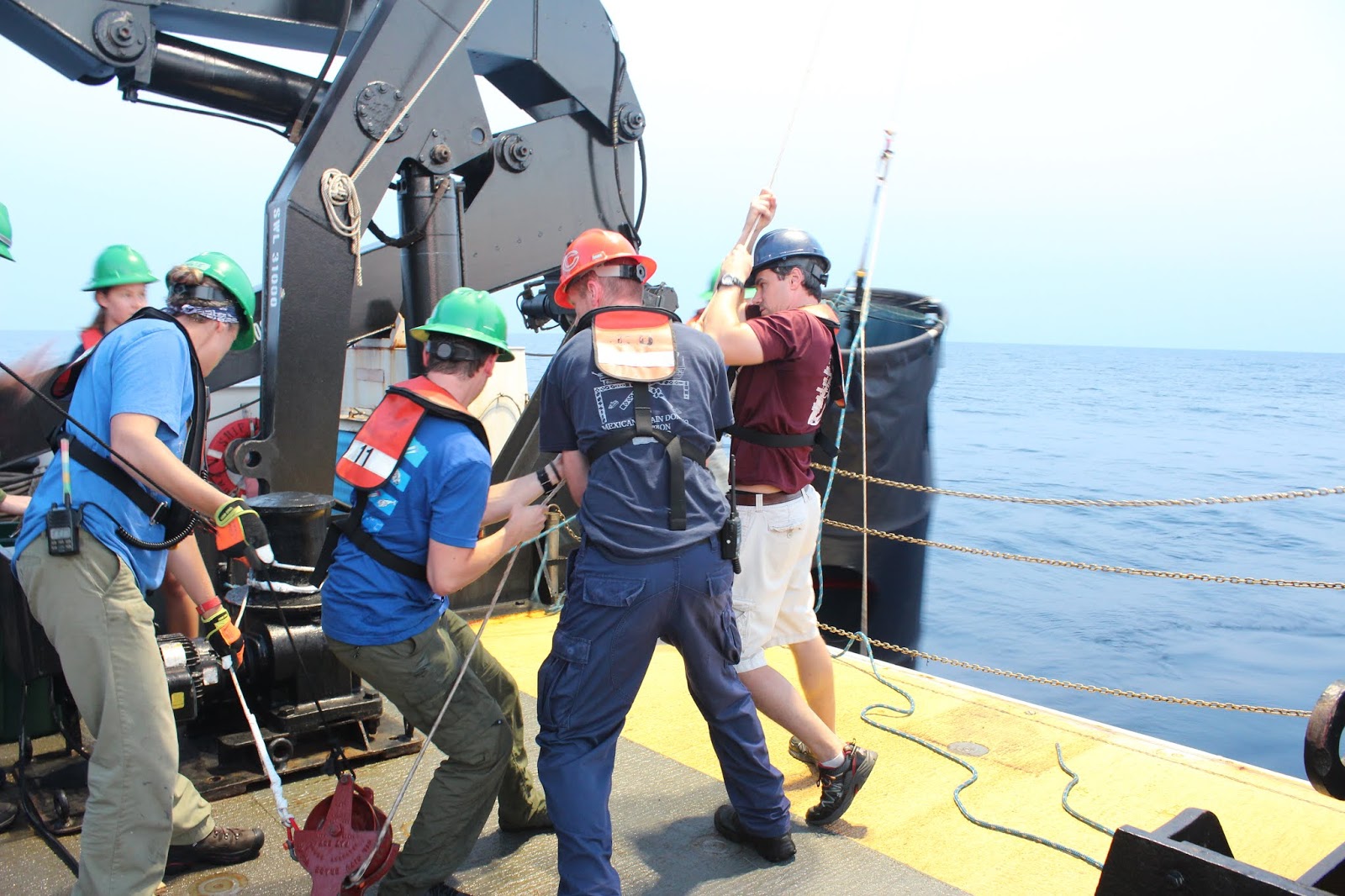
Stukel and the team during sediment trap operations on the back-deck
If you are a teacher or student and want to learn more about plankton, check out Mike's lab's website and this link and has lesson plan too!) developed by Ms. Colleen Miks.

Tuesday, June 6, 2017

Featured Scientist: Michael Landry

As we wrap up this year's survey, the first of two annual research surveys in the Gulf of Mexico for the NOAA RESTORE Act Science Program, we'd like you to get to know the PI from Scripps Institution of Oceanography, Professor Mike Landry! Read on as he describes his research and our cruise goals in his own words!

"I am a biological oceanographer. I have been on many ocean research expeditions over the years (since the 1970s), but never on a cruise in the Gulf of Mexico, never on a NOAA ship and never with fisheries scientists trying to understand a specific fisheries-related problem. So this particular cruise is special and a new learning experience in many respects. At the same time, it is also familiar. What we have investigated on past expeditions is how plankton food webs in different areas of the oceans function under different environmental conditions in order to understand the “rules” of why systems vary and how they respond to change. Our hope in this project is to apply the techniques that we have developed and the results from past experiences to characterize the unique aspects of the Gulf of Mexico habitat that lead to rapid growth and success of larval bluefin tuna (why do momma tunas migrate vast distances to spawn in only few small places in the ocean?) so that fisheries scientists might be better able to predict how they might be affected by future ocean changes.

Above: Groups of water bottles to
be sent to different depths
Below: Our filtration set up -
6 bottles at once!
"In this project, we are taking two approaches to studying food-web relationship and rates. One is experimental, involving direct measurements of community composition, productivity and nutrient uptake by phytoplankton, the microscopic plants of the sea. We also measure the consumption (grazing) of phytoplankton by zooplankton, the slightly larger but still pretty small protozoa and small animals that comprise the first 2-3 steps of the ocean food web. This is the “what is there,” "what are they doing,” and “how fast are they doing it” part of the study. Phytoplankton often go through one or two generations (cell divisions) per day, and they get eaten almost as fast as as they divide, so the tricky part of these experiments is separating the two rates (production growth and grazing loss) that are going on at the same time. We have a technique for this, which involves dilution of the grazing impact (using filtered water, changing the encounter frequency of predators and prey) in some of our experimental bottles. It is also important that we run our experiments under natural conditions of underwater light and temperature, so all of our experimental bottles that contain the plankton that we collected at different depths are put in net bags and attached at same depth to a line underneath a free-floating drifter float that we track by satellite for a day before picking up and exchanging bottles for a new batch of experiments. After a lot of filtering, preservation or freezing, and later analysis in our lab on shore, we should have a pretty good picture of how productivity and nutrients are moving through various routes in the food web to get to the specific zooplankton prey that bluefin tuna larvae like to eat.

Tom (L) and Mike (R) attach bottles to the sediment trap array

Mike (L) and Aki (R) hunt for BFT using microscopes onboard
"In the second approach to this study, we will use the tuna larvae themselves to tell us where they reside in the food web and what is the main source of nutrients (nitrogen) for primary production. This information resides in the nitrogen isotopic composition of the amino acids that make up the proteins of the tuna larva muscle tissue, which varies with the source of nitrogen (N2 gas for nitrogen fixation versus nitrate from deep water upwelling) and the number of predator-prey steps that the nitrogen has taken to get to the larvae, starting from phytoplankton. This sounds complicated, but the isotope analysis is easier to do than all of the experiments that are needed to assemble the food-web picture. One of our goals is to see if results from these two approaches agree, which has never been done before for any system because the isotope approach is so new. If this works out, it would validate using the isotopes in future studies, or also to look at changes in food-web structure and nitrogen sources that may have already occurred with climate change, using the muscle tissues of fish samples that have been taken in the past and preserved in museum collections."

Sunday, May 28, 2017

Outreach & Education: Nancy Opens her doors during our Progreso Open House


The ship Nancy Foster arrived for the first time to Progreso in Yucatán on May 19. On Saturday, May 20, we held an Open House event to explain the scientific research activities we carried out in the Gulf of Mexico. On this occasion we were accompanied by Dr. Mario González Espinosa, Director of ECOSUR, Dr. Magda Estela Domínguez Machín, Assistant Director of Fisheries Resources in the Atlantic of INAPESCA, Dr. Josefina del Carmen Santos Valencia, Chief of CRIP Yucalpetén, and Dr. Alvaro Hernández Flores, Professor-Researcher at MARISTA University, together with Doctorate students in Fisheries and Aquaculture Bioeconomics at the university. The students of Marine Biology (UADY), led by Dr. Alfonso Aguilar Perera, Professor-Researcher of UADY Marine Biology Faculty, were present as well as Mr. Manuel Sánchez González, President of the Yucatán Shipowners Union.

Mike Stukel explains the sediment traps to local fishers
Student explores plankton in the microscope!
While everyone explored the ship, scientists explained the main activities carried out during our campaign in the different laboratories. In the “wetlab,” everyone got an opportunity to see the many organisms that make up the plankton using microscopes. 

The wetlab is also where each sample is carefully examined to search for tuna larvae and multiple filtrations of seawater take place. In the “dry lab” all the controls for deployment and recovery of of equipment take place. On the back deck, we saw the equipment used to ascertain nitrogen sources in relation to the plankton food-web dynamics in the habitats of the BFT. 

Scientists examine specimens under the microscope
Chief Sci Estrella Malca discusses the project goals
This is novel and exciting because, despite its importance, these research activities are being conducted for the first time in the Gulf of Mexico! Finally, on the bridge, the NOAA Corps officers showed us the state of the art navigation equipment and instruments utilized to safely and accurately lead the ship to and from our sampling locations.

Mexico and US collaborators
Students and researchers asked questions about our various activities and were surprised by the great diversity of organisms observed in the microscope and those captured on the computer screen during this survey. We would like to thank everyone for participating and to all of the port agents, the scientists, crew and officers for making this a fun and well organized event!

Tuesday, May 23, 2017

Featured Scientist: Meet Mike!

This year's voyage is the first of two annual research surveys in the Gulf of Mexico for the NOAA RESTORE Act Science Program. Our project, "Research, observation, and monitoring to support long-term sustainability in the GoM ecosystem, including fish stocks, fish habitat, and fishing industries," is in collaboration with some new partners to the FORCES Lab. Read on and get introduced to the project's PI from Florida State University, Mike Stukel!

Mike prepares sample bottles to be loaded into the sediment trap
My name is Mike Stukel, and I am an assistant professor at Florida State University. I am a plankton ecologist and biogeochemist in the FSU Plankton Ecology and Biochemistry Lab. I study the role that some of the smallest organisms in the ocean play in the global carbon cycle and their role in removing carbon dioxide from the atmosphere. On this cruise, I am studying the role that different nutrients play in limiting the primary production of phytoplankton. These tiny algae are responsible for half of the world’s photosynthesis and half of the oxygen that you breathe. Their photosynthesis also supports the entire marine ecosystem of the open ocean Gulf of Mexico. One of my goals in this project is to quantify the food web pathways that partition this phytoplankton production between either the biological pump (which transports atmospheric CO2 into the deep ocean where it can be stored for centuries) or higher trophic levels including larval tuna. 

Mike and Tom (R) with their double-decker water filtrations!
My goal for this cruise is to understand the base of the food web that supports larval tuna.  In particular, I am interested in whether the algae responsible for photosynthesis are ultimately getting their nutrients from upwelling that brings nutrient-rich deep water into the sunlit surface zone or whether special phytoplankton (called Nitrogen-fixers) are creating their own nutrients from the nitrogen gas that is abundant in the atmosphere and ocean.  Answering this question is important to understanding whether or not total productivity in the Gulf of Mexico will decrease due to climate change.

Mike deploys the drifter array in the wee hours of the morning


Wednesday, May 17, 2017

Featured Scientist: Meet Lulu!

Our annual surveys would not be possible without our wonderful collaborators from around the world. We'll dedicate several future blog posts to highlight these individuals, so that you can learn more about them, their research, and the valuable contributions they make to the survey. You can find previous posts here. Today we feature Lourdes Vásquez Yeomans from ECOSUR!

Today’s blog features our long-time collaborator and friend Lourdes Vásquez Yeomans, or “Lulu,” who is one of our most enthusiastic colleagues from Mexico’s ECOSUR (El Colegio de la Frontera Sur) Chetumal campus. Lulu is an ichthyologist in the Zooplankton Laboratory in the Departamento de Sistemática y Ecología Marina.

Lulu sorts plankton samples in search of bluefin tuna larvae
“I work with coastal and oceanic ichthyoplankton (eggs and fish larvae) mainly from the Mesoamerican Reef System, with emphasis on the Mexican Caribbean. ECOSUR has one of the best collections of larval fishes in Mexico! I am also one of the curators of this collection, and always facilitating its expansion. Thousands of fishes in the museum have been archived from the multiple joint-oceanographic surveys carried out with NOAA in Mesoamerican waters, the Eastern Caribbean, Cuba, and the Gulf of Mexico. An added value of this collection is that more than 4,000 specimens so far have been analyzed for genetic ID, so we know with certainty which species it is. One of our partners in this endeavor is the MEXBOL network as well as the BOLD consortium.


L-R: Jason, Lulu, Sydney, and Sarah rinse down the Bongo net

Lulu and Chief Scientist Estrella model their cruise shirts
“On this survey, I am using my skills as a taxonomist to help the team identify bluefin tuna larvae and other resources of high commercial value such as dorado, marlin, grouper, and snapper. My main goal on this survey is to increase my country’s understanding of bluefin tuna spawning events in our territorial waters. Bluefin tuna is a resource of high commercial value that has suffered a significant decrease in its abundance, which is an alarming situation. Bluefin tuna are also a shared resource between USA and Mexico, so we have to make collaborative academic partnerships like our 10-year academic and research partnership between NOAA’s FORCES lab and my Larval Fish Lab in ECOSUR.

The Night Shift! L-R: Sydney, Lulu, Jason, and Sarah
“I hope that many young marine biology students are motivated by this field of research! I think that it is necessary to continue these efforts. I am happy to participate in this project, and I am grateful to Dr. John Lamkin for being part of his team and the Mexican authorities (SEMAR, DIGAOHMINAPESCA, SRE) for understanding the importance of these investigations and granting our project the scientific permits to work in Mexican waters."

Friday, May 12, 2017

Return of the Tuna!

And....we're back! Back in the Gulf of Mexico (GoM), on the hunt for larval bluefin tuna (BFT)! The next two legs of our survey will be focused on finding patches of bluefin larvae (Thunnus thynnus), and studying the biogeochemical habitat in which we find them. We are joined by some familiar collaborators from the University of Miami-RSMAS, El Colegio de la Frontera Sur (ECOSUR), and the Spanish Institute of Oceanography (IEO), as well as some new team members!

A glimpse of some of the new equipment we'll be using!
Why is this important? Well, you may know that BFT are one of the mostly highly sought after fish in the commercial industry, as they are large, delicious, and highly valuable. But this also means that they are being over exploited - which means that the levels at which they are currently fished are not sustainable long-term. Atlantic BFT are highly migratory species (HMS), distributed throughout the northern Atlantic Ocean. However, they migrate south to the GoM and the Mediterranean Sea to spawn only once a year during the summer months.

The FORCES lab studies the early life stages of tunas in order to tell their "origin story." Why do the adults travel miles and miles to this specific area? Are there certain oceanic features that provide a protective nursery habitat for the larvae and increase their chances for survival? Are there certain biochemical gradients in these waters that help the larvae grow faster or more fit for surviving the pelagic environment? How will forecasted changes in this environment affect larvae in the coming decades?

LOTS of water filtration will be involved!
We are incredibly excited to be embarking upon a brand new set of surveys with several new partners in order to start to answer some of these questions.  We even more thrilled that our new research team was selected as one of the few projects funded by the NOAA RESTORE Act Science Program! This Science Program funds "research, observation, and monitoring to support long-term sustainability in the GoM ecosystem, including fish stocks, fish habitat, and fishing industries" (for more on the program, click here). The FORCES Lab at the NOAA Southeast Fisheries Science Center teamed up with Scripps Institute of Oceanography, Florida State University, and the University of Hawaii at Manoa to examine the "Effects of nitrogen sources and plankton food web dynamics on habitat quality for larval BFT."  Together, we will use net tows, satellite data, oceanographic models, and drifters, to find patches of bluefin tuna larvae in the GoM and then we will follow these patches over the next few days. Every day we will sample (around the clock!) the in situ conditions and characteristics of the patch, in order to obtain a bottom-up understanding of BFT recruitment in the GoM. We will share with you more as we keep drifting with the tunas!

We can't wait to share this new journey with you!

Don't worry, we'll still show you loads of sunsets at sea


Wednesday, April 26, 2017

Featured Scientist: Meet Kristen!

Our annual surveys would not be possible without our wonderful collaborators from around the world. We'll dedicate several future blog posts to highlight these individuals, so that you can learn more about them, their research, and the valuable contributions they make to the survey. You can find previous posts here. Today we feature Kristen Ewen from the University of the Virgin Islands!

My name is Kristen Ewen, and I'm a first year Masters Student at the University of the Virgin Islands!
Kristen deploys a biodegradable drifter

My thesis project looks to model population connectivity of large bodied parrotfish of the genus Scarus within the USVI. The reason why we are focused on parrotfish is because they are one of the largest herbivores on Caribbean reefs. They remove excess algae which allows for coral dominated reefs. These fish are also delicious! Which makes them a huge staple in the artisanal fisheries of the territory. However, their populations have declined recently, primarily due to overfishing, reducing their contribution to these ecosystem services.  To better manage this genus, computer models can be developed to take larval fish found in the water column and trace them back to where they were born.  These sites where these fish are reproducing can then be protected to increase the chance of repopulating the surrounding reefs.


Kristen communicates from inside the wet lab with the winch operator, the back deck, and the bridge during a net tow

Since I am using the larval fish data collected on this cruise, I wanted to come aboard to really understand the collection process rather then just reading about it.  From this experience aboard the Nancy Foster I now have the complete story. I may have come for the sampling methods, but stayed for the cute baby parrotfish!

Beast mode! Kristen flexes her muscles on the back deck

Tuesday, April 25, 2017

Featured Scientist: Meet Sennai!

Our annual surveys would not be possible without our wonderful collaborators from around the world. We'll dedicate several future blog posts to highlight these individuals, so that you can learn more about them, their research, and the valuable contributions they make to the survey. You can find previous posts here. Today we feature Sennai Habtes from the University of the Virgin Islands!

Sennai Habtes has been a longtime collaborator with the FORCES lab, since his days as a PhD student. We are always excited to get to sail with him each year! Sennai is a Research Assistant Professor of Biological Oceanography at the Center for Marine and Environmental Studies, University of the Virgin Islands.

"This year I am working with the scientists of the NOAA SEFSC, Dr. Dan Otis from the University of South Florida, and Dr. David Lindo from the City University of New York, to understand how physical oceanographic processes affect larval dispersal around spawning periods. We are particularly interested in two phenomena: where do grouper larvae go after they are spawned, and how the oceanographic conditions surrounding high biological productivity areas in the USVI and Puerto Rico have an impact. Myctoperca venenosa, or the Yellowfin Grouper, spawn approximately 8-10 days after the full moon from January until April, at spawning aggregations sites along the shelf surrounding the USVI (primarily along the Gramanik Bank, on the South Drop). Although we routinely sample for larval fish during the times of year when grouper are actively spawning around the USVI, we have very little luck catching these larvae. We believe this may because they target zones with particular currents that transport the larvae below the surface. During this cruise we are using specialized nets called a MOCNESS (Multiple Openning and Closing Net Environmental Sampling System) to sample the area surrounding the spawning aggregations. This will allow us to determine where in the water column these larvae are transported.

Grouper larva, ~5mm length
Photo credit: FORCES Lab
"Additionally, we are targeting Lang Bank on St. Croix, to determine how oceanographic conditions, which support a high biological region there, influence the transport of larval fish. Along with our traditional measurements of oceanographic conditions, and net sampling of zooplankton and ichthyoplankton (larval fish) we are also using satellite imagery to identify interesting features that may help in either transporting the larvae faster or retaining them in coastal areas surrounding the USVI. These are two smaller studies that we have implemented in this years cruise to help understand how the coastal oceanography around the USVI and PR affect larval recruitment (addition of new fish into adult populations) and connectivity (transport, ultimately allowing for better management of marine fish populations in the Eastern Caribbean."

Satellite image shows the oceanography of the US Virgin Islands, with tracks of the drifters deployed on NF-17-03.
Image courtesy of Dr. Dan Otis - Institute for Marine Remote Sensing USF-CMS

For more on Sennai’s research see his faculty webpage at UVI: http://www.uvi.edu/directory/profiles/staff/habtes-sennai-y.aspx
or this recent news post from the team at the VI-EPSCoR program about Sennai’s background and his research: https://www.viepscor.org/news/2017/4/12/drhabtes

Wednesday, April 19, 2017

Featured Scientist: Meet Giovanni!


Our annual surveys would not be possible without our wonderful collaborators from around the world. We'll dedicate several future blog posts to highlight these individuals, so that you can learn more about them, their research, and the valuable contributions they make to the survey. Today we feature Giovanni Seijo-Ellis from the University of Puerto Rico - Mayaguez!

Giovanni successfully completes a 1500-meter CTD cast
Hi everyone! My name is Giovanni Seijo-Ellis, I'm a physics masters student at the University of Puerto Rico - Mayaguez, and I'm starting my PhD next fall at the City University of New York's Graduate Center with Dr. David Lindo.

I always knew that I wanted to work on something related to the oceans and as I grew up that interest grew bigger. When I found out as a young teenager that there is a field called physical oceanography, I felt I was born for it. Back in Puerto Rico there are no undergraduate programs in oceanography, so I decided to go into Theoretical Physics, took some advanced oceanography courses and complemented it with atmospheric dynamics courses. I worked for three and a half years for the Puerto Rico Seismic Network doing tsunami simulations and hazard assessments under a National Tsunami Hazard and Mitigation Program grant. 

Ready to launch the XBT!
Then I moved to work with the Caribbean Coastal Ocean Observing System (CariCOOS), the Caribbean Component of NOAA's Integrated Ocean Observing System (IOOS). There I work as an ocean modeler. I basically work with validation and development of ocean models for the Caribbean region in order to have better forecasts of ocean currents and I also prepare some operational products for the CariCOOS webpage users. Besides that, I also do storm surge simulation and mapping with special focus on energy distribution over coral reefs along the northern and eastern part of Puerto Rico. Every now and then I help in CariCOOS field work (which is probably my favorite thing to do), deploying CTDs, and deploying/recovering sea gliders or anything else that comes up. 

One of the homemade biodegradable
CariCOOS drifters
I met Dr. Lindo some months ago and we quickly noticed that we had many research interests in common, so I decided to apply to CUNY's Earth and Environmental Sciences program where we could work together and I could reach my goal of getting a PhD. A couple of weeks after, he called me to see if I was interested in participating on a research cruise...of course I was interested!!!! Our goal is to understand the cross-shelf exchange of waters between St. Thomas and St. Croix. Ocean circulation/currents in the Caribbean is not as easy to understand as one may think. The rapid variation of the bathymetry has a huge effect on ocean currents and waves which makes it a challenge to model accurately and many mesoscale features are also common in this region. So, does water from south of the shelf break cross to the shallower part north of the shelf break? Or does it move along the shelf break? Or do the shallow water cross into the deeper waters? How does this affect larval dispersal in the region? 

These are some of the questions that will help us understand what is happening in this part of the Caribbean and how it affects larval dispersal near the shelf break, especially on the Grammanik and Hind Banks. To accomplish this we will use data obtained from 8 SVP drifters, 4 Bio-degradable drifters (home-made by CariCOOS), 22 XBT launches, and CTD deployments. The use of plankton nets will allow us to collect fish larvae at different water depths and potentially trace back to their place of origin. 

It's away! Positioning the XBT launcher during deployment
So here I am, learning a lot and enjoying every second. So far it has been an amazing experience, the crew and the science team are wonderful. Everyone on the science team is just great, they are really open to hear any suggestions and really care for everyone to learn how to do everything around here. Doesn't matter if you're an undergrad or graduate student, with or without experience in the field, here you are a scientist and will be treated as one. We are all equal, and that makes it really comfortable for such a diverse group to work together successfully. 

While not working, I really enjoy sailing either on a Catalina 30 sailboat, racing on a J30 or J24 or just relaxing near a pond and sail my radio control sailboat. I also do cross-country mountain biking and ride my MTB to work at least once a week. I really hope and look forward to be able to come back on board the Nancy Foster with this amazing team in years to come!

Thanks!


Tuesday, April 18, 2017

Leading Off

This type of buoy will be attached to the mooring
The first event or "op" of the survey was deploying a mooring! Moorings are devices that are usually hooked up to stationary wire that is secured to the sea floor. This mooring will serve as an anchor for the University of the Virgin Island’s real-time oceanographic data buoy. This buoy is part of the larger CariCOOS System (Caribbean Coastal Ocean Observing System), which conducts operational oceanography and ocean observing.

This buoy will be positioned on the northwest shelf of St. Thomas, and will collect real time measurements of:
  • air temperature
  • wind speed & direction
  • wave height & direction
  • sea temperature 
  • salinity
  • density
  • velocity of ocean currents
  • turbidity
  • chlorophyll
  • dissolved oxygen 

Officers, crew, and scientists work together to deploy the mooring, chain, and floats.
The chain was snaked back and forth on deck to allow safe deployment. 

The floats will help divers attach the buoy to the chains.
With the crew of the Nancy Foster, we were able to deploy the 2,500-pound (1,134 kg) concrete anchor and 300-foot chain, which will be paired with the oceanographic buoy by local divers later this month. Deployments like these can be very dangerous, so the scientists, crew, and officers had several safety meetings to devise the safest technique for deployment. The anchor was deployed by one of the ship's cranes, and the chain was carefully arranged on deck so that it smoothly and safely fed into the water once the anchor was dropped. Each person involved had a specific role and position on deck. Check out a video of the deployment below!


You can find historic data collected by the buoy available at CariCOOS.org.


Monday, April 17, 2017

Welcome Aboard NF-17-03!

Welcome back to another exciting year at sea!

NOAA Ship Nancy Foster in Brewers Bay, St. Thomas, USVI
The FORCES Lab at the NOAA Southeast Fisheries Science Center (SEFSC) invites you to join us again as we board the Nancy Foster and experience the wonder of the marine world! The 2017 survey begins in the Caribbean Sea around the stunning islands of the US and British Virgin Islands. We will continue our historical sampling grid from previous years, collecting water and plankton samples.We will also seek out information about the cross-shelf transport of water and planktonic organisms around these islands, and hopefully capture spawning events of commercially valuable reef fish. We are pleased to be sailing with collaborators from NOAA Atlantic Oceanographic and Meteorological Laboratory (AOML), University of Miami (RSMAS), University of the Virgin Islands (UVI), City University of New York (CUNY), University of Puerto Rico-Mayaguez (UPRM), University of South Florida (USF), and USVI Department of Planning and Natural Resources (DPNR). 

Later, the Foster will make her triumphant return to the Gulf of Mexico, going on the hunt for recently spawned patches of larval bluefin tuna! We have many new and exciting sampling schemes planned for this portion of our survey that we look forward to sharing. 

From L-R: Scientists Sarah (UVI), Giovanni (UPRM), Jason (RSMAS), Kristen (UVI),
Jess (CUNY), & Tanya (CUNY) enjoy the view as we set sail from Old San Juan, Puerto Rico

Once again, we'd like to offer a glimpse into what life on a research vessel is like, as well as introduce our incredible collaborators, veteran researchers, and up-and-coming young scientists. We hope you'll join us!

Check out posts from last year's cruise blog!

Friday, June 24, 2016

Another Year Complete!

A post-storm sunset captured from the beach in St. Croix, while the Foster (far left) is docked in port
Another cruise is in the books! We can't believe it's over already! This year's cruise was defined by balancing new sampling techniques and research goals with familiar methods and regions.

We made history by becoming the first federal vessel to dock in Havana, Cuba, since the restoration of diplomatic relations between the two countries, but also returned to the familiar U.S. Virgin Islands, where we sampled for the 7th year. We updated our usual pre-determined sampling plan in order to explore the dynamics of ever-changing mesoscale eddies, yet maintained the integrity of historical sampling sites. We welcomed new faces on board, including Cuban observers, and rekindled relationships with colleagues from years past.

Some final stats for Legs 1, 2, and 3 combined:
Sarah and Alexis rinse down the S25 net
  • CTD casts = 121
  • S10/S25 net tows = 105
  • Bongo tows = 41
  • Neuston tows = 17
  • MOCNESS = 74
  • mini-Bongo tows = 66
  • drifters deployed = 13
  • plankton samples collected = over 500!
  • countries visited = 4 (U.S., Cuba, Mexico, Jamaica)
  • collaborating countries = 7 (U.S., Mexico, Cuba, Japan, Spain, France, Dominican Republic)
  • collaborating institutions = 15
We still have lots of work left to do - unloading the ship, unpacking, cleaning, and repairing all our gear, sorting over 500 plankton samples, identifying larval fish, processing CTD files, running chlorophyll and isotope samples, and more! While we get back to work, check out some of our final images and videos from the last leg of the cruise, and be sure to check back for more next year!

Thanks for reading and sharing in our NF-16-02 adventures!
Leg 3! L-R: Omar, Trika, Sennai, Dan, Alexis, Aras, Mara, Ryan, Alex, Kathryn, Sarah, Adrianne, Angela, LaTreese


Aras patiently filters the mini-Bongo sample through find mesh funnels
Time-lapse: MOCNESS retrieval! 
(Video by Mara Duke)
Time-lapse: S25 tow - this was in very shallow water so you can see the ocean floor!
(Video by Mara Duke)

Adrianne and Angela deploy the CTD while ST Nick directs the winch operator
Ryan takes water samples from the CTD rosette bottles (top), then treats them so the
oxygen concentration can be measured back in the lab (bottom).
Omar (L) rinses the S25 neuston net, while Adrianne and Kathryn hold it steady.
Safety first! Everyone wears hard hats and PFDs, and are tethered to the deck with a safety line.

Day Shift Rules! Mara, Sarah, Sennai, and Alexis take a selfie in their safety gear.

Night Shift makes you crazy! LaTreese, Adrianne, Alex, Omar, Angela, Aars, & Kathryn started work at midnight everyday!

We're done! See you next year!!