Wednesday, June 22, 2016

Featured Scientist: Angela Ferrá-Elías!

Today's featured scientist, and final guest post for NF1602, is Angela Ferrá-Elías, from the University of Puerto Rico at Mayaguez! Angela is new to our cruise team, but quickly became one of us - we have loved sailing with her! Read more about her research and passion for her field!

Angela presents her research at the American
Meteorological Society Annual Meeting
"¡Saludos! My name is Angela Ferrá-Elías, a graduate student from the Marine Science Department at the University of Puerto Rico at Mayaguez (UPRM). Since I was 10 years old, I have been in love with the weather, ocean and the atmospheric phenomena. It was at this age, while attending 6th grade in elementary school, that I said, “when I grow up, I want to be a meteorologist”. This has been my dream since then and pursuing this dream, I completed a degree in physical science and a curricular sequence in Atmospheric Science and Meteorology in May 2013. During my years as an undergrad student I worked as a summer intern in the Geological and Environmental Remote Sensing Laboratory (GERS Lab) with Dr. Fernando Gilbes in the Geology Department at UPRM. Through these internships I combined my knowledge in meteorology with oceanography and remote sensing techniques. These opportunities opened my way to graduate studies in Physical Oceanography and with these opportunities came a new passion... the oceanography.

"As a masters graduate student I’m trying to focus my research and studies experience in the relationship and interaction of the ocean and the atmosphere. My research focus is based in the detection of mesoscale eddies in the eastern Caribbean Sea using sea water bio-optical properties. The objective is to identify if some bio-optical parameters are goods trackers for mesoscale eddies.

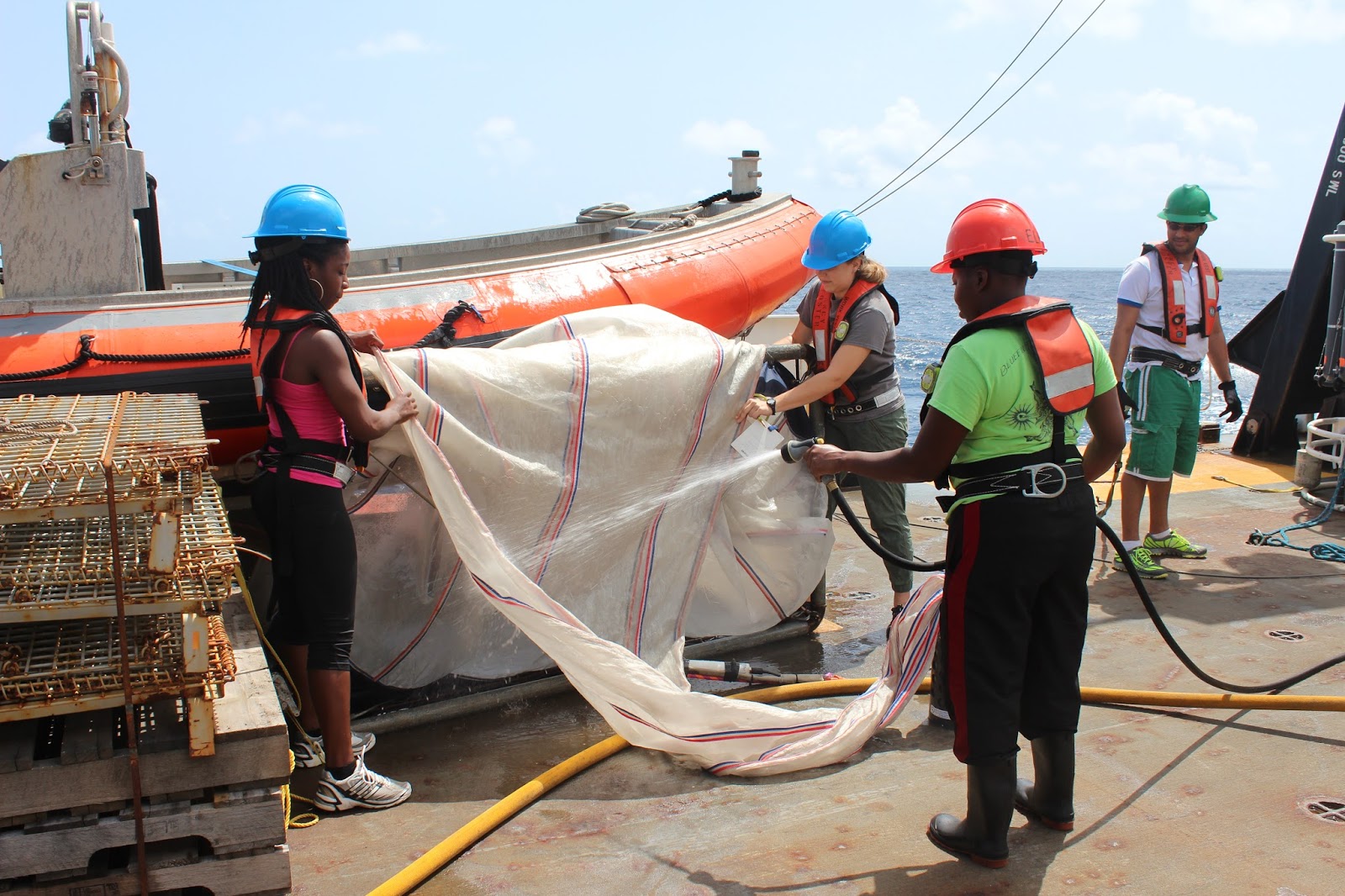
L: Angela deploys a CTD with Omar; R: Angela and Aras rinse down the mini-bongo net

"Because of my type of research I’m always behind the computer working but I really like and enjoy going out and doing some field work! This is why this experience aboard the NOAA Ship Nancy Foster is so exciting for me…. I’m going out! Finally, I have the opportunity to be in the field and learn new things. Even if I have experience working with the CTD, the best way to learn is by practicing and with this opportunity I definitely have much more experience.

Meteorology and Climate Change
workshop at US Fish & Wildlife
Service, Cabo Rojo, PR
"In my free time I enjoy going to the beach, doing some snorkeling, watching tv series and “dormir” (sleep)! But I also enjoy educating. This is why I work as marine educator in Sea Grant Puerto Rico and outreach coordinator in AECiMa (Asociación de Estudiantes de Ciencias Marinas). With all the experience and the knowledge obtained in this oceanographic expedition I definitely have more outreach activities to coordinate in my beautiful Puerto Rico. 

"Thanks for this amazing opportunity aboard the NOAA Ship Nancy Foster!" 

Thanks for reading all about our amazing guest scientists from NF1602! Keep checking back this week for some fun microscopic critters, and our final cruise post! 


Tuesday, June 21, 2016

Featured Scientists: Dan Otis and Alexis Sabine!

Today's post features two cruise veterans who joined us on the USVI Leg on last year's cruise, Dan Otis and Alexis Sabine! We are thrilled to welcome both of them back, and want to share a little more about them with you.

Dan uses a special camera to measure light reflected
from the ocean surface.
Dr. Dan Otis is a post-doc at the Institute for Marine Remote Sensing at the University of South Florida. "On land, I spend most of my time in the office downloading and processing satellite imagery of the ocean. However, it's great to get out to sea and take samples. While on cruise, I measure the color of the water using a special camera. The camera tells us how much light of each wavelength is being reflected from the ocean surface. This provides a great comparison to the satellite and allows us to calibrate sensors and develop new algorithms.

"I also filter lots of seawater on cruise to see what is absorbing and reflecting light. Both dissolved substances and particles like phytoplankton affect light in the ocean, so measuring what is actually in the water helps us interpret what we see from the satellite."

We are lucky to have Dan's expertise on board, as his optics studies bring in instruments and techniques new to our lab! Dan also has a great sense of humor and keeps us laughing all through shift! 

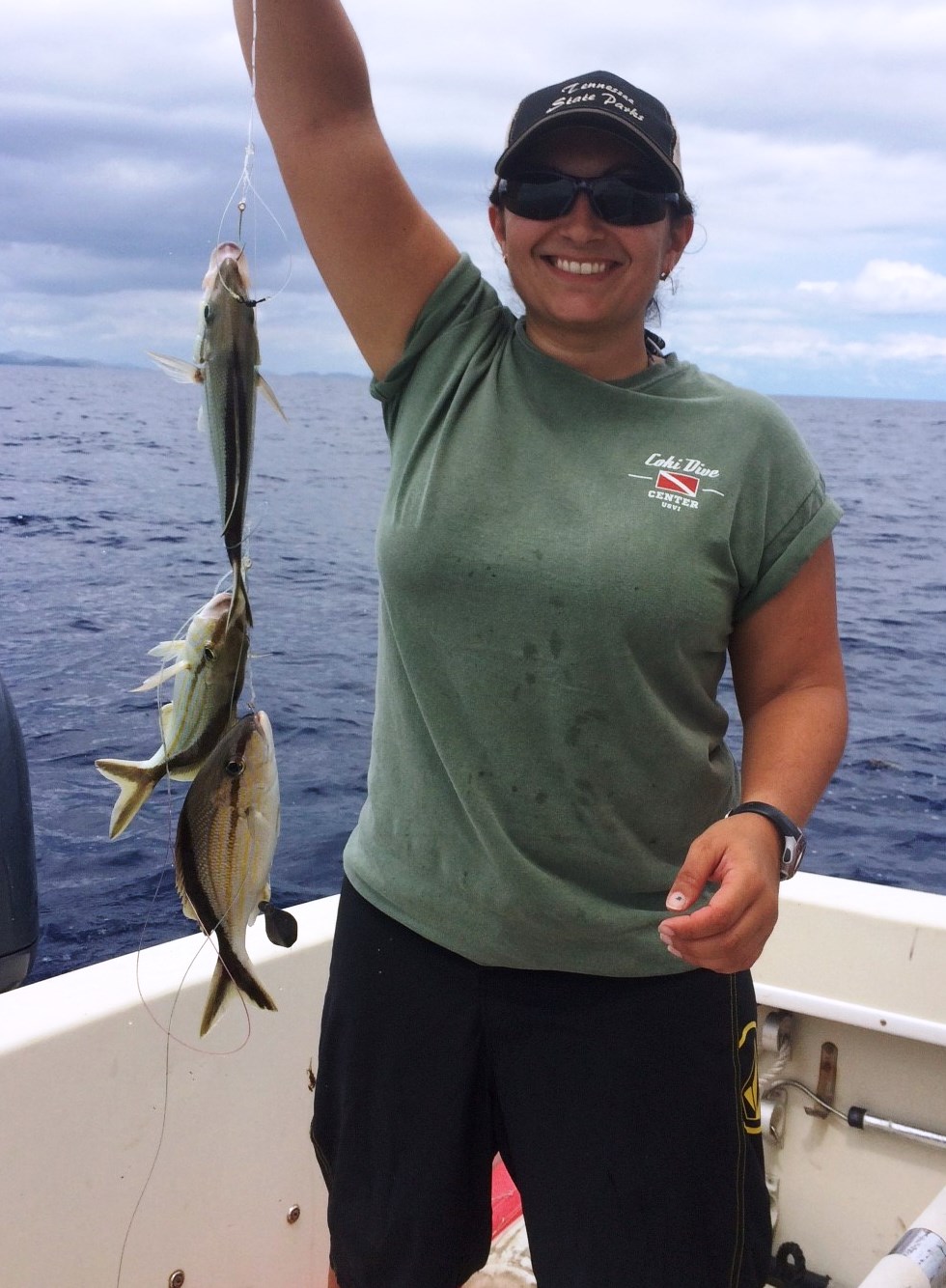
Alexis Sabine is a Fisheries Biologist at the US Virgin Islands Department of Planning and Natural Resources (DPNR), Division of Fish and Wildlife (DFW). "At the DFW, I help manage and conserve the marine and fisheries resources of the US Virgin Islands. My job consists of a variety of activities pertaining to research, monitoring, and management of the local marine environment. I am very lucky to get to do fieldwork in the beautiful tropical seas of the USVI, which includes “work” such as handline fishing for reef fish and SCUBA diving to survey fish and their associated habitats. I am based on the island of St. Thomas so most of my work is focused on the northern islands of St. Thomas and St. John, but the entire territory is managed as a whole since all the islands share the same resources.


Alexis collects reef fish during a SEAMAP sampling
project in the USVI
"I work on various projects that involve collection and management of commercial landings data and related fisheries-dependent surveys, as well as fisheries-independent assessments of populations of fish and other commercially important species in the USVI. Another large component of my job is to carry out projects that support and enhance recreational sport fish opportunities for Virgin Islanders. My work in this aspect involves deploying and monitoring Fish Aggregating Devices, which function by attracting pelagic sport fish species to anchored surface and submerged buoys. FADs have the dual benefit of alleviating some of the fishing pressure that nearshore reefs experience as well as reducing the effort anglers must expend in order to locate fish. I am also involved with maintaining public boating facilities such as recreational moorings and boat ramps and will hopefully soon be deploying some new artificial reefs around the US Virgin Islands.

"I am grateful to have participated in my first research cruise on the Nancy Foster last year, and am excited to be returning for the USVI leg this year as well. Last year I became familiar with the biological and physical techniques used on the cruise, such as the mighty MOCNESS net tows. This year I am looking forward to applying these techniques again, becoming more adept at identifying larval fish, sharing my personal knowledge about the local waters and fisheries, and learning more about the research projects being done by the different agencies represented aboard the ship. I am also looking forward to bringing this knowledge back to St. Thomas with me and sharing it with my colleagues at the Division of Fish and Wildlife."

Welcome back to the Foster, Alexis! She is incredibly passionate about her work, and not a shift goes by without intense discussions about collaborations and ideas for future projects. We love working with you throughout the year, and hope to continue to do so for many years to come!
Dan and Alexis pose on the back deck with the their Day Shift partners: L-R Mara, Sennai, Sarah, Dan, Alexis

Friday, June 17, 2016

Featured Scientists: LaTreese Denson and Sennai Habtes!

Today we'd like to introduce you to two collaborators that we've had the pleasure of working with for many years, LaTreese Denson and Sennai Habtes! 

LaTreese first teamed up with the FORCES lab in the summer of 2009 when she completed her Hollings Scholar internship in Miami. We were thrilled when she returned to Miami last year to start her PhD at the UM Rosenstiel School for Marine and Atmospheric Science (RSMAS), funded by the NOAA LMRCSC Fellowship! 
LaTreese shared with us about herself: "Since this is my first year, I currently take classes and experiment with data (e.g., fish abundance, environmental indices, etc ) and different population estimation models to help figure out what I will be using for my dissertation. At this point I basically sit inside all day and read. On the cruise, I am hoping to get more experience with data collection methods for the ecology of larval fish so that I have a better understanding of the quality of the data that is available for my population models. I also just want to be outside/at-sea.

Her research: "I am interested in modeling fish populations and the effect oceanography may have on their dynamics. Modeling fish populations and estimating their abundance is like putting together one of those insane 1000 piece puzzles with a three year old. The pieces might be everywhere or even missing, there is probably a lot of jamming of miss match pieces together and you won't finish it as soon as you thought but eventually you get close to putting the edges of the puzzle together. In the end its great because even those small steps are huge when you consider the magnitude of the problem."

We love LaTreese's passion and curiosity for marine science! Be sure to check out her personal blog as well, where she's currently sharing her own experiences on the Nancy Foster!

Dr. Sennai Habtes has been an honorary member of the FORCES lab since 2009 when he participated in the Spring SEAMAP plankton survey, and then throughout his PhD studies on larval bluefin tuna. He is now an Assistant Research Professor of Biological Oceanography at the Center for Marine and Environmental Studies (CMES) at the University of the Virgin Islands (UVI).

Read more about Sennai's research! "As a professor at UVI, my time is split evenly between research, teaching, and running the Coastal Oceanography lab for UVI-CMES. My research falls primarily within the fields of fisheries oceanography and zooplankton ecology and is focused on using time series data to study patterns in, and impacts to marine organisms in tropical and subtropical regions. This often requires the development and analysis of data products from satellite, airborne and in-situ oceanographic sensors to understand large marine ecosystems at synoptic spatial and longer temporal scales. Here at UVI I am interested in studying the physical processes and environmental variability in coastal and pelagic ecosystems surrounding the Virgin Islands and Puerto Rico, and to determine how these factors affect the abundance and distribution of marine organisms. In particular I am interested in larval fish and zooplankton, which are important life stages for most commercial and recreational fisheries. This information can be used to develop better tools for ecosystem based management and fisheries decision support systems. The Coastal Oceanography Lab or “Ocean Lab,”  is involved in a range of oceanographic research activities surrounding the USVI, including management of two coastal ocean buoy systems which are part of the CARICOOS buoy network, deployment and recovery for a host of oceanographic sensors used in conjunction with marine research for the Virgin Islands Experimental Program to Stimulate Competitive Research (VI-EPSCoR), and a time-series of zooplankton and oceanographic data used as part of an ecosystem analysis project within Brewers Bay, on St. Thomas. In addition I teach courses on Ecological Research Methods for the Masters for Marine and Environmental Studies program at UVI and a course in oceanography for the undergraduate BS/BA programs in Marine Biology and Environmental Sciences for UVI."

Goals for this cruise: "Beyond simply getting to interact with the cool and amazing scientists in the FORCES lab at NOAA SEFSC and Physical Oceanography Division at NOAA AOML, I am collecting zooplankton in conjunction with the surveys on larval reef fish to understand how oceanographic conditions affect patterns in zooplankton abundance, distribution, and community composition. In addition this data can be used to understand over time if there are changes in Caribbean zooplankton communities and to asses how this may impact larval fish habitat suitability and survival."
Sennai is excited for the waterspout that came near the ship!

We are grateful for the time we've had with LaTreese and Sennai, and look forward to collaborating with them for many years to come!

Thursday, June 16, 2016

Featured Scientists: Adrianne Wilson and Mara Duke!

We are extremely lucky to have so many partners and collaborators from around the country and globe - over the next few posts we'd like to introduce you to some of them that have joined us for Leg 3! First up, we have two graduate students who are spending some of their summers with us, Adrianne Wilson and Mara Duke! 


Adrianne Wilson is a Master's student at Florida A&M University. She is currently working on her M.S. in Environmental Science with a concentration in marine and estuarine studies. Her Master's thesis focuses on larval fish assemblages in the Gulf of Mexico. Adrianne is doing a summer internship in the FORCES lab in Miami, and we are thrilled she was able to join us for a leg of the cruise! During these two weeks at sea Adrianne hopes to learn more about the methods behind larval fish sampling, gain research cruise experience, meet cool scientists and study fish all day!


Mara Duke is a graduate student in the Masters of Marine and Environmental Science Program at University of the Virgin Islands. Her thesis research is on the connection between water quality and abundance and distribution of zooplankton in Brewers Bay in St Thomas, USVI. This is Mara's first cruise, and she hopes to gain her "sea legs" and experience on an oceanographic vessel!

Both Adrianne and Mara have already showed how valuable they are as scientists on board, and we can't wait to see what is in store for these awesome young researchers! 


via GIPHY
(Mara is preparing the plankton collected in the MOCNESS for preservation in ethanol)

Wednesday, June 15, 2016

Return to the Virgin Islands

While Legs 1 and 2 of NF1602 involved updated collection strategies, adaptive sampling, new techniques, and historic port stops, Leg 3 brings us back to some welcome familiar territory, the U.S. and British Virgin Islands! The partners at AOML/PHOD and NMFS/SEFSC have sampled these regions from 2007-2011, and again in 2015. 

Brewers Bay, St. Thomas, USVI

A plankton sample is preserved
This year, the research collaboration will focus on surveying the oceanographic conditions (using CTD, ADCP, and drifter data), larval reef fish populations (with neuston and MOCNESS net tows), and zooplankton concentrations (mini-bongo) across the coastal shelf of the U.S. Virgin Islands and the surrounding region. Data collected will help us understand the connectivity and variation in the transport and supply of reef fish larvae between managed and non-managed areas in the Virgin Islands. 

Scientist Kathryn sorts a fresh sample
We'll be sorting our plankton samples live on board, like on Legs 1 and 2. This way, we can get real-time information on fish species of interest, and freeze samples immediately so we can conduct DNA and isotope analyses on the samples. Nitrogen isotopes in these samples provide definitive biological linkages and trophic structure comparisons between fish populations. We are especially targeting larval parrotfish. These colorful species are fished locally, especially in St. Croix, USVI. From an ecosystem standpoint, herbivorous parrotfish are valuable grazers on coral reefs, feeding on competitive algae which can inhibit coral recruitment.
The two genera of parrotfish larvae we are interested in: left, Sparisoma sp., and right, Scarus sp.
We have many new faces on board this leg, so stayed tuned for some spotlights on our guest scientists and their research! For now, here's a sneak peak at what we've been up to so far...


Scientists Adrianne, Kathryn, and LaTreese rinse down the "S25" neuston net
Scientist Dan takes light measurements for his optics study
Oceanographer Ryan takes water samples from the CTD
Scientist Mara preserves a microzooplankton sample from the mini-bongo


Monday, June 13, 2016

Leg 2 Wrap Up!

"Leg 3" of the survey has officially started! Nancy, as we affectionately call the ship, departed from St. Thomas and is currently sampling in and around the US and British Virgin Islands as well as Puerto Rico for the next couple of weeks to continue our larval reef fish monitoring in the area (EST 2007-2011, 2013 and 2015!). The focus of this survey is quite different than the previous month (chasing eddies, lobsters and tunas!) and we will continue to share our journey along the way.

So to wrap up the first portion (NF1602), our Legs 1 and 2 chief scientist shared some of her thoughts:

John, our SEFSC Principle Investigator (PI) on the back deck
Evidence of our very international sci-crew
"The past month aboard the NOAA Ship Nancy Foster has been compiled with unforgettable moments! After many years of trying to have a port visit with our neighbor country (Cuba), we successfully docked in La Habana as well as in Cienfuegos!! As marine scientists, we are often ultra-focused on the science, but often the social angle gets lost in the mountains of paperwork we have to navigate to accomplish our research. Our trip to Cuba was possible thanks to many many people in the University, as well as multiple people in both of our governmental institutions - each doing their part to inch our collaborations forward. Our blog portrays the most fun aspect of going to sea, but just to set foot on the ship, A LOT happens behind the scenes!

"So without much further ado, THANK YOU to all that made the month of MAY possible! If you are one of those people reading the blog (you know who you are), we truly appreciate your efforts and hope you enjoyed the blog so far!"

We have some May photos for your enjoyment... stay tuned for most of June as Nancy returns to the eastern Caribbean!!


Miami-Cozumel (Leg 1)
L-R: Ofelia, Lulu, John, Yoandry, Raul, Aki, Grant, Jason, Matthieu, Leif, Atsushi
Front: Sarah and Estrella


Cozumel-Cienfuegos (Leg 2)
L-R: Estrella, John, Trika, David, Aki, Leif, Cati, Ofelia, Jason, Ryan
Front: Raul, Yoandry
Yoandry, Grant, Lulu, and Raul pose during a station on the back deck
Selfie!! Leg 1 scientists on the back deck at the end of the leg.
Cati, Ofelia, Raul, and Aki take in the view from the bridge deck as the ship pulls into Cienfuegos, Cuba.
L-R: John, Raul, Jason, David, Leif, Ryan, Aki, Trika, Cati, Ofelia, and Estrella in Cienfuegos.

Thursday, June 9, 2016

Featured Scientist: Catalina "Cati" Mena Oliver

Although we are starting to sample in the eastern Caribbean, today's blog features a 'leg 2' participant: Cati! 
Picoplankton and the microbial food web (from Johnson and Lin, 2009)
Processing plankton samples
Catalina Mena Oliver (Cati) joined us in Cozumel back in May to specifically sample picoplankton during Leg 2. Catalina is a PhD student from the Spanish Institute of Oceanography (Oceanographic Centre of  Baleares - Larval Ecology Group), and she is developing her Doctoral Thesis studying the base of the planktonic food web with special interest in the bacterioplankton communities (picoplankton). 
Dynamic oceanographic currents of the western MED
(Balbin et al 2014)
Picophytoplankton (~0.2 to 2 µm) are the smallest autotrophic organisms on Earth and in stratified oligotrophic regions (like the Mediterranean and the Caribbean) can be a key component as biomass source. During our survey we aim to link the community of primary producers to eddy structures, since these communities can be highly influenced by mesoscale dynamics and by changes in resource supply. The phytoplankton size structure and the relative contribution of the different phytoplankton size fractions in terms of carbon biomass strongly affect the carbon transfer and the ecosystem functioning.
Cati shares her research with the science team
Cati shared with our blog: “I am very grateful to FORCES Lab from SEFSC-NOAA to give me the opportunity to participate in the Nancy Foster survey and I hope we could continue this collaboration in the future. The results obtained will help us to assess if the ecosystem is supported by a microbial food web, dominated by the picophytoplankton fraction, which might be crucial as food source not only for bluefin tuna larval ecology but also for other many species”.
We enjoyed to have Cati aboard and hope that she will sail again with us! We look forward to sharing her results in the future with you our loyal reader! 

Trying on the safety suit! (Cati is a LOBSTER)