Showing posts with label habitat. Show all posts

Tuesday, May 30, 2017

Featured Scientist: Tom Kelly

Today we learn about Tom who shares his insights into the infamous sediment trap! Here is his blog post. (Read previous guest posts here!)

Tom and the incubation system
My name is Thomas Kelly and I am a PhD Candidate at Florida State University in the Plankton Ecology and Biogeochemistry Lab. One of the principal tools that I use in my research is called a sediment trap. A sediment trap collects marine particles and organisms as they sink through the water column. You can think of a sediment trap as an underwater rain gauge that collects sinking plankton instead of falling rain drops.

Since most of the biological growth occurs where light is plentiful (i.e. photosynthesis), the majority of marine organisms live within the surface layers of the oceans. But as these organisms die, get broken up, or defecate, particles settle out of the surface layer and into the deeper ocean. Our sediment traps are placed in between these layers and can tell us about what kind and how quickly carbon, nutrients, and other material leaves the surface ecosystem.
Tom and Mike deploy the sediment trap


The deployment of the sediment trap is really quite straightforward and will typically take a bit over an hour. The whole assembly consists of a long rope that extends from the surface all the way down to the depth of the last sediment trap frame (Pictured to the left), about 650 (210m) feet. At the bottom we place 60 lbs (27 kg) of weights and at the top a set of buoys. For the Bluefin Tuna Cruise the sediment trap frames are placed at approximately 150, 400, and 600ft (50, 120, and 200m) of water depth so that we can measure how the sinking of particles changes with depth.

Onto the frame we attach a set of tubes filled with extra salty seawater so that any particles that sink into them will stay in the tube rather than being mixed out again (the denser fluid will stay inside the tube just like a glass of water will stay inside a cup). Besides that, the tubes are also spiked with formaldehyde to kill anything that tries to eat the sinking material and a baffle at the top to reduce turbulence around the top of the tube.

Tom plots his next filtration experiment
After 3-5 days of drifting, the sediment trap is ready to come aboard and be processed. In general, each of the sampling tubes is filtered and frozen for later processing on land where we can look at such things as the carbon and nitrogen content. Some of the specialized aspects that we can look at from the sediment traps include the size classes of the particles collected, the source of the material collected, and the quantity of various metals and nutrients within the material. Ultimately the sediment trap provides invaluable information about how the ecosystem looses energy and material to the deeper water column.

Friday, May 12, 2017

Return of the Tuna!

And....we're back! Back in the Gulf of Mexico (GoM), on the hunt for larval bluefin tuna (BFT)! The next two legs of our survey will be focused on finding patches of bluefin larvae (Thunnus thynnus), and studying the biogeochemical habitat in which we find them. We are joined by some familiar collaborators from the University of Miami-RSMAS, El Colegio de la Frontera Sur (ECOSUR), and the Spanish Institute of Oceanography (IEO), as well as some new team members!

A glimpse of some of the new equipment we'll be using!
Why is this important? Well, you may know that BFT are one of the mostly highly sought after fish in the commercial industry, as they are large, delicious, and highly valuable. But this also means that they are being over exploited - which means that the levels at which they are currently fished are not sustainable long-term. Atlantic BFT are highly migratory species (HMS), distributed throughout the northern Atlantic Ocean. However, they migrate south to the GoM and the Mediterranean Sea to spawn only once a year during the summer months.

The FORCES lab studies the early life stages of tunas in order to tell their "origin story." Why do the adults travel miles and miles to this specific area? Are there certain oceanic features that provide a protective nursery habitat for the larvae and increase their chances for survival? Are there certain biochemical gradients in these waters that help the larvae grow faster or more fit for surviving the pelagic environment? How will forecasted changes in this environment affect larvae in the coming decades?

LOTS of water filtration will be involved!
We are incredibly excited to be embarking upon a brand new set of surveys with several new partners in order to start to answer some of these questions.  We even more thrilled that our new research team was selected as one of the few projects funded by the NOAA RESTORE Act Science Program! This Science Program funds "research, observation, and monitoring to support long-term sustainability in the GoM ecosystem, including fish stocks, fish habitat, and fishing industries" (for more on the program, click here). The FORCES Lab at the NOAA Southeast Fisheries Science Center teamed up with Scripps Institute of Oceanography, Florida State University, and the University of Hawaii at Manoa to examine the "Effects of nitrogen sources and plankton food web dynamics on habitat quality for larval BFT."  Together, we will use net tows, satellite data, oceanographic models, and drifters, to find patches of bluefin tuna larvae in the GoM and then we will follow these patches over the next few days. Every day we will sample (around the clock!) the in situ conditions and characteristics of the patch, in order to obtain a bottom-up understanding of BFT recruitment in the GoM. We will share with you more as we keep drifting with the tunas!

We can't wait to share this new journey with you!

Don't worry, we'll still show you loads of sunsets at sea


Thursday, June 23, 2016

Parrotfish: Coral Reef Vegetarians

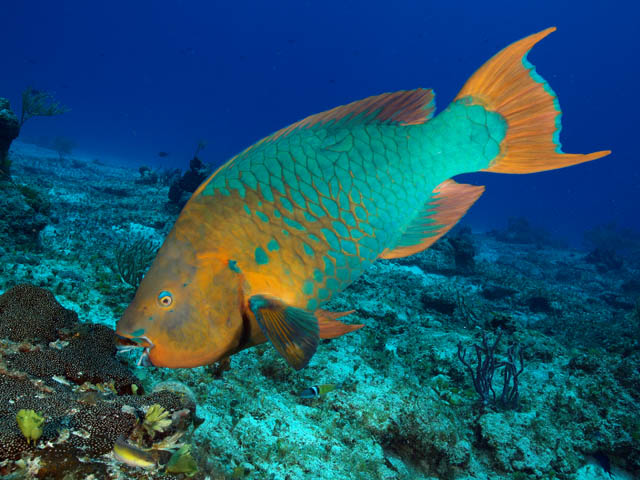
A rainbow parrotfish grazing on algae in the Caribbean
Photo source: CFMC, caribbeanfmc.com/fmp_reef_fish.html
Parrotfish are one of the most universally recognized reef fish, with their bright colors and beautiful varieties. If you've ever been snorkeling or SCUBA diving on a reef, you've probably easily spotted parrotfish swimming around, biting off pieces of coral - wait, biting coral? Isn't that bad for it? Aren't corals endangered?

Believe it or not, this "grazing" behavior is actually really good for coral reefs! Parrotfish are herbivores, which means that they eat only plant matter, not other fish, and when you see them biting at the coral, they are actually eating the algae that are growing there. This allows the living part of coral reefs, the polyps, to expand and grow, making the reef bigger and stronger. Without the parrotfish to remove the algae, the polyps would be smothered and eventually die! 

Parrotfish (along with snapper) for
sale in a Caribbean grocery store
Parrotfish are also important sources of food for many Caribbean islands. In the US Virgin Islands, the people of St. Croix especially love fishing and eating parrotfish. Managers must carefully assess the health of the parrotfish stock, due to this fishing demand.

On Leg 3 of our cruise, we are specifically targeting parrotfish larvae for the first time! We want to know where these fish are being spawned, retained, and/or transported, and what differences exist between the St. Thomas/St. John and St. Croix populations.

In the Virgin Islands, we mainly find two genera of parrotfish: Sparisoma and Scarus. Within these genera are more than a dozen different species, like midnight, rainbow, stoplight, queen, and princess parrotfish. Our taxonomists look at the fish's body shape, pigment patterns, and number of fin rays to determine which genus they find. Unfortunately we can't identify all these species at the larval stage with only a microscope (keep reading to find out how we can!). 

Taxonomists carefully collect the sample after a net tow and keep it on ice, then pick through the sample under a microscope, looking for fish larvae - live and on the ship! If we find any parrotfish larvae, they are identified to genus, measured, and then preserved based on the type of future analysis to be conducted. Some larvae are frozen in liquid nitrogen (about -340° F!) so that we can measure their stable carbon and nitrogen isotopes. Other larvae are preserved in refrigerated ethanol to keep their DNA pristine, which can be sequenced to identify the species of each fish, and what population it belongs to!
The two main genera in the Caribbean: Sparisoma (top), ~9mm SL, and Scarus (bottom), ~7mm SL.
Can you spot the differences between the two genera? (HINT: look at the pigments!)
So far, we've found over 300 parrotfish larvae in our samples! We can't wait to get back to the lab to see how many more we caught, and to discover more about the ecology and biology of these beautiful fish! 

Wednesday, June 15, 2016

Return to the Virgin Islands

While Legs 1 and 2 of NF1602 involved updated collection strategies, adaptive sampling, new techniques, and historic port stops, Leg 3 brings us back to some welcome familiar territory, the U.S. and British Virgin Islands! The partners at AOML/PHOD and NMFS/SEFSC have sampled these regions from 2007-2011, and again in 2015

Brewers Bay, St. Thomas, USVI

A plankton sample is preserved
This year, the research collaboration will focus on surveying the oceanographic conditions (using CTD, ADCP, and drifter data), larval reef fish populations (with neuston and MOCNESS net tows), and zooplankton concentrations (mini-bongo) across the coastal shelf of the U.S. Virgin Islands and the surrounding region. Data collected will help us understand the connectivity and variation in the transport and supply of reef fish larvae between managed and non-managed areas in the Virgin Islands. 

Scientist Kathryn sorts a fresh sample
We'll be sorting our plankton samples live on board, like on Legs 1 and 2. This way, we can get real-time information on fish species of interest, and freeze samples immediately so we can conduct DNA and isotope analyses on the samples. Nitrogen isotopes in these samples provide definitive biological linkages and trophic structure comparisons between fish populations. We are especially targeting larval parrotfish. These colorful species are fished locally, especially in St. Croix, USVI. From an ecosystem standpoint, herbivorous parrotfish are valuable grazers on coral reefs, feeding on competitive algae which can inhibit coral recruitment.
The two genera of parrotfish larvae we are interested in: left, Sparisoma sp., and right, Scarus sp.
We have many new faces on board this leg, so stayed tuned for some spotlights on our guest scientists and their research! For now, here's a sneak peak at what we've been up to so far...


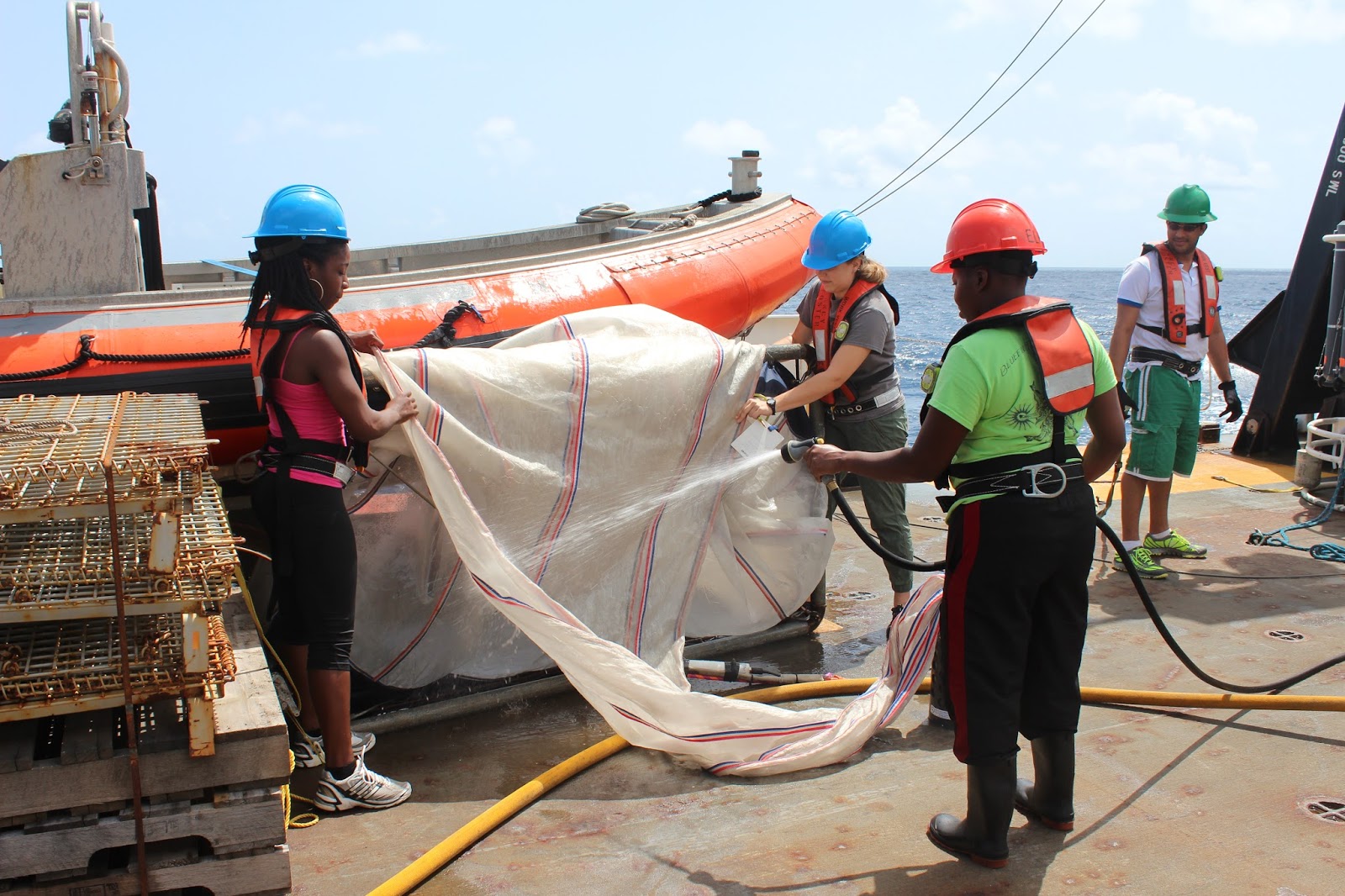
Scientists Adrianne, Kathryn, and LaTreese rinse down the "S25" neuston net
Scientist Dan takes light measurements for his optics study
Oceanographer Ryan takes water samples from the CTD
Scientist Mara preserves a microzooplankton sample from the mini-bongo


Wednesday, June 8, 2016

Featured Scientist: Dr. Raul Laiz Carrion!

Dear reader, today we feature a guest post by Dr. Raul Laiz Carrion. Please scroll down for English. 
Raul and Lulu collect plankton

En esta campaña NF1602, somos muy afortunados de nuevamente contar con la participación del Investigador del Centro Oceanográfico de Málaga del Instituto Español de Oceanografía (IEO) el Dr. Raul Laiz-Carrión! Raul se ha convertido en un “clásico” de nuestro equipo de trabajo en las campañas de investigación del Mar Caribe, gracias a la estrecha colaboración que existe entre el IEO y el FORCES Lab del SEFSC-NOAA. 


Measuring fish before freezing them in Liquid Nitrogen
Esta fructífera colaboración entre las dos instituciones ha dado lugar a que actualmente se haya conseguido financiación de la Secretaria de Estado de Investigación,  Desarrollo e Investigación del Ministerio de Economía y Competitividad de España para realizar el proyecto ECOLATUN (CTM2015-68473-R-MINECO/FEDER), titulado: “ECOLOGIA TROFICA COMPARATIVA DE LARVAS DE ATUN ROJO ATLANTICO (THUNNUS THYNNUS) DE LAS AREAS DE PUESTA DEL MEDTERRANEO-NO Y EL GOLFO DE MEXICO.”


El principal interés del Dr. Laiz-Carrión se centra en la ecología larvaria de 
especies de especial interés no solo desde el punto de vista económico sino fundamentalmente ecológico, como puede es el atún rojo. En los últimos años ha centrado sus investigaciones en tratar de explicar la variabilidad en el crecimiento a través de las diferentes estrategias tróficas en estadios de temprana edad... “Pequeñas variaciones en el crecimiento pueden originar grandes cambios en la supervivencia larvaria y por consiguiente en el reclutamiento de la especie. 


PI Lamkin and PI Laiz-Carrion 
Tratamos de entender estas variaciones en el crecimiento no solo con la caracterización de los diferentes hábitats de puesta, sino también entendiendo la ecología trófica de la especie objeto de estudio y su interacción con otras especies que la acompañan y con las que puede compartir los recursos alimenticios a lo largo de la cadena trófica. Todo esto lo abordamos desde el punto de vista comparativo entre el Golfo de México y áreas adyacentes y las aguas del Mar Balear del Mediterráneo. Para abordar este proyecto tan ilusionante, es una verdadera suerte el poder contar con la participación y el apoyo de expertos de reconocido prestigio internacional de diferentes instituciones americanas (NOAA, Univ. of Miami/CIMAS, CUNY, WHOI), mexicanas (ECOSUR) y españolas (IEO).”

A brief summary in English:

Raul processes data from the Mini-Bongo net
During this research survey (NF1602) we are lucky to once again have the participation of Dr. Raul Laiz-Carrión, a researcher from the Centro Oceanográfico de Málaga del Instituto Español de Oceanografía (IEO). Raul has become a “classic” member of our team during our Gulf/Caribbean surveys as a result of the close-collaborations between his Lab at the IEO and the NOAA NMFS FORCES Lab. Our productive collaboration has proven effective as we recently awarded a proposal from the Research Ministry of Spain (Secretaria de Estado de Investigación,  Desarrollo e Investigación del Ministerio de Economía y Competitividad de España) in a project titled: “Comparative trophic ecology of bluefin tuna (Thunnus thynnus) in spawning areas in the Northwest Mediterranean and the Gulf of Mexico.”


Raul’s research is focused on the larval ecology for species of interest (not just from a commercial emphasis, but mainly from an ecological context). In the last few years, Raul’s work has investigated the natural variability in growth by examining trophic strategies during the earliest larval stages. Recently we have compared the Balearic Sea (Mediterranean) with the Gulf of Mexico thanks to our multidisciplinary and international support from NOAA, UM/CIMAS, CUNY, WHOI, ECOSUR (Mexico), IEO (Spain).