Showing posts with label FSU. Show all posts

Tuesday, June 19, 2018

A better late than never post for #NF1802, Dr. Stukel #ontheblog

Stukel sets up the satellite-tracker inside the buoys
Although NF1802 has come to an end, we will continue to post for the rest of the summer! Stay tuned!

Today, Dr. Mike Stukel joins us once again on the blog! Mike is an Assistant Professor at Florida State University and one of the PIs on our joint NOAA RESTORE Science project. His PhD students, Tom and Taylor joined him in this survey.


“I study the intersection of plankton ecology and biogeochemistry.  I have a fascination for all of the microscopic critters (plankton) that drift constantly with the currents of the open ocean.  Much of my research focuses on either the role of plankton in converting carbon dioxide to organic matter and then storing that organic matter in the deep ocean (a process referred to as the biological pump) or determining how changes in the planktonic ecosystem affect the availability of prey for fish and other large organisms. During this project, my research goal is to understand how biogeochemical and ecological interactions at the base of the food web affect the survival of larval tuna.
The golden tufts in the bottom left are Trichodesmium, the long organism in the middle is a chaetognath, and many of the out-of-focus blobs are copepods
Specifically, I'm interested in two questions:

  1. What processes supply nutrients to the algae at the base of the food web (upwelling that introduces deep nutrients to the surface ocean or nitrogen fixation that converts abundant nitrogen gas into plankton fuel)?  
  2. How does the structure of the planktonic food web affect the efficiency with which primary production is converted to zooplankton biomass (i.e. fish food)?  
Illustration by Sabine and Baxter

On this cruise, one of my lab’s goals is to make simultaneous measurements of nitrate uptake and nitrogen fixation in tuna spawning habitat."

Mike looks for microscopic organisms in between stations
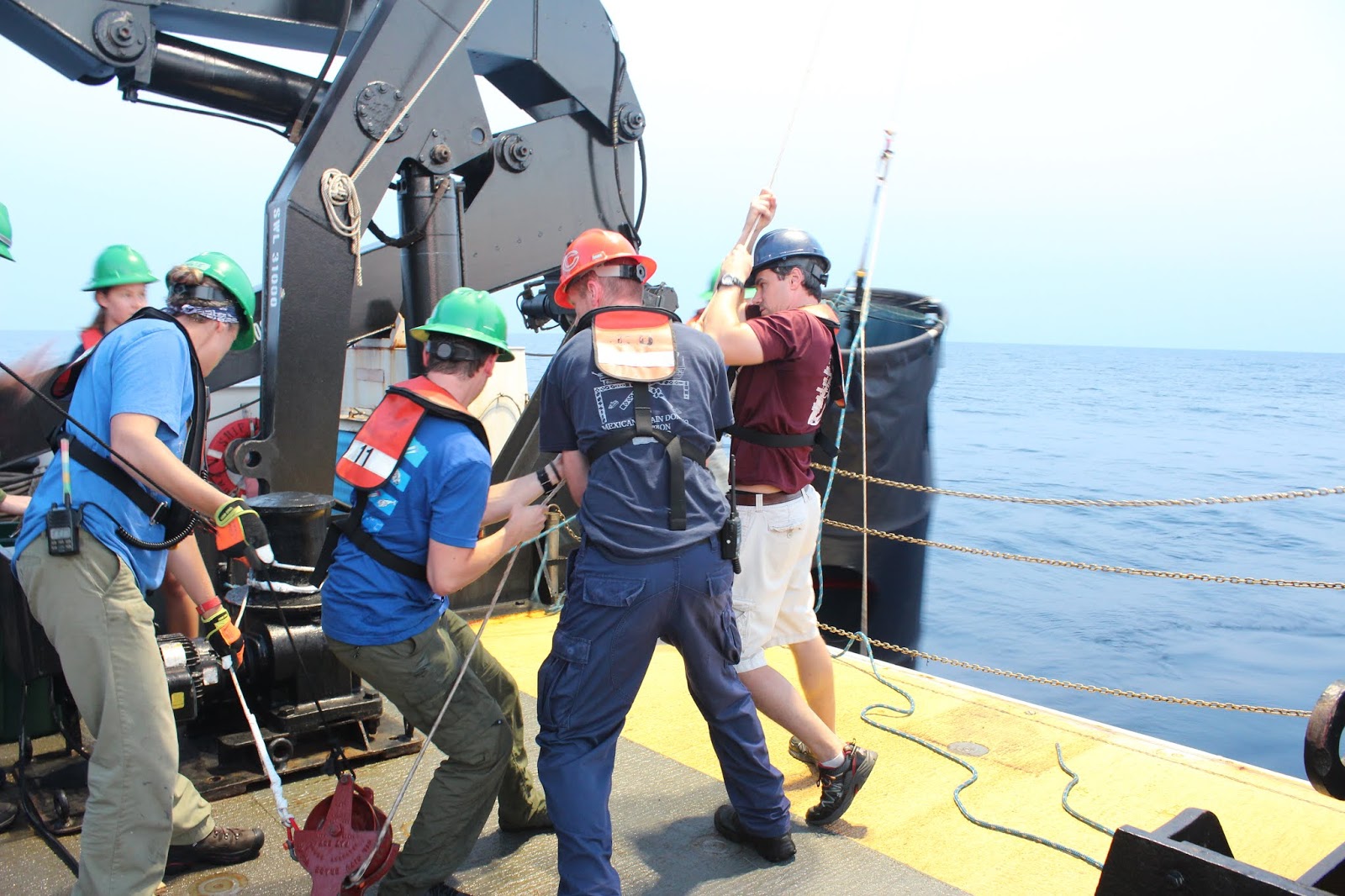
Stukel and the team during sediment trap operations on the back-deck
If you are a teacher or student and want to learn more about plankton, check out Mike's lab's website and this link and has lesson plan too!) developed by Ms. Colleen Miks.

Friday, May 25, 2018

PhD student Rachel Thomas on the blog!

Rachel filters water collected at 500 m in the GOM
Rachel Thomas from Florida State University's Earth Ocean and Atmospheric Sciences Department is a doctoral student in the Knapp Lab and she is our guest-blogger today sharing a bit of her research and cruise goals:

"My personal goal on this cruise is to be able to identify bluefin tuna through a microscope. I’ve never seen fish larvae before, so everything the “fish team” brings up in the nets is new and exciting to me! Most of my previous work is involved in the Southern Ocean, where there are unused nutrients in the surface ocean. This gives us a unique ability to look at how phytoplankton are reacting to different physiological stresses, such as light and nutrient availability."
One of these nutrients, is Nitrate (NO3) which is a form of dissolved inorganic nitrogen that is utilized by phytoplankton in the ocean (Malerba et al 2012). One of the aspects of our project (NF1704 & NF1802 is to examine the dynamics between these inorganic compounds at different depths of the surface water column (0-500 m).

Typical nitrate vertical profile comparison, (modified from A. Nahian Avro)
T. Kelly and Rachel Thomas recover the CTD rosette 
"The Gulf of Mexico has a very different light regime compared to the Southern Ocean, and little to no nitrate in the surface waters. Our research team hopes to explore how these contrasts are expressed in the isotopic composition of subsurface nitrate in the Gulf of Mexico. We will also use the isotopic composition of subsurface nitrate in the Gulf of Mexico to understand the nutrient sources for primary productivity fueling bluefin tuna growth in surface waters." 

Click here for last year's blog post from Rachel's experiences during NF1704.

A bit of trivia: the Southern Ocean is the fourth largest of the world's ocean basins and extends to Antarctica. Psst, how many oceans are there? (click here for an answer)

Rachel Thomas and Alanna Mnich ready to deploy an SVP drifter on the fan tail

Friday, June 2, 2017

Featured Scientist: Rachel Thomas

Today on the blog, we have a guest post from Rachel Thomas, learn about her research objectives during this survey in the Gulf of Mexico!
Rachel takes the CTD down to 2500m in the Gulf of Mexico!
My name is Rachel Thomas and I’m a PhD student at Florida State University studying the marine nitrogen cycle with the Knapp Lab.
Filtering sea water
On this cruise, I am looking at the concentrations of nitrate, a nutrient required by primary producers, found in the upper 300 meters of the water column. Water samples are prepared using a colorimetric technique that will turn the water varying degrees of pink, depending on concentration, and analyzed at a certain wavelength. I am also collecting water samples from various depths ranging from a depth of 2500 meters and 3 meters below the surface. These samples will be taken back to FSU where we will look at the different nitrogen isotope signatures found in the water parcel.

Rachel examines nitrate concentrations
Think of an isotope signature as a fingerprint, where each source of nitrogen has its own unique fingerprint. By comparing the known signatures of each source to our water parcel, we will be able to determine where the nitrogen is coming from.
Collecting water from the CTD rosette 
It is important to understand where these nutrients are coming from to fuel primary producers in order to better understand how changes in nutrient sources will affect the GOM productivity.

Tuesday, May 30, 2017

Featured Scientist: Tom Kelly

Today we learn about Tom who shares his insights into the infamous sediment trap! Here is his blog post. (Read previous guest posts here!)

Tom and the incubation system
My name is Thomas Kelly and I am a PhD Candidate at Florida State University in the Plankton Ecology and Biogeochemistry Lab. One of the principal tools that I use in my research is called a sediment trap. A sediment trap collects marine particles and organisms as they sink through the water column. You can think of a sediment trap as an underwater rain gauge that collects sinking plankton instead of falling rain drops.

Since most of the biological growth occurs where light is plentiful (i.e. photosynthesis), the majority of marine organisms live within the surface layers of the oceans. But as these organisms die, get broken up, or defecate, particles settle out of the surface layer and into the deeper ocean. Our sediment traps are placed in between these layers and can tell us about what kind and how quickly carbon, nutrients, and other material leaves the surface ecosystem.
Tom and Mike deploy the sediment trap


The deployment of the sediment trap is really quite straightforward and will typically take a bit over an hour. The whole assembly consists of a long rope that extends from the surface all the way down to the depth of the last sediment trap frame (Pictured to the left), about 650 (210m) feet. At the bottom we place 60 lbs (27 kg) of weights and at the top a set of buoys. For the Bluefin Tuna Cruise the sediment trap frames are placed at approximately 150, 400, and 600ft (50, 120, and 200m) of water depth so that we can measure how the sinking of particles changes with depth.

Onto the frame we attach a set of tubes filled with extra salty seawater so that any particles that sink into them will stay in the tube rather than being mixed out again (the denser fluid will stay inside the tube just like a glass of water will stay inside a cup). Besides that, the tubes are also spiked with formaldehyde to kill anything that tries to eat the sinking material and a baffle at the top to reduce turbulence around the top of the tube.

Tom plots his next filtration experiment
After 3-5 days of drifting, the sediment trap is ready to come aboard and be processed. In general, each of the sampling tubes is filtered and frozen for later processing on land where we can look at such things as the carbon and nitrogen content. Some of the specialized aspects that we can look at from the sediment traps include the size classes of the particles collected, the source of the material collected, and the quantity of various metals and nutrients within the material. Ultimately the sediment trap provides invaluable information about how the ecosystem looses energy and material to the deeper water column.

Tuesday, May 23, 2017

Featured Scientist: Meet Mike!

This year's voyage is the first of two annual research surveys in the Gulf of Mexico for the NOAA RESTORE Act Science Program. Our project, "Research, observation, and monitoring to support long-term sustainability in the GoM ecosystem, including fish stocks, fish habitat, and fishing industries," is in collaboration with some new partners to the FORCES Lab. Read on and get introduced to the project's PI from Florida State University, Mike Stukel!

Mike prepares sample bottles to be loaded into the sediment trap
My name is Mike Stukel, and I am an assistant professor at Florida State University. I am a plankton ecologist and biogeochemist in the FSU Plankton Ecology and Biochemistry Lab. I study the role that some of the smallest organisms in the ocean play in the global carbon cycle and their role in removing carbon dioxide from the atmosphere. On this cruise, I am studying the role that different nutrients play in limiting the primary production of phytoplankton. These tiny algae are responsible for half of the world’s photosynthesis and half of the oxygen that you breathe. Their photosynthesis also supports the entire marine ecosystem of the open ocean Gulf of Mexico. One of my goals in this project is to quantify the food web pathways that partition this phytoplankton production between either the biological pump (which transports atmospheric CO2 into the deep ocean where it can be stored for centuries) or higher trophic levels including larval tuna. 

Mike and Tom (R) with their double-decker water filtrations!
My goal for this cruise is to understand the base of the food web that supports larval tuna.  In particular, I am interested in whether the algae responsible for photosynthesis are ultimately getting their nutrients from upwelling that brings nutrient-rich deep water into the sunlit surface zone or whether special phytoplankton (called Nitrogen-fixers) are creating their own nutrients from the nitrogen gas that is abundant in the atmosphere and ocean.  Answering this question is important to understanding whether or not total productivity in the Gulf of Mexico will decrease due to climate change.

Mike deploys the drifter array in the wee hours of the morning


Friday, May 12, 2017

Return of the Tuna!

And....we're back! Back in the Gulf of Mexico (GoM), on the hunt for larval bluefin tuna (BFT)! The next two legs of our survey will be focused on finding patches of bluefin larvae (Thunnus thynnus), and studying the biogeochemical habitat in which we find them. We are joined by some familiar collaborators from the University of Miami-RSMAS, El Colegio de la Frontera Sur (ECOSUR), and the Spanish Institute of Oceanography (IEO), as well as some new team members!

A glimpse of some of the new equipment we'll be using!
Why is this important? Well, you may know that BFT are one of the mostly highly sought after fish in the commercial industry, as they are large, delicious, and highly valuable. But this also means that they are being over exploited - which means that the levels at which they are currently fished are not sustainable long-term. Atlantic BFT are highly migratory species (HMS), distributed throughout the northern Atlantic Ocean. However, they migrate south to the GoM and the Mediterranean Sea to spawn only once a year during the summer months.

The FORCES lab studies the early life stages of tunas in order to tell their "origin story." Why do the adults travel miles and miles to this specific area? Are there certain oceanic features that provide a protective nursery habitat for the larvae and increase their chances for survival? Are there certain biochemical gradients in these waters that help the larvae grow faster or more fit for surviving the pelagic environment? How will forecasted changes in this environment affect larvae in the coming decades?

LOTS of water filtration will be involved!
We are incredibly excited to be embarking upon a brand new set of surveys with several new partners in order to start to answer some of these questions.  We even more thrilled that our new research team was selected as one of the few projects funded by the NOAA RESTORE Act Science Program! This Science Program funds "research, observation, and monitoring to support long-term sustainability in the GoM ecosystem, including fish stocks, fish habitat, and fishing industries" (for more on the program, click here). The FORCES Lab at the NOAA Southeast Fisheries Science Center teamed up with Scripps Institute of Oceanography, Florida State University, and the University of Hawaii at Manoa to examine the "Effects of nitrogen sources and plankton food web dynamics on habitat quality for larval BFT."  Together, we will use net tows, satellite data, oceanographic models, and drifters, to find patches of bluefin tuna larvae in the GoM and then we will follow these patches over the next few days. Every day we will sample (around the clock!) the in situ conditions and characteristics of the patch, in order to obtain a bottom-up understanding of BFT recruitment in the GoM. We will share with you more as we keep drifting with the tunas!

We can't wait to share this new journey with you!

Don't worry, we'll still show you loads of sunsets at sea