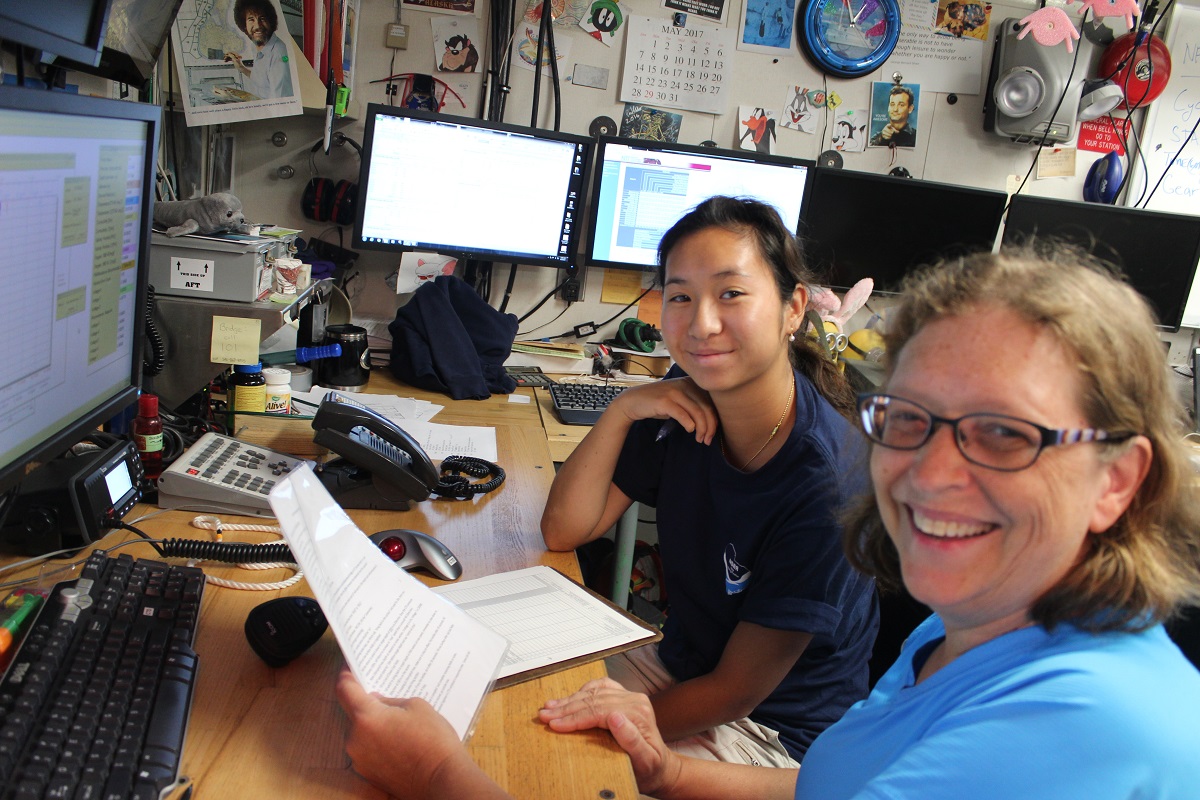
Rachel filters water collected at 500 m in the GOM
Rachel Thomas from Florida State University's Earth Ocean and Atmospheric Sciences Department is a doctoral student in the Knapp Lab and she is our guest-blogger today sharing a bit of her research and cruise goals:
"My personal goal on this cruise is to be able to identify bluefin tuna through a microscope. I’ve never seen fish larvae before, so everything the “fish team” brings up in the nets is new and exciting to me! Most of my previous work is involved in the Southern Ocean, where there are unused nutrients in the surface ocean. This gives us a unique ability to look at how phytoplankton are reacting to different physiological stresses, such as light and nutrient availability."
One of these nutrients, is Nitrate (NO3) which is a form of dissolved inorganic nitrogen that is utilized by phytoplankton in the ocean (Malerba et al 2012). One of the aspects of our project (NF1704 & NF1802 is to examine the dynamics between these inorganic compounds at different depths of the surface water column (0-500 m).
Typical nitrate vertical profile comparison, (modified from A. Nahian Avro)
T. Kelly and Rachel Thomas recover the CTD rosette
"The Gulf of Mexico has a very different light regime compared to the Southern Ocean, and little to no nitrate in the surface waters. Our research team hopes to explore how these contrasts are expressed in the isotopic composition of subsurface nitrate in the Gulf of Mexico. We will also use the isotopic composition of subsurface nitrate in the Gulf of Mexico to understand the nutrient sources for primary productivity fueling bluefin tuna growth in surface waters."
Click here for last year's blog post from Rachel's experiences during NF1704.
A bit of trivia: the Southern Ocean is the fourth largest of the world's ocean basins and extends to Antarctica. Psst, how many oceans are there? (click here for an answer)
Rachel Thomas and Alanna Mnich ready to deploy an SVP drifter on the fan tail
Today’s post features LTJG Nikita "Niki" Norton, and officially welcomes her
to the FORCES Lab family! Niki is the current "Florida Bay Operations Officer," replacing LTJG
Aras Zygas. As a part of
the NOAA Commissioned Officer Corps, she operates sampling platforms to
facilitate scientific research and provides logistical and administrative
support to NOAA’s mission. She shared with the blog:
Niki records the flowmeter data into our logsheets
"For the last
three years, I was assigned to the NOAA Ship Bell M. Shimada out of Newport, Oregon, conducting fisheries surveys from
Vancouver, Canada all the way down to San Diego, CA. Along with the responsibilities of being
Navigation Officer and Medical Person in Charge, my primary duty was to
“drive” the 210’ Fisheries Survey Vessel every day for 200+ days a year
Niki and Loni on the back deck, waiting to deploy the CTD
"Many of the sampling techniques that are routinely performed
by research groups on the West Coast to collect plankton are exactly the same
as those conducted by the FORCES lab to collect larval fish!
"This included
Bongos, Neustons, MOCNESS, and CTDs on many of the projects. We performed extensive mid-water stern
trawls with a net the size of a football field to catch fish like Pacific hake
and sardine. We followed and tagged endangered Resident Killer Whale pods and
acoustically monitored beaked whales at 4000m depth. The remainder of the year, the ship completed Remotely Operated Vehicle (ROV) transects and hydrographic missions in the Farallons and Channel Islands.
Niki and Estrella deploy a satellite tracked drifter
"While many of the operations may be the same, this new job
with the Southeast Fisheries Science Center is quite different - as is the
scenery! Rather than the whipping cold
wind of the Pacific Northwest, the hot sun in the Caribbean and Gulf of Mexico
is one of my favorite parts of the job. With the FORCES Lab, I get to work "on deck" to deploy and recover gear, wash down nets, assist with station planning, and see the plankton and water samples we catch up close!
NOAA Ship Nancy Foster, Brewers Bay, USVI
"When I am not underway as a
scientist, I work in the office to ensure that the lab has everything they
need logistically to sail each year by assisting with cruise planning and administrative
budgeting. Now that the first year of
sampling has come to a close, I am very excited to see what new projects I will get to be a part of and hope to use my background in reef fish ecology
and microbiology to explore new research with the FORCES lab – while getting ready
for next year!"
Girl Power! The women behind the science in NF1703!
Top (L-R): Sarah H., Niki, Trika, Sarah P.
Bottom (L-R): Kristen, Vanessa, Jess, Alexis
Before we return back to our corresponding labs, and start to process our samples, we have one more post from one of our collaborators! Dr. Bob Arnone was part of the land-support team which guided our survey with satellite updates and oceanographic analyses of daily conditions. The GOM is a very large and dynamic ecosystem and we can use all the help we can get! Bob and two post-doctoral researchers (Brooke Jones and Inia Soto) prepared a blog post to share some of their work at the University of Southern Mississippi. I hope you enjoy it and next year, we encourage our collaborators to do joint posts like this one to share their land based work as well!
Robert Arnone and Brooke Jones in the OWX showing the cruise track
of the Nancy Foster in the Gulf of Mexico and the daily ocean conditions
"We are Prof. Robert Arnone, Dr. Brooke Jones, and Dr. Inia Soto from the University of Southern Mississippi, Division of Marine Science, Stennis Space Center. Our Ocean Weather Laboratory (OWX) was able to work with the researchers aboard the Nancy Foster during the RESTORE Bluefin tuna survey (NF1704) this past May and early June 2017. We provided daily updates on relevant ocean conditions while we followed the ship's cruise track as well as abnormal conditions that might affect the research results. Many of the ocean products we provided are new, and working with the Foster cruise allowed us to compare the observations from our lab with ship observations. Our goal is to demonstrate that our daily ocean products can provide the Foster a better understanding of sampling for Bluefin tuna. We want to continue to work with the research group to optimize our products and the packages we provide.
"The OWX Laboratory was established to characterize the daily ocean conditions and abnormal events in the Gulf of Mexico. Our focus is to assemble products from satellite remote sensing ocean color data, sea surface temperature, and several physical ocean circulation models to define ongoing ocean activity. Our daily products include the ocean bio-optical properties of chlorophyll-a, turbidity, water clarity, phytoplankton absorption, and particle back-scattering and physical oceanographic conditions (temperature, salinity, currents, mixed layer depth). The OWX Laboratory research is focused on the understanding of the interactions between the oceanographic conditions and the ecosystem. New OWX products also include weekly dynamic "anomalies" which can help us identify abnormal physical or biological conditions that are occurring so possible bio-physical oceanographic events can be identified in the Gulf of Mexico.
The Ocean Weather Laboratory at USM with various screens visually monitoring ocean conditions using Google Earth
"The daily OWX Laboratory products provided locations to the Foster for adaptive sampling to help support optimum data collection and understand how Bluefin tuna are responding to changing bio-physical conditions, as well as identify events such as harmful algal blooms, flooding events, coral reef mortality, and others that may be occurring in the Gulf of Mexico.
"The OWX Laboratory visually displays animated ocean properties in several monitors using Google Earth. These tools provide capability to integrate ship tracks and observed data with satellite and model data so we can coordinate with ship operations.
"The videos below show Google Earth animations of the OWX Lab's animated daily products of the nowcast bio-physical processes (Chlorophyll, currents, and salinity) and the dynamic abnormal ocean conditions with the ship track for the Nancy Foster Bluefin tuna survey for the week (May 22-27, 2017)."
We love to share our collaborators' research, especially when the OWX Lab's main focus is to provide new capabilities for ship sampling so that optimum data can be collected and related to the changing ocean conditions. We hope that the daily OWX products can be used for fisheries applications very soon!
Karen in the lab-van whispering to the flow cytometer!
Hello blog, today Dr. Karen Selph from the University of Hawaii at Manoa shares some of her expert insight into the nutrient-limited world! Karen shared with the blog just a few of the multiple experiments she carried out while on board the NOAA Ship Nancy Foster during NF1704 as part of our NOAA RESTORE project. Karen’s main focus was
collecting phytoplankton to analyze with a “flow cytometer” – a machine that
tells us how many phytoplankton are out there and gives us a rough idea of
their types.
In addition, she
measured water column light levels used for photosynthesis by phytoplankton
with a photosynthetically-active radiation (PAR) sensor that was
attached to the CTD rosette. Karen shared with the blog: "The 6 casts that we performed will yield invaluable information on
the light regime during the cruise."
"The nutrient limiting
phytoplankton growth in the Gulf of Mexico is nitrogen. Nitrogen has
many forms, and most phytoplankton can only use reduced inorganic forms (e.g.,
nitrate (NO3), ammonium (NH4)). However, some
phytoplankton can use nitrogen gas (N2), which is in abundant
supply. This is quite a trick, as the chemistry involved is
anaerobic (no or low oxygen) and phytoplankton produce oxygen!
Karen and Lucy carry out one of the PAR casts
On this cruise, we
collected many samples to figure out which of the larger nitrogen-fixing
organisms that might be present – in particular, Trichodesmium (usually
a bane to those who study zooplankton, as it can clog their nets!!).
Additionally, to assess the base line N-isotopic value for Trichodesmium,
we collected samples for stable nitrogen isotope analyses. We even
analyzed a sample of Sargassum to figure out its isotopic
signature with respect to the other nitrogen-fixing players in the GOM.
Once we get back to the lab, we will also examine our samples under the
microscope looking for the presence of other nitrogen-fixers – some diatoms and
other species harbor symbionts capable of this remarkable feat!"
The dynamic duo, Tom and Karen processed hundreds of samples during the survey
Shaun, Karen's travel companion, makes some new friends
As we wrap up this year's survey, the first of two annual research surveys in the Gulf of Mexico for the NOAA RESTORE Act Science Program, we'd like you to get to know the PI from Scripps Institution of Oceanography, Professor Mike Landry! Read on as he describes his research and our cruise goals in his own words!
"I am a biological oceanographer. I have been on many ocean research expeditions over the years (since the 1970s), but never on a cruise in the Gulf of Mexico, never on a NOAA ship and never with fisheries scientists trying to understand a specific fisheries-related problem. So this particular cruise is special and a new learning experience in many respects. At the same time, it is also familiar. What we have investigated on past expeditions is how plankton food webs in different areas of the oceans function under different environmental conditions in order to understand the “rules” of why systems vary and how they respond to change. Our hope in this project is to apply the techniques that we have developed and the results from past experiences to characterize the unique aspects of the Gulf of Mexico habitat that lead to rapid growth and success of larval bluefin tuna (why do momma tunas migrate vast distances to spawn in only few small places in the ocean?) so that fisheries scientists might be better able to predict how they might be affected by future ocean changes.
Above: Groups of water bottles to be sent to different depths Below: Our filtration set up - 6 bottles at once!
"In this project, we are taking two approaches to studying food-web relationship and rates. One is experimental, involving direct measurements of community composition, productivity and nutrient uptake by phytoplankton, the microscopic plants of the sea. We also measure the consumption (grazing) of phytoplankton by zooplankton, the slightly larger but still pretty small protozoa and small animals that comprise the first 2-3 steps of the ocean food web. This is the “what is there,” "what are they doing,” and “how fast are they doing it” part of the study. Phytoplankton often go through one or two generations (cell divisions) per day, and they get eaten almost as fast as as they divide, so the tricky part of these experiments is separating the two rates (production growth and grazing loss) that are going on at the same time. We have a technique for this, which involves dilution of the grazing impact (using filtered water, changing the encounter frequency of predators and prey) in some of our experimental bottles. It is also important that we run our experiments under natural conditions of underwater light and temperature, so all of our experimental bottles that contain the plankton that we collected at different depths are put in net bags and attached at same depth to a line underneath a free-floating drifter float that we track by satellite for a day before picking up and exchanging bottles for a new batch of experiments. After a lot of filtering, preservation or freezing, and later analysis in our lab on shore, we should have a pretty good picture of how productivity and nutrients are moving through various routes in the food web to get to the specific zooplankton prey that bluefin tuna larvae like to eat.
Tom (L) and Mike (R) attach bottles to the sediment trap array
Mike (L) and Aki (R) hunt for BFT using microscopes onboard
"In the second approach to this study, we will use the tuna larvae themselves to tell us where they reside in the food web and what is the main source of nutrients (nitrogen) for primary production. This information resides in the nitrogen isotopic composition of the amino acids that make up the proteins of the tuna larva muscle tissue, which varies with the source of nitrogen (N2 gas for nitrogen fixation versus nitrate from deep water upwelling) and the number of predator-prey steps that the nitrogen has taken to get to the larvae, starting from phytoplankton. This sounds complicated, but the isotope analysis is easier to do than all of the experiments that are needed to assemble the food-web picture. One of our goals is to see if results from these two approaches agree, which has never been done before for any system because the isotope approach is so new. If this works out, it would validate using the isotopes in future studies, or also to look at changes in food-web structure and nitrogen sources that may have already occurred with climate change, using the muscle tissues of fish samples that have been taken in the past and preserved in museum collections."
We are wrapping up this year's survey!... but we still have a few more posts from our scientists and will give you the numbers (eventually!)!
Rinsing down the bongo net
Meet our newest UMiami RSMAS marine science graduate, Alanna (Loni) Mnich! Loni has been a volunteer at the FORCES Lab and she shares some of her experiences on her first research survey aboard the NOAA Ship Nancy Foster.
Decked out with safety gear, ready for deployment
She shared with the blog: “My goal for this cruise is get my first at sea experience. I hope to gain a better understanding through practice of field research concepts and learn more about plankton and the early life stages of fish that I can then apply in the lab and in future studies. I am excited to see some cool organisms over the course of this cruise!
“I have been in the FORCES lab at NOAA for about a year and a half. My experience there began with sorting plankton that was collected on other oceanographic cruises, so I am excited to participate in the collection stage now. During the past months I have focused on cephalopod paralarvae as the subject of my undergraduate senior thesis, which I hope to expand into a publication.
Loni takes command of the Bongo and Ring net tows in the dry lab
"Over the course of this cruise I have gained significant hands on experience in plankton collection and processing, including deploying the bongo net, driving the bongo, fixing samples, as well as deploying the CTD. I will soon be able to apply these skills if I get an opportunity to participate in another cruise (hopefully in late July!). Through the rest of the summer, I will be back in the FORCES lab, likely sorting plankton from the cruise and continuing my previous work with cephalopods. In the future, I would like to gain more hands on lab and field experience and I also plan on attending graduate school to expand my studies."
Hi everyone! Today we get to have a unique perspective! One of the crew of the Nancy Foster wanted to stop by and say hello! Meet Angie Fay Ullmann. Angie was our survey technician on the night watch (midnight to noon shift) and helped us safely deploy and recover countless equipment during her watch! She is a NOAA wage mariner, her official position is an “Able-bodied Seaman” and is part of the ‘deck’ department. The science party works closely with the crew members from the survey and deck department as they facilitate multiple and often difficult tasks that include deployment, recovery, set up, break down, winch operations, small boat operations, among many others.
Angie on the bow of the Foster leaving Key West, FL
Angie shared with our blog from her angle:
“I have worked for NOAA for 2.5 years now and have worked on 10 of the 16 ships in our fleet. I am required to do many different tasks on each assignment, but this last cruise really stands out from the rest. I got to work more closely with the scientists and asked more questions about what they were looking for and why. I really enjoyed being more involved and the crew I worked with was a lot of fun and made the days pass by quickly. I hope the data we collected helps contribute to a better future- it gives so much more purpose and satisfaction to my work- even if I don't directly do any science, I'm helping it happen! Before this cruise, I didn't realize the scarcity of bluefin tuna nor that so many scientists try to analyze its behavior in efforts to revitalize its population.”
Angie shows Lucy the ropes, he he
We truly enjoyed working with Angie and hope she will join us again in one of our next adventures on Nancy or another NOAA ship!
On this cruise, I am looking at the concentrations of nitrate, a nutrient required by primary producers, found in the upper 300 meters of the water column. Water samples are prepared using a colorimetric technique that will turn the water varying degrees of pink, depending on concentration, and analyzed at a certain wavelength. I am also collecting water samples from various depths ranging from a depth of 2500 meters and 3 meters below the surface. These samples will be taken back to FSU where we will look at the different nitrogen isotope signatures found in the water parcel.
Rachel examines nitrate concentrations
Think of an isotope signature as a fingerprint, where each source of nitrogen has its own unique fingerprint. By comparing the known signatures of each source to our water parcel, we will be able to determine where the nitrogen is coming from.
Collecting water from the CTD rosette
It is important to understand where these nutrients are coming from to fuel primary producers in order to better understand how changes in nutrient sources will affect the GOM productivity.
Hi everyone, I'm Lucy Fitzgerald, a rising senior and a marine science/biology major at Eckerd College in St. Petersburg, FL. Though I've logged plenty of lab time, this is my first experience on a research vessel. This trip is the beginning of my NOAA Hollings internship at the SEFSCFORCES Lab in Miami. I've been on the night shift and am learning the ropes with tasks such as deploying nets and the CTD, logging data, and tracking the SVPdrifter buoy. I have also gotten to see a lightning storm at night, fabulous sunrises, and tons of plankton!
My goal is to learn about the upstream process of collecting specimens before working with them in the lab this summer, looking at the age and growth of billfish. As an undergrad, I'm trying to figure out what field of research I want to go into before applying to graduate school.
Karen and Lucy send the CTD to 300m in the GOM
Lucy learns about the array recovery from Tom and Becca
I don't have a specific research focus yet but my research experience has been primarily with paralarval squid, Doryteuthis pealeii, and looking at the effects of hypoxia on the boundary layer of the egg capsules as well as hatching rates/cues last summer and winter at the Woods Hole Oceanographic Institution. I have also looked at the population genetics of the brown Sargassum snail and bandtooth conger eel in the western Atlantic.
Being out in the open water where these species live brings a whole new perspective to my work in the lab!
Today's featured scientist is Jason Mostowy - read on for more about his cruise and future goals!
My name is Jason, I graduated from the University of Miami in 2015 with a B.S. in Biology/Marine Science, and I've been working as a research tech in the FORCES Lab since 2013.
My main work for the lab involves processing the zooplankton samples we collect on cruises like this one - meticulously removing fish larvae and other target organisms, fitting the results into our considerable database, and dissecting larval fish for otoliths (earstones, used for ageing studies), gut contents, or genetic analysis projects. I'm also currently working on a project to characterize the larval distribution of the highly invasive Indo-Pacific lionfish (Pterois volitans/miles) in the tropical western Atlantic. Gaining a better understanding of the early life ecology of this harmful species will help scientists better predict levels of lionfish population replenishment, which in turn can be used to determine where and how often lionfish removal efforts should be performed.
Jason sorts through plankton search for tunas
Jason rinses down the Bongo-90 with
Sarah and Lulu during night shift
This is my third year sailing aboard the Foster. I love working in the field, especially the many perks that come with going to sea - the chances to practice and expand my scientific skill set, the opportunities to get to know other scientists from a variety of disciplines, the stewards rescuing me from my unfortunate cooking for a few weeks, etc. It's been a long cruise for me; I first embarked way back on April 13th, and by the time we reach port on June 2nd I'll have spend 35 of the last 48 days at sea!
This fall - after what I hope will be a commensurately long and relaxing stint on solid ground over the summer - I plan to start graduate school where I will continue to study the factors that mediate the distribution and survival of larval fish in the GOM and Caribbean.
Today we learn about Tom who shares his insights into the infamous sediment trap! Here is his blog post. (Read previous guest posts here!)
Tom and the incubation system
My name is Thomas Kelly and I am a PhD Candidate at Florida
State University in the Plankton Ecology and Biogeochemistry Lab. One of the
principal tools that I use in my research is called a sediment trap. A sediment trap collects marine particles and
organisms as they sink through the water column. You can think of a sediment
trap as an underwater rain gauge that collects sinking plankton instead of
falling rain drops.
Since most of the biological growth occurs where light is
plentiful (i.e. photosynthesis), the majority of marine organisms live within
the surface layers of the oceans. But as these organisms die, get broken up, or
defecate, particles settle out of the surface layer and into the deeper ocean.
Our sediment traps are placed in between these layers and can tell us about
what kind and how quickly carbon, nutrients, and other material leaves the
surface ecosystem.
Tom and Mike deploy the sediment trap
The deployment of the sediment trap is really quite straightforward and will typically take a bit over an hour. The whole assembly consists of a long rope that extends from the surface all the way down to the depth of the last sediment trap frame (Pictured to the left), about 650 (210m) feet. At the bottom we place 60 lbs (27 kg) of weights and at the top a set of buoys. For the Bluefin Tuna Cruise the sediment trap frames are placed at approximately 150, 400, and 600ft (50, 120, and 200m) of water depth so that we can measure how the sinking of particles changes with depth.
Onto the frame we attach a set of tubes filled with extra
salty seawater so that any particles that sink into them will stay in the tube
rather than being mixed out again (the denser fluid will stay inside the tube
just like a glass of water will stay inside a cup). Besides that, the tubes are
also spiked with formaldehyde to kill anything that tries to eat the sinking
material and a baffle at the top to reduce turbulence around the top of the
tube.
Tom plots his next filtration experiment
After 3-5 days of drifting, the sediment trap is ready to
come aboard and be processed. In general, each of the sampling tubes is
filtered and frozen for later processing on land where we can look at such
things as the carbon and nitrogen content. Some of the specialized aspects that
we can look at from the sediment traps include the size classes of the
particles collected, the source of the material collected, and the quantity of
various metals and nutrients within the material. Ultimately the sediment trap
provides invaluable information about how the ecosystem looses energy and
material to the deeper water column.
The ship Nancy Foster arrived for the first time to Progreso
in Yucatán on May 19. On Saturday, May
20, we held an Open House event to explain the scientific research activities
we carried out in the Gulf of Mexico. On this occasion we were accompanied by
Dr. Mario González Espinosa, Director of ECOSUR, Dr. Magda Estela Domínguez
Machín, Assistant Director of Fisheries Resources in the Atlantic of INAPESCA, Dr. Josefina del Carmen Santos Valencia, Chief of CRIP Yucalpetén, and Dr.
Alvaro Hernández Flores, Professor-Researcher at MARISTA University, together
with Doctorate students in Fisheries and Aquaculture Bioeconomics at the university. The students of Marine Biology (UADY), led by Dr.
Alfonso Aguilar Perera, Professor-Researcher of UADY Marine Biology Faculty, were present as well as Mr. Manuel Sánchez González, President of
the Yucatán Shipowners Union.
Mike Stukel explains the sediment traps to local fishers
Student explores plankton in the microscope!
While everyone exploredthe ship, scientists explained the main activities carried out during
our campaign in the different laboratories. In the “wetlab,” everyone got an
opportunity to see the many organisms that make up the plankton using
microscopes.
The wetlab is also where each sample is carefully examined to search for tuna larvae and multiple filtrations of seawater take place. In the “dry lab” all the controls for deployment and recovery of of equipment take place. On the back deck, we saw the equipment used to ascertain nitrogen sources in relation to the plankton food-web dynamics in the habitats of the BFT.
Scientists examine specimens under the microscope
Chief Sci Estrella Malca discusses the project goals
This
is novel and exciting because, despite its importance, these research
activities are being conducted for the first time in the Gulf of Mexico!
Finally, on the bridge, the NOAA Corps officers showed us the state of the art
navigation equipment and instruments utilized to safely and accurately lead the
ship to and from our sampling locations.
Mexico and US collaborators
Students and researchers asked questions about our various activities
and were surprised by the great diversity of organisms observed in the
microscope and those captured on the computer screen during this survey. We
would like to thank everyone for participating and to all of the port agents,
the scientists, crew and officers for making this a fun and well organized
event!
Today's featured scientist is a recent graduate from University of California - San Diego, Jennifer Beatty! She is a research assistant at the Scripps Institution of Oceanography. Read on to find out her goals for this survey in her own words!
Jennifer fixes a sample collected in the GOM
"The lab I'm involved with studies the interaction of phytoplankton and zooplankton, which are the lowest levels of marine food webs. Phytoplankton are essentially the plants of the sea, while zooplankton are the animal plankton that eat them. The way these two interact changes in different parts of the ocean, which impacts the dynamics of organisms further up the food web, including bluefin tuna larvae! During this cruise, we are hoping to get an idea of what is happening at these lower food web levels to illuminate what conditions are optimal for larval bluefin tuna.
Processing the ring net in the wetlab
"My
primary goal for this cruise is to gain field experience at sea. I've worked with
samples in the lab, but I wanted to see where they come from and how
they are collected. Additionally, I wanted to taste what research at sea
is like because I plan to pursue a graduate degree in marine science.
Before I head there, I'd like to have a better idea if I prefer research
dependent on field work or prefer to stay in the lab."
This year's voyage is the first of two annual research surveys in the Gulf of Mexico for the NOAA RESTORE Act Science Program. Our project, "Research, observation, and monitoring to support long-term sustainability in the GoM ecosystem, including fish stocks, fish habitat, and fishing industries," is in collaboration with some new partners to the FORCES Lab. Read on and get introduced to the project's PI from Florida State University, Mike Stukel!
Mike prepares sample bottles to be loaded into the sediment trap
My name is Mike Stukel, and I am an assistant professor at Florida State University. I am a plankton ecologist and biogeochemist in the FSU Plankton Ecology and Biochemistry Lab. I study
the role that
some of the smallest organisms in the ocean play in the global
carbon cycle and
their role in removing carbon dioxide from the atmosphere. On this cruise, I am studying
the role that
different nutrients play in limiting the primary production of
phytoplankton. These tiny algae are
responsible for half of the world’s photosynthesis and half of the
oxygen that
you breathe. Their
photosynthesis also
supports the entire marine ecosystem of the open ocean Gulf of
Mexico. One of my goals in
this project is to
quantify the food web pathways that partition this phytoplankton
production
between either the biological pump (which transports atmospheric
CO2 into the
deep ocean where it can be stored for centuries) or higher trophic
levels
including larval tuna.
Mike and Tom (R) with their double-decker water filtrations!
My goal for this cruise is to understand the base of the food web that supports larval tuna. In particular, I am interested in whether the algae responsible for photosynthesis are ultimately getting their nutrients from upwelling that brings nutrient-rich deep water into the sunlit surface zone or whether special phytoplankton (called Nitrogen-fixers) are creating their own nutrients from the nitrogen gas that is abundant in the atmosphere and ocean. Answering this question is important to understanding whether or not total productivity in the Gulf of Mexico will decrease due to climate change.
Mike deploys the drifter array in the wee hours of the morning