Showing posts with label isotopes. Show all posts

Monday, July 23, 2018

For the first time, Rasmus joins us on the blog!

Rasmus and Nancy
My name is Rasmus Swalethorp and I am a postdoctoral researcher at Scripps Institution of Oceanography, UC San Diego. I am a biological oceanographer with a particular interest in the ecology of planktonic organisms. Up until now most of my research has been done in the Arctic and Antarctic and this was my first research cruise to the Gulf of Mexico.
Photo by Leif Toudal Pedersen
Fishing for copepods in the sea ice in the Artic Ocean
Compared to the polar seas it was astounding to see the number of planktonic species that lived in the Gulf. While, I am used to only seeing about tens of different species of fish larvae or copepods (small planktonic crustaceans), in the Gulf I was amazed to see hundreds. This high species richness leads to very complex ecosystems that my colleagues and I are working hard to disentangle!

A lovely bluefin tuna (Thunnus thynnus) larvae collected during our survey

This is the second cruise aimed at understanding what makes up a good habitat for larval Bluefin tuna (BFT) to survive and grow. We want to be able to tell where to find these habitats and how much will be available in the future ocean. Much of my research has focused on baby fishes, the larval period of a fish’s life. This is the time when fish, are the most vulnerable to starvation and predation. Therefore, it is also considered to be the period most critical to recruitment: which is the number of fish that make it to adulthood and reproduce themselves someday. Understanding what is needed for a larval fish to survive is of particularly importance to management of commercially exploited fish such as Bluefin tuna.

https://commons.wikimedia.org/wiki/File:Tuna_Sushi.jpg

After all what would the world be without sushi?

That’s where my expertise comes at play. I study what they eat. The more the larvae eat, the faster they can grow to improve their hunting capabilities and to avoid being eaten themselves. So, how do we determine a good larval tuna habitat? First, we need to know how much food is available to the larvae, and then which sources of nutrients are sustaining the food chain sustaining the larvae.
Mike L. and Ramus recover and rinse the ring-net
that has sampled the zooplankton (prey of BFT)
You may imagine that these guys are just little eating machines consuming everything available around them. But despite being ferocious predators, we have found that they are actually quite picky with what they eat. So to determine the availability of larval tuna “food,” we first need to figure out what the larvae are actually eating. This is done through meticulously by dissecting the tiny stomach and intestine of the larvae under a microscope to analyze their diet. As many of the prey are crustaceans, they are difficult to digest, (imagine digesting a crab with its shell, ouch!), so we can identify the species and size based on the undigested remains. By comparing this diet information with what is collected in our zooplankton nets we can see which zooplankton the larvae prefer to eat and how much food is available to them.

We are also studying their feeding habits by looking at their Nitrogen (N) signature. What is a Nitrogen signature? We look at the two naturally occurring isotopes of N (that is different variants of N). This is done in specific amino acids, the building blocks of proteins that make up the body tissues of the fish larvae. The less common 15N isotope is heavier than the common 14N. This weight difference means that 15N assimilated from the food is moved around the larval body and ultimately excreted as waste products at a slower speed relative to 14N. As a result there is a buildup of 15N compared to 14N in the larvae relative to their food.
http://ian.umces.edu/enewsletter/article/525/identifying_nitrogen_sources_in_the_choptank_river/
Nitrogen atoms
Because we know the amount of 15N in the prey, and that the buildup increases at a constant rate for each level of the food chain, from algae to herbivorous zooplankton to carnivorous fish, we can determine how high up the food chain the larvae are.

Some larger zooplankton collected by our ring net
This method gives information on what the larvae have been feeding on the past days to weeks, while looking at the stomach contents only tells us what they have eaten over the last few hours. Also this method gives us clues on other potential preys, such as smaller unicellular protozooplankton that have soft bodies and are rapidly digested and therefore cannot be seen in the stomachs analyzed under the microscope. By looking at 15N we can also tell from where the N is coming from that is taken up by the algae at the bottom of the food chain. We can see this by looking at certain amino acids in the larval tuna where there is no buildup of 15N. Therefore, these amino acids reflects the composition of the N taken up by the algae so if e.g., there is very little 15N compared to 14N it means that the plants are taking up N2 from the atmosphere, and if there is more it means they are taking up Nitrate brought up from the deep.
I am now back in the lab and I can’t wait to start analyzing all the tuna larvae we collected to unravel the secrets of their diet.

http://www.chemistryjokes.com/jokes/what-do-you-call-an-acid-with-an-attitude/


Sunday, May 6, 2018

NF1802! May the tuna be found today!

Fish eggs
Hello and welcome back to another year of our Nancy Foster Chronicles! This time we are well into Episode 2 of our NOAA RESTORE Project "Bluefin Tuna Ecology." Please check out last year's posts particularly the Return of the tuna!

Top: NOAA Shiptracker map of transit
around Florida
Bottom: Four NOAA Ships meet off the
Dry Tortugas!
Our survey started in Jacksonville, FL, and did a fun U-shaped track around the Florida Peninsula until we reached our study destination: the grand Gulf of Mexico. We even sailed past several other NOAA ships doing work in the area (NOAA Ship party!) to include the NOAA Ships Okeanos Explorer (EX), Oregon II (R2), and the Pisces (PI)! The NOAA Ships fleet support science in multiple fields including oceanographic, fisheries, and atmospheric research.

Join us for another adventure on NOAA Ship Nancy Foster!
It's been a week already, and we are now in the Northern Gulf of Mexico searching for the elusive bluefin tuna larvae. They have been hiding from us, but we are relentless and will keep searching! Our strategy is to target some favorable habitat which is usually in between oceanographic features.

I hope you learn something new during our journey and feel free to ask questions!


Monday, June 19, 2017

We are back home! Last post from the Chief Sci


Scientists and crew sign the NF1703/04 NOAA Corps flag 
First of all thank you for following our research expedition by reading our blog! My name is Estrella Malca and I was the chief scientist for this survey (NF1704) aboard the NOAA Ship Nancy Foster. What does that mean? Each project has a designated person that takes a leading role on the logistical, scientific and reporting aspect of the entire survey. 
One last selfie!
Estrella (Chief Sci) and Samantha (Senior survey tech)

I love to figure out the 'tetris' of things, so this year's cruise has been challenging but fun! Why challenging? Well, usually we have 6 months+ to prepare for our surveys: buying equipment, supplies, assigning scientists and volunteers to participate, and most importantly, securing any relevant permits as well as communicating with the ship's officers and crew about the multiple operational aspects of our project at sea. However, because of our very recent NOAA RESTORE project selected for funding, we had just two months to get a brand new project planned, signed and delivered on time! Without the rest of the science team, there is no way we can come out here and successfully achieve all of our research goals and deliverables!


We had the pleasure to continue to collaborate with several of our partners and also obtained new research connections!

NF1704 Leg 1 scientists
NF1704 Leg 2 scientists

Estrella and Niki deploy our very last satellite tracked drifter

Here is a list of our NF1704 accomplishments!! We were quite busy this  past month as you can see!


ü  500++ Tunas collected, more than 600 specimens individually measured at sea
ü  90 CTD casts: Depths were (300m, 500m, 1500m, and 2500m). The sensors we used on the CTD included temperature, oxygen, salinity, chlorophyll-a and CDOM, conductivity, PAR.
ü  Continuous measurements of currents (ADCP) from Key West to Progreso and to Miami
ü  Continuous measurement of flow through (TSG) from Key West to Progreso and to Miami
ü  7 SVP Drifters were deployed
ü  546 Flow cytometry samples (phytoplankton, bacteria, water column abundance)
ü  72 Elemental Nitrogen (N2)-fixing organism samples
ü  6 casts with PAR (Photosynthetically-Active Radiation) sensor
ü  207 Microbial Abundances and Biomass samples
ü  95 Sediment Trap Flux samples
ü  78 Thorium concentration profiles (dissolved + particulate)
ü  354 Primary Production and Nitrate Uptake
ü  226 Deckboard Incubations for nitrogen utilization rates
ü  120 Shipboard Nitrate Concentrations
ü  57 Deckboard Incubations for δ15N.
ü  130 Nutrient Profiles for NO3- + NO2,-PO43- and isotope analyses (δ15N and δ18O)
ü  95 Mesozooplankton Biomass and Grazing
ü  48 Growth and Grazing Rate Profiles (8 experiments x 6 depths)
ü  279 Phytoplankton Pigments fluorometric Chla,
ü  210 High-performance liquid chromatography  samples
ü  19 ring net tows (100m)
ü  136 net tows (25m): 120 Bongo-90 (240 jars) & 16 Mini-bongo net tows
ü  16 Mesozooplankton and 16 microzooplankton samples
ü  120 Live-sorted plankton samples
ü  95 specimens selected for genetic analysis
*   40+ Open House attendees. Our outreach event welcomed our scientific counterparts, students, professors, and fishermen in Progresso, Mexico

We hope that our projects will fill in a lot of the gaps about the biogeochemical ecosystem in the Gulf of Mexico as it relates to bluefin tuna research for the Western Atlantic stock. Our results will be shared with local and regional stakeholders like NOAA, ICCAT, among others. Soon, we will get started working up the data! Stay tuned and read our posts!


Group selfie, navigating into to the port of Miami

Friday, June 2, 2017

Featured Scientist: Rachel Thomas

Today on the blog, we have a guest post from Rachel Thomas, learn about her research objectives during this survey in the Gulf of Mexico!
Rachel takes the CTD down to 2500m in the Gulf of Mexico!
My name is Rachel Thomas and I’m a PhD student at Florida State University studying the marine nitrogen cycle with the Knapp Lab.
Filtering sea water
On this cruise, I am looking at the concentrations of nitrate, a nutrient required by primary producers, found in the upper 300 meters of the water column. Water samples are prepared using a colorimetric technique that will turn the water varying degrees of pink, depending on concentration, and analyzed at a certain wavelength. I am also collecting water samples from various depths ranging from a depth of 2500 meters and 3 meters below the surface. These samples will be taken back to FSU where we will look at the different nitrogen isotope signatures found in the water parcel.

Rachel examines nitrate concentrations
Think of an isotope signature as a fingerprint, where each source of nitrogen has its own unique fingerprint. By comparing the known signatures of each source to our water parcel, we will be able to determine where the nitrogen is coming from.
Collecting water from the CTD rosette 
It is important to understand where these nutrients are coming from to fuel primary producers in order to better understand how changes in nutrient sources will affect the GOM productivity.

Thursday, June 23, 2016

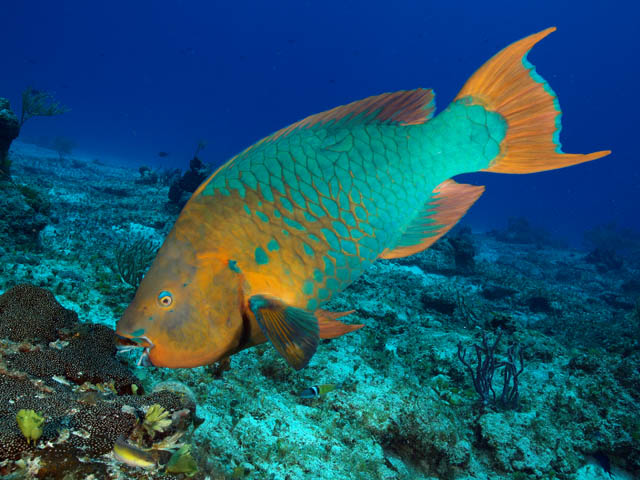
Parrotfish: Coral Reef Vegetarians

A rainbow parrotfish grazing on algae in the Caribbean
Photo source: CFMC, caribbeanfmc.com/fmp_reef_fish.html
Parrotfish are one of the most universally recognized reef fish, with their bright colors and beautiful varieties. If you've ever been snorkeling or SCUBA diving on a reef, you've probably easily spotted parrotfish swimming around, biting off pieces of coral - wait, biting coral? Isn't that bad for it? Aren't corals endangered?

Believe it or not, this "grazing" behavior is actually really good for coral reefs! Parrotfish are herbivores, which means that they eat only plant matter, not other fish, and when you see them biting at the coral, they are actually eating the algae that are growing there. This allows the living part of coral reefs, the polyps, to expand and grow, making the reef bigger and stronger. Without the parrotfish to remove the algae, the polyps would be smothered and eventually die! 

Parrotfish (along with snapper) for
sale in a Caribbean grocery store
Parrotfish are also important sources of food for many Caribbean islands. In the US Virgin Islands, the people of St. Croix especially love fishing and eating parrotfish. Managers must carefully assess the health of the parrotfish stock, due to this fishing demand.

On Leg 3 of our cruise, we are specifically targeting parrotfish larvae for the first time! We want to know where these fish are being spawned, retained, and/or transported, and what differences exist between the St. Thomas/St. John and St. Croix populations.

In the Virgin Islands, we mainly find two genera of parrotfish: Sparisoma and Scarus. Within these genera are more than a dozen different species, like midnight, rainbow, stoplight, queen, and princess parrotfish. Our taxonomists look at the fish's body shape, pigment patterns, and number of fin rays to determine which genus they find. Unfortunately we can't identify all these species at the larval stage with only a microscope (keep reading to find out how we can!). 

Taxonomists carefully collect the sample after a net tow and keep it on ice, then pick through the sample under a microscope, looking for fish larvae - live and on the ship! If we find any parrotfish larvae, they are identified to genus, measured, and then preserved based on the type of future analysis to be conducted. Some larvae are frozen in liquid nitrogen (about -340° F!) so that we can measure their stable carbon and nitrogen isotopes. Other larvae are preserved in refrigerated ethanol to keep their DNA pristine, which can be sequenced to identify the species of each fish, and what population it belongs to!
The two main genera in the Caribbean: Sparisoma (top), ~9mm SL, and Scarus (bottom), ~7mm SL.
Can you spot the differences between the two genera? (HINT: look at the pigments!)
So far, we've found over 300 parrotfish larvae in our samples! We can't wait to get back to the lab to see how many more we caught, and to discover more about the ecology and biology of these beautiful fish! 

Wednesday, June 8, 2016

Featured Scientist: Dr. Raul Laiz Carrion!

Dear reader, today we feature a guest post by Dr. Raul Laiz Carrion. Please scroll down for English. 
Raul and Lulu collect plankton

En esta campaña NF1602, somos muy afortunados de nuevamente contar con la participación del Investigador del Centro Oceanográfico de Málaga del Instituto Español de Oceanografía (IEO) el Dr. Raul Laiz-Carrión! Raul se ha convertido en un “clásico” de nuestro equipo de trabajo en las campañas de investigación del Mar Caribe, gracias a la estrecha colaboración que existe entre el IEO y el FORCES Lab del SEFSC-NOAA. 


Measuring fish before freezing them in Liquid Nitrogen
Esta fructífera colaboración entre las dos instituciones ha dado lugar a que actualmente se haya conseguido financiación de la Secretaria de Estado de Investigación,  Desarrollo e Investigación del Ministerio de Economía y Competitividad de España para realizar el proyecto ECOLATUN (CTM2015-68473-R-MINECO/FEDER), titulado: “ECOLOGIA TROFICA COMPARATIVA DE LARVAS DE ATUN ROJO ATLANTICO (THUNNUS THYNNUS) DE LAS AREAS DE PUESTA DEL MEDTERRANEO-NO Y EL GOLFO DE MEXICO.”


El principal interés del Dr. Laiz-Carrión se centra en la ecología larvaria de 
especies de especial interés no solo desde el punto de vista económico sino fundamentalmente ecológico, como puede es el atún rojo. En los últimos años ha centrado sus investigaciones en tratar de explicar la variabilidad en el crecimiento a través de las diferentes estrategias tróficas en estadios de temprana edad... “Pequeñas variaciones en el crecimiento pueden originar grandes cambios en la supervivencia larvaria y por consiguiente en el reclutamiento de la especie. 


PI Lamkin and PI Laiz-Carrion 
Tratamos de entender estas variaciones en el crecimiento no solo con la caracterización de los diferentes hábitats de puesta, sino también entendiendo la ecología trófica de la especie objeto de estudio y su interacción con otras especies que la acompañan y con las que puede compartir los recursos alimenticios a lo largo de la cadena trófica. Todo esto lo abordamos desde el punto de vista comparativo entre el Golfo de México y áreas adyacentes y las aguas del Mar Balear del Mediterráneo. Para abordar este proyecto tan ilusionante, es una verdadera suerte el poder contar con la participación y el apoyo de expertos de reconocido prestigio internacional de diferentes instituciones americanas (NOAA, Univ. of Miami/CIMAS, CUNY, WHOI), mexicanas (ECOSUR) y españolas (IEO).”

A brief summary in English:

Raul processes data from the Mini-Bongo net
During this research survey (NF1602) we are lucky to once again have the participation of Dr. Raul Laiz-Carrión, a researcher from the Centro Oceanográfico de Málaga del Instituto Español de Oceanografía (IEO). Raul has become a “classic” member of our team during our Gulf/Caribbean surveys as a result of the close-collaborations between his Lab at the IEO and the NOAA NMFS FORCES Lab. Our productive collaboration has proven effective as we recently awarded a proposal from the Research Ministry of Spain (Secretaria de Estado de Investigación,  Desarrollo e Investigación del Ministerio de Economía y Competitividad de España) in a project titled: “Comparative trophic ecology of bluefin tuna (Thunnus thynnus) in spawning areas in the Northwest Mediterranean and the Gulf of Mexico.”


Raul’s research is focused on the larval ecology for species of interest (not just from a commercial emphasis, but mainly from an ecological context). In the last few years, Raul’s work has investigated the natural variability in growth by examining trophic strategies during the earliest larval stages. Recently we have compared the Balearic Sea (Mediterranean) with the Gulf of Mexico thanks to our multidisciplinary and international support from NOAA, UM/CIMAS, CUNY, WHOI, ECOSUR (Mexico), IEO (Spain).

Thursday, May 12, 2016

The FORCES Awaken

NOAA Ship Nancy Foster alongside in Havana, Cuba
The Nancy Foster is underway once again with an eager compliment of scientists ready to comb the Caribbean for plankton! As with last year the Southeast Fisheries Science Center (SEFSC) is partnering with the Atlantic Oceanographic and Meteorological Laboratory (AOML) to tackle this year’s scientific objectives.

The first part of the 2016 survey (NF-16-02) will be working in waters around western Cuba and east of the Yucatan Peninsula. The focus of this part of the survey will be to continue our study of the distribution and abundance of Atlantic bluefin tuna (ABT) and other tuna larvae in the Gulf of Mexico and western Caribbean Sea. In addition to tuna larvae, the 2016 survey will sample other larval species found near regional coastal reefs including snapper, grouper, parrotfish, and spiny lobster larvae. The goal is to understand the role that the major current systems play in the dispersal/retention of these species and identify possible spawning locations, examine growth and survival of larvae, and increase our understanding of species recruitment to benthic habitat.

The second part of the 2016 survey (NF-16-03) will take place in the vicinity of the Virgin Islands (VI). During this part of the survey, we plan on sampling water properties, currents, and dispersal and transport of fish larvae in the VI and neighboring regions. Results from the survey can enhance our understanding of regional spatial variation in the supply of fish larvae between managed and non-managed areas.

The mighty Neuston net soars again
While the research area and sampling methods may seem similar to last year’s project, we can assure you, our loyal reader, that new and exciting things are in store for 2016! One major change that happened since last year is a rebranding of the very lab that brings you this blog. Say goodbye to the SEFSC’s Early Life History (ELH) Lab and hello to the Fisheries Oceanography for Recruitment, Climate, and Ecosystem Studies (FORCES) Lab! During its humble beginnings, the ELH lab was focused on larval fish taxonomy (i.e. the description and classification of larval fishes) but in the years that followed our work has expanded to a point where now we use tools such as biophysical models, genetics, and isotope analysis to look at the role larval fish and plankton play in the ocean ecosystem in an effort to protect and manage our valuable ocean resources.

The first days of any cruise are indeed hectic as the science party begins to regain their sea legs and shake the rust off. As we put our first nets in the water and deploy our inaugural CTDs north of Havana, Cuba, here is a recap of what the Foster has been up to since we embarked in Miami.

Castillo de los Tres Reyes Magos del Morro
NOAA Ship Nancy Foster arrived at the U.S. Coast Guard Base Miami Beach on May 2nd, at which point the controlled chaos began. Scientists and crew worked like ants to load all of the necessary equipment and supplies for almost two months at sea; nets, frames, CTDs, hundreds of sample jars, drums of ethanol, drifters, microscopes, computers, liquid nitrogen, fuel, FOOD! Members of the science party flew in from all corners of the world; Mexico, Spain, Japan… Last-minute generator repairs completed…Amongst the chaos we also managed to host a 6th grade class for a field trip aboard the vessel. Somehow, everything got done and on May 7th, lines were tossed and NF-16-02 and the Nancy Foster were underway! Next stop: Havana.

The day long transit to Havana gave us some time to catch up with each other, (re)familiarize ourselves with the ship, and discuss the upcoming sampling plan. We also took this time to test all of our science equipment. We stopped to deploy our nets and CTD to make sure all of the electronics were functioning properly and went over deployment and recovery procedures (it is a true group effort!).

A Havana icon
The Nancy Foster arrived in Havana on May 8th to embark the last two members of our science party. The crew and science party enjoyed the prestige of being one of the first U.S. Government vessels to pull in to Havana in a very long time. For more pictures and information on the Nancy Foster's visit to Cuba click here, or here.  With our Cuban colleagues aboard, the Foster left Havana on May 10th en route to station 001.  Although the weather was less than ideal, we were hoping that our excitement to get the survey started would soothe our seasickness (but if that doesn’t work, there is always sea sickness medication).


Stay tuned as our exciting 2016 survey unfolds. If this is your first Nancy Foster Chronicle, feel free to browse previous years’ blogs to get an idea of what we are all about!

Clyde keeps a watchful eye on the ship