Wednesday, June 15, 2016

Return to the Virgin Islands

While Legs 1 and 2 of NF1602 involved updated collection strategies, adaptive sampling, new techniques, and historic port stops, Leg 3 brings us back to some welcome familiar territory, the U.S. and British Virgin Islands! The partners at AOML/PHOD and NMFS/SEFSC have sampled these regions from 2007-2011, and again in 2015. 

Brewers Bay, St. Thomas, USVI

A plankton sample is preserved
This year, the research collaboration will focus on surveying the oceanographic conditions (using CTD, ADCP, and drifter data), larval reef fish populations (with neuston and MOCNESS net tows), and zooplankton concentrations (mini-bongo) across the coastal shelf of the U.S. Virgin Islands and the surrounding region. Data collected will help us understand the connectivity and variation in the transport and supply of reef fish larvae between managed and non-managed areas in the Virgin Islands. 

Scientist Kathryn sorts a fresh sample
We'll be sorting our plankton samples live on board, like on Legs 1 and 2. This way, we can get real-time information on fish species of interest, and freeze samples immediately so we can conduct DNA and isotope analyses on the samples. Nitrogen isotopes in these samples provide definitive biological linkages and trophic structure comparisons between fish populations. We are especially targeting larval parrotfish. These colorful species are fished locally, especially in St. Croix, USVI. From an ecosystem standpoint, herbivorous parrotfish are valuable grazers on coral reefs, feeding on competitive algae which can inhibit coral recruitment.
The two genera of parrotfish larvae we are interested in: left, Sparisoma sp., and right, Scarus sp.
We have many new faces on board this leg, so stayed tuned for some spotlights on our guest scientists and their research! For now, here's a sneak peak at what we've been up to so far...


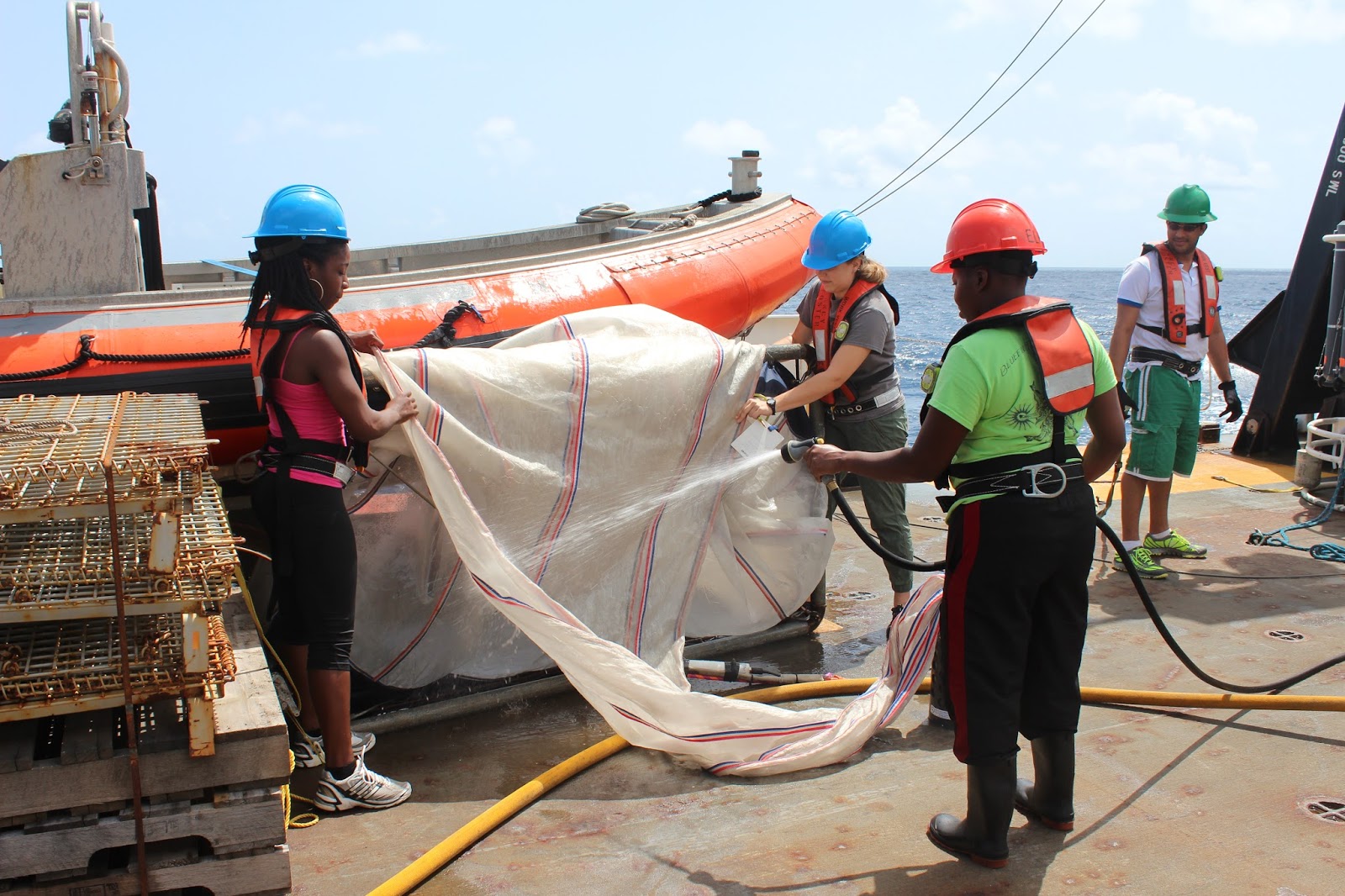
Scientists Adrianne, Kathryn, and LaTreese rinse down the "S25" neuston net
Scientist Dan takes light measurements for his optics study
Oceanographer Ryan takes water samples from the CTD
Scientist Mara preserves a microzooplankton sample from the mini-bongo


Monday, June 13, 2016

Leg 2 Wrap Up!

"Leg 3" of the survey has officially started! Nancy, as we affectionately call the ship, departed from St. Thomas and is currently sampling in and around the US and British Virgin Islands as well as Puerto Rico for the next couple of weeks to continue our larval reef fish monitoring in the area (EST 2007-2011, 2013 and 2015!). The focus of this survey is quite different than the previous month (chasing eddies, lobsters and tunas!) and we will continue to share our journey along the way.

So to wrap up the first portion (NF1602), our Legs 1 and 2 chief scientist shared some of her thoughts:

John, our SEFSC Principle Investigator (PI) on the back deck
Evidence of our very international sci-crew
"The past month aboard the NOAA Ship Nancy Foster has been compiled with unforgettable moments! After many years of trying to have a port visit with our neighbor country (Cuba), we successfully docked in La Habana as well as in Cienfuegos!! As marine scientists, we are often ultra-focused on the science, but often the social angle gets lost in the mountains of paperwork we have to navigate to accomplish our research. Our trip to Cuba was possible thanks to many many people in the University, as well as multiple people in both of our governmental institutions - each doing their part to inch our collaborations forward. Our blog portrays the most fun aspect of going to sea, but just to set foot on the ship, A LOT happens behind the scenes!

"So without much further ado, THANK YOU to all that made the month of MAY possible! If you are one of those people reading the blog (you know who you are), we truly appreciate your efforts and hope you enjoyed the blog so far!"

We have some May photos for your enjoyment... stay tuned for most of June as Nancy returns to the eastern Caribbean!!


Miami-Cozumel (Leg 1)
L-R: Ofelia, Lulu, John, Yoandry, Raul, Aki, Grant, Jason, Matthieu, Leif, Atsushi
Front: Sarah and Estrella


Cozumel-Cienfuegos (Leg 2)
L-R: Estrella, John, Trika, David, Aki, Leif, Cati, Ofelia, Jason, Ryan
Front: Raul, Yoandry
Yoandry, Grant, Lulu, and Raul pose during a station on the back deck
Selfie!! Leg 1 scientists on the back deck at the end of the leg.
Cati, Ofelia, Raul, and Aki take in the view from the bridge deck as the ship pulls into Cienfuegos, Cuba.
L-R: John, Raul, Jason, David, Leif, Ryan, Aki, Trika, Cati, Ofelia, and Estrella in Cienfuegos.

Thursday, June 9, 2016

Featured Scientist: Catalina "Cati" Mena Oliver

Although we are starting to sample in the eastern Caribbean, today's blog features a 'leg 2' participant: Cati! 
Picoplankton and the microbial food web (from Johnson and Lin, 2009)
Processing plankton samples
Catalina Mena Oliver (Cati) joined us in Cozumel back in May to specifically sample picoplankton during Leg 2. Catalina is a PhD student from the Spanish Institute of Oceanography (Oceanographic Centre of  Baleares - Larval Ecology Group), and she is developing her Doctoral Thesis studying the base of the planktonic food web with special interest in the bacterioplankton communities (picoplankton). 
Dynamic oceanographic currents of the western MED
(Balbin et al 2014)
Picophytoplankton (~0.2 to 2 µm) are the smallest autotrophic organisms on Earth and in stratified oligotrophic regions (like the Mediterranean and the Caribbean) can be a key component as biomass source. During our survey we aim to link the community of primary producers to eddy structures, since these communities can be highly influenced by mesoscale dynamics and by changes in resource supply. The phytoplankton size structure and the relative contribution of the different phytoplankton size fractions in terms of carbon biomass strongly affect the carbon transfer and the ecosystem functioning.
Cati shares her research with the science team
Cati shared with our blog: “I am very grateful to FORCES Lab from SEFSC-NOAA to give me the opportunity to participate in the Nancy Foster survey and I hope we could continue this collaboration in the future. The results obtained will help us to assess if the ecosystem is supported by a microbial food web, dominated by the picophytoplankton fraction, which might be crucial as food source not only for bluefin tuna larval ecology but also for other many species”.
We enjoyed to have Cati aboard and hope that she will sail again with us! We look forward to sharing her results in the future with you our loyal reader! 

Trying on the safety suit! (Cati is a LOBSTER)


Wednesday, June 8, 2016

Featured Scientist: Dr. Raul Laiz Carrion!

Dear reader, today we feature a guest post by Dr. Raul Laiz Carrion. Please scroll down for English. 
Raul and Lulu collect plankton

En esta campaña NF1602, somos muy afortunados de nuevamente contar con la participación del Investigador del Centro Oceanográfico de Málaga del Instituto Español de Oceanografía (IEO) el Dr. Raul Laiz-Carrión! Raul se ha convertido en un “clásico” de nuestro equipo de trabajo en las campañas de investigación del Mar Caribe, gracias a la estrecha colaboración que existe entre el IEO y el FORCES Lab del SEFSC-NOAA. 


Measuring fish before freezing them in Liquid Nitrogen
Esta fructífera colaboración entre las dos instituciones ha dado lugar a que actualmente se haya conseguido financiación de la Secretaria de Estado de Investigación,  Desarrollo e Investigación del Ministerio de Economía y Competitividad de España para realizar el proyecto ECOLATUN (CTM2015-68473-R-MINECO/FEDER), titulado: “ECOLOGIA TROFICA COMPARATIVA DE LARVAS DE ATUN ROJO ATLANTICO (THUNNUS THYNNUS) DE LAS AREAS DE PUESTA DEL MEDTERRANEO-NO Y EL GOLFO DE MEXICO.”


El principal interés del Dr. Laiz-Carrión se centra en la ecología larvaria de 
especies de especial interés no solo desde el punto de vista económico sino fundamentalmente ecológico, como puede es el atún rojo. En los últimos años ha centrado sus investigaciones en tratar de explicar la variabilidad en el crecimiento a través de las diferentes estrategias tróficas en estadios de temprana edad... “Pequeñas variaciones en el crecimiento pueden originar grandes cambios en la supervivencia larvaria y por consiguiente en el reclutamiento de la especie. 


PI Lamkin and PI Laiz-Carrion 
Tratamos de entender estas variaciones en el crecimiento no solo con la caracterización de los diferentes hábitats de puesta, sino también entendiendo la ecología trófica de la especie objeto de estudio y su interacción con otras especies que la acompañan y con las que puede compartir los recursos alimenticios a lo largo de la cadena trófica. Todo esto lo abordamos desde el punto de vista comparativo entre el Golfo de México y áreas adyacentes y las aguas del Mar Balear del Mediterráneo. Para abordar este proyecto tan ilusionante, es una verdadera suerte el poder contar con la participación y el apoyo de expertos de reconocido prestigio internacional de diferentes instituciones americanas (NOAA, Univ. of Miami/CIMAS, CUNY, WHOI), mexicanas (ECOSUR) y españolas (IEO).”

A brief summary in English:

Raul processes data from the Mini-Bongo net
During this research survey (NF1602) we are lucky to once again have the participation of Dr. Raul Laiz-Carrión, a researcher from the Centro Oceanográfico de Málaga del Instituto Español de Oceanografía (IEO). Raul has become a “classic” member of our team during our Gulf/Caribbean surveys as a result of the close-collaborations between his Lab at the IEO and the NOAA NMFS FORCES Lab. Our productive collaboration has proven effective as we recently awarded a proposal from the Research Ministry of Spain (Secretaria de Estado de Investigación,  Desarrollo e Investigación del Ministerio de Economía y Competitividad de España) in a project titled: “Comparative trophic ecology of bluefin tuna (Thunnus thynnus) in spawning areas in the Northwest Mediterranean and the Gulf of Mexico.”


Raul’s research is focused on the larval ecology for species of interest (not just from a commercial emphasis, but mainly from an ecological context). In the last few years, Raul’s work has investigated the natural variability in growth by examining trophic strategies during the earliest larval stages. Recently we have compared the Balearic Sea (Mediterranean) with the Gulf of Mexico thanks to our multidisciplinary and international support from NOAA, UM/CIMAS, CUNY, WHOI, ECOSUR (Mexico), IEO (Spain).

Monday, June 6, 2016

Megastations!

The second portion of our research survey ("Leg 2") is complete! Over the course of ~3 intense days, we worked around the clock and deployed 104 XBTs, conducted 14 CTD casts, and completed 27 MOCNESS, 19 Neuston, and 6 mini-bongo tows - all in order to better understand the mesoscale eddies that had formed in the south of Cuba, and how these dynamic water masses may impact larval zooplankton and fish! (see this post for more about what we were looking for!)

While we are currently enjoying a little break from sampling, we'd love to share with you some images of the last few days....
Planning in the dry lab to discuss our super-intense sampling strategy! Leif leads the discussion in the dry lab!

Left: Ryan carefully plots the next station
Right: Megastations! Our white board gets full, listing all the planned station events

Resultant velocity vectors showing the speed (vector length) and direction of the currents as we traversed
the anticyclonic (rotating clockwise) eddy. Vector colors indicate sea surface temperature. 

Nets! Top: Sr. Survey Tech Samantha supervises the deployment of the MOCNESS
Bottom: Scientists Leif and Jason deploy the  Neuston net

When you've been up all night working, things get a little silly!
Top L: Jason, Aki, and Yoandry celebrate their 5th MOCNESS tow of the day! Top R: Estrella models the new cruise uniform. Bottom: Jason is excited to have run another successful MOCNESS tow! 

We're done! Scientists Jason, Estrella, and Yoandry celebrate the end of Leg 2 with a back deck selfie! 


Friday, June 3, 2016

Cozumel Open House: Guest Post by Lourdes Vasquez Yeomans

Dear readers, today we feature a guest post written by one of our long-time collaborators Lourdes Vasquez Yeomans (Lulu!). While the ship was in Cozumel, we opened our doors once again to another group of enthusiastic students that wanted to learn a bit about our research in the region. Lulu's post is in Spanish, please ask (in the comments) if you have any questions and I will be happy to answer them.

La M. en C. Lourdes Vasquez Yeomans con nuestros
 invitados comparte sobre su experiencia en la campana NF1602
Desde el 6 mayo al 19 del año en curso, la M. en C. Lourdes Vásquez Yeomans de la Unidad Chetumal participó en el crucero oceanográfico a bordo del buque Nancy Foster. Durante 14 días de travesía se obtuvieron muestras de plancton en el NE de Cuba y norte del Caribe mexicano con el objetivo de localizar áreas de desove de valiosos recursos pesqueros, sobre todo atunes, dorados y picudos. También se midieron variables físicas y registraron procesos oceanográficos. 

Estudiantes, profesores, e investigadores con la oficial ENS S. Thompson
El 19 de mayo el Nancy Foster arribó al puerto de Cozumel y el día 20 abrió sus puertas a miembros de la comunidad académica de Quintana Roo recibiendo la visita de estudiantes del Instituto tecnológico de Chetumal (ITCH) y la Universidad de Quintana Roo (UQROO).  También participaron de este recorrido, varios  miembros del personal administrativo de la Unidad Chetumal de ECOSUR. La oficial Ensign Sara Thompson dio una clara explicación de las maniobras y equipos de navegación del buque. Adicionalmente los científicos participantes en la travesía explicaron los objetivos centrales que justifican la realización de este tipo de cruceros de investigación, se explicaron también el funcionamiento de los equipos utilizados para los muestreos biológicos en la columna de agua así como para la obtención de las variables físicas medidas con equipos oceanográficos especializados.  Todo ello implica un esfuerzo coordinado de equipos bien definidos de trabajo que cubren dos horarios de muestreo. 

Lief comparte detalels sobre el esfuerzo de multibeam del Banco San Antonio
Los estudiantes, profesores y personal participante hicieron diversas preguntas sobre las actividades realizadas por los científicos especialmente las que implican el reconocimiento de las especies objetivo, medición y toma de fotografías,  sobre las fuentes de financiamiento para lograr cubrir los costos de un buque de este magnitud, así como de los equipos utilizados para las mediciones de variables físicas. Manifestaron su interés de participar en una de las últimas estaciones de trabajo, si vuelve el Nancy Foster el próximo año, dijeron “queremos subir al NF ver directamente como trabajan los científicos!” una propuesta  para los jefes de campaña John Lamkin, Estrella Malca y Ryan Smith.

Eloy y Lulu explican la maniobra de la MOCNESS abordo

Wednesday, June 1, 2016

Featured Scientist: Professor David Lindo-Atichati!

David prepares to deploy an XBT on the back deck
The incredible science that we conduct each year on our cruise would not be possible without our diverse international collaborations. We'd like to continue to introduce you to some of the brilliant people who help make our cruises a success! Today's featured scientist is David Lindo-Atichati, Assistant Professor at City University of New York and Guest Investigator at Woods Hole Oceanographic Institution.

"I am a tenure-track assistant professor at City University of New York and, while I am primarily focused on research, I very much enjoy teaching. At CUNY I am developing a new graduate course in Physical Oceanography, and a new undergraduate course in Meteorology. I love conveying to students my own excitement about the importance of the ocean in our daily lives, and I relish awakening their curiosity on the interdependence of the physical, chemical, and biological systems in the ocean.

"My focus on this cruise will be on the physics of the sea. I study ocean eddies, which are rotating bodies of water that make up the weather of the sea. The diameter of these features range from 1 kilometer to a few hundred kilometers. These invisible islands of water bring together and mix ocean life while swirling like a hurricane. In a nutshell, the data I will obtain from this cruise will allow me to look at the evolution of unexplored ocean eddies South of Cuba.

"My research, in conjunction with an international network of collaborators, grapples with questions at the frontiers of physics, biology, and chemistry in the oceanic systems. I approach these questions from a multidimensional perspective that includes theory, observation, and modeling. By weaving these three approaches together, my research program is specifically designed to understand the interactions between oceanic circulation, marine ecosystems, and marine pollutants at very fine scales.

"This marine expedition aboard the Nancy Foster to South Cuba is a unique opportunity for me to rigorously test predictions of ocean models and satellite altimetry products with the massive set of in situ observations that we are collecting in the region. Most importantly, this expedition will lay the foundations to further study the dynamics of three semi-permanent eddies locates south of Cuba and evaluate their profound impacts on the transport of water masses and marine ecosystems South of Cuba and downstream into the Gulf of Mexico."


The FORCES Lab has been privileged to work with David for many years now, and is thrilled that he was able to join us again on this historic cruise! Thanks for sharing a bit about yourself and your research!