Friday, April 21, 2017

Featured Scientist: Meet Vanessa!

Our annual surveys would not be possible without our wonderful collaborators from around the world. We'll dedicate several future blog posts to highlight these individuals, so that you can learn more about them, their research, and the valuable contributions they make to the survey. You can find previous posts here. Today we feature Vanessa McKague from the University of the Virgin Islands!

Vanessa runs the CTD in the dry lab on Easter Sunday
Hi everyone! I'm Vanessa McKague, Oceanographic Technician from the University of the Virgin Islands! I am also a new mother of an 8 month old boy.  Having a child really changes so much in your life and most of all your priorities change dramatically.  But because I love my job and what I do, I wouldn't want to have to choose between them. I am learning as I go along but I am trying my best to be both a great mother and a productive scientist. I love being an Oceanographic Technician because I get to do all of the hands on science that I love. I work with many oceanographic instruments (i.e., CTDs, ADCPs) and perform calibrations and maintenance as well as program them for deployments and process the data. On this cruise I have been running the CTD rosette.  I work in the dry lab on the computer using Seasave software to view the ocean profile data in real time and to collect water samples in the niskin bottles at the surface and at the deep chlorophyll maximum.

Vanessa decked out in safety gear on the back deck.
At UVI, I work with Dr. Sennai Habtes (who is also on this cruise) in the Oceanography Laboratory.  One great opportunity that I recently had was to take a Larval Fish Identification Course.  I have not had previous experience doing this so it was such a great learning experience for me.  It was very hands on and we all had microscopes to look at all of the samples.  My favorite part of the course was taking an unknown sample and using the skills that we had gained to identify the larval fish species.

Colton helps Mom learn how to identify larval fish! 
What I want to get out of the cruise: Deploying the mooring for the relocation of the St. Thomas CariCOOS/VI-EPSCoR oceanographic buoy. The original location was south of St. Thomas, but now we will have real time oceanographic data northwest of St. Thomas.  It will be the first oceanographic buoy located north of the Virgin Islands in the Atlantic Ocean!  We successfully deployed the anchor and chain with surface buoy markers on the first day of the cruise.  We will then go back out on a calm day in a smaller vessel and use commercial divers to attach the buoy and inspect the site.

Secondly, I just want to be out to sea doing science!  This is one of the best parts of my job and I look forward to this opportunity.  It is a time to focus on collecting data and to talk to other scientists without interruptions of everyday life.  We are all living out here together so there are plenty opportunities to learn from each other and to come up with new ideas and projects for future work.

Thursday, April 20, 2017

The weather started getting rough....

....the tiny ship was tossed!

Jason and Alexis deploy the CTD using tag lines
Working in the Caribbean is usually filled with picturesque islands, clear skies, and flat seas, but sometimes a weather system comes through that changes all that! The last few days we've experienced some big waves and windy conditions, and slightly altered our course to try to stay in more protected waters. We want to ensure the safety of everyone on board, as well as protect our delicate plankton nets and sensitive instruments.

Sara and Jason are ready to hook the CTD for recovery
Though we always have certain safety measures in place, we'll make some changes once the weather starts to turn. Everything on the ship needs to be carefully secured. We use tag lines to keep instruments steady during deployment and use hooks for recovery. We sometimes even have to change our course to avoid bad weather. This week, we diverted our trackline inshore to avoid wind speeds of 30 knots!

Weather is just one of the many factors we have to consider while sampling at sea!

Giovanni ducks to avoid a wave crashing on the back deck! 

Jason and Alexis weren't so lucky - they got drenched while rinsing down the Bongo net!

Thankfully, at the end of every storm is a sunrise like this:
Sunrise off the bow. Photo credit: LTJG Niki Norton

Wednesday, April 19, 2017

Featured Scientist: Meet Giovanni!


Our annual surveys would not be possible without our wonderful collaborators from around the world. We'll dedicate several future blog posts to highlight these individuals, so that you can learn more about them, their research, and the valuable contributions they make to the survey. Today we feature Giovanni Seijo-Ellis from the University of Puerto Rico - Mayaguez!

Giovanni successfully completes a 1500-meter CTD cast
Hi everyone! My name is Giovanni Seijo-Ellis, I'm a physics masters student at the University of Puerto Rico - Mayaguez, and I'm starting my PhD next fall at the City University of New York's Graduate Center with Dr. David Lindo.

I always knew that I wanted to work on something related to the oceans and as I grew up that interest grew bigger. When I found out as a young teenager that there is a field called physical oceanography, I felt I was born for it. Back in Puerto Rico there are no undergraduate programs in oceanography, so I decided to go into Theoretical Physics, took some advanced oceanography courses and complemented it with atmospheric dynamics courses. I worked for three and a half years for the Puerto Rico Seismic Network doing tsunami simulations and hazard assessments under a National Tsunami Hazard and Mitigation Program grant. 

Ready to launch the XBT!
Then I moved to work with the Caribbean Coastal Ocean Observing System (CariCOOS), the Caribbean Component of NOAA's Integrated Ocean Observing System (IOOS). There I work as an ocean modeler. I basically work with validation and development of ocean models for the Caribbean region in order to have better forecasts of ocean currents and I also prepare some operational products for the CariCOOS webpage users. Besides that, I also do storm surge simulation and mapping with special focus on energy distribution over coral reefs along the northern and eastern part of Puerto Rico. Every now and then I help in CariCOOS field work (which is probably my favorite thing to do), deploying CTDs, and deploying/recovering sea gliders or anything else that comes up. 

One of the homemade biodegradable
CariCOOS drifters
I met Dr. Lindo some months ago and we quickly noticed that we had many research interests in common, so I decided to apply to CUNY's Earth and Environmental Sciences program where we could work together and I could reach my goal of getting a PhD. A couple of weeks after, he called me to see if I was interested in participating on a research cruise...of course I was interested!!!! Our goal is to understand the cross-shelf exchange of waters between St. Thomas and St. Croix. Ocean circulation/currents in the Caribbean is not as easy to understand as one may think. The rapid variation of the bathymetry has a huge effect on ocean currents and waves which makes it a challenge to model accurately and many mesoscale features are also common in this region. So, does water from south of the shelf break cross to the shallower part north of the shelf break? Or does it move along the shelf break? Or do the shallow water cross into the deeper waters? How does this affect larval dispersal in the region? 

These are some of the questions that will help us understand what is happening in this part of the Caribbean and how it affects larval dispersal near the shelf break, especially on the Grammanik and Hind Banks. To accomplish this we will use data obtained from 8 SVP drifters, 4 Bio-degradable drifters (home-made by CariCOOS), 22 XBT launches, and CTD deployments. The use of plankton nets will allow us to collect fish larvae at different water depths and potentially trace back to their place of origin. 

It's away! Positioning the XBT launcher during deployment
So here I am, learning a lot and enjoying every second. So far it has been an amazing experience, the crew and the science team are wonderful. Everyone on the science team is just great, they are really open to hear any suggestions and really care for everyone to learn how to do everything around here. Doesn't matter if you're an undergrad or graduate student, with or without experience in the field, here you are a scientist and will be treated as one. We are all equal, and that makes it really comfortable for such a diverse group to work together successfully. 

While not working, I really enjoy sailing either on a Catalina 30 sailboat, racing on a J30 or J24 or just relaxing near a pond and sail my radio control sailboat. I also do cross-country mountain biking and ride my MTB to work at least once a week. I really hope and look forward to be able to come back on board the Nancy Foster with this amazing team in years to come!

Thanks!


Tuesday, April 18, 2017

Leading Off

This type of buoy will be attached to the mooring
The first event or "op" of the survey was deploying a mooring! Moorings are devices that are usually hooked up to stationary wire that is secured to the sea floor. This mooring will serve as an anchor for the University of the Virgin Island’s real-time oceanographic data buoy. This buoy is part of the larger CariCOOS System (Caribbean Coastal Ocean Observing System), which conducts operational oceanography and ocean observing.

This buoy will be positioned on the northwest shelf of St. Thomas, and will collect real time measurements of:
  • air temperature
  • wind speed & direction
  • wave height & direction
  • sea temperature 
  • salinity
  • density
  • velocity of ocean currents
  • turbidity
  • chlorophyll
  • dissolved oxygen 

Officers, crew, and scientists work together to deploy the mooring, chain, and floats.
The chain was snaked back and forth on deck to allow safe deployment. 

The floats will help divers attach the buoy to the chains.
With the crew of the Nancy Foster, we were able to deploy the 2,500-pound (1,134 kg) concrete anchor and 300-foot chain, which will be paired with the oceanographic buoy by local divers later this month. Deployments like these can be very dangerous, so the scientists, crew, and officers had several safety meetings to devise the safest technique for deployment. The anchor was deployed by one of the ship's cranes, and the chain was carefully arranged on deck so that it smoothly and safely fed into the water once the anchor was dropped. Each person involved had a specific role and position on deck. Check out a video of the deployment below!


You can find historic data collected by the buoy available at CariCOOS.org.


Monday, April 17, 2017

Welcome Aboard NF-17-03!

Welcome back to another exciting year at sea!

NOAA Ship Nancy Foster in Brewers Bay, St. Thomas, USVI
The FORCES Lab at the NOAA Southeast Fisheries Science Center (SEFSC) invites you to join us again as we board the Nancy Foster and experience the wonder of the marine world! The 2017 survey begins in the Caribbean Sea around the stunning islands of the US and British Virgin Islands. We will continue our historical sampling grid from previous years, collecting water and plankton samples.We will also seek out information about the cross-shelf transport of water and planktonic organisms around these islands, and hopefully capture spawning events of commercially valuable reef fish. We are pleased to be sailing with collaborators from NOAA Atlantic Oceanographic and Meteorological Laboratory (AOML), University of Miami (RSMAS), University of the Virgin Islands (UVI), City University of New York (CUNY), University of Puerto Rico-Mayaguez (UPRM), University of South Florida (USF), and USVI Department of Planning and Natural Resources (DPNR). 

Later, the Foster will make her triumphant return to the Gulf of Mexico, going on the hunt for recently spawned patches of larval bluefin tuna! We have many new and exciting sampling schemes planned for this portion of our survey that we look forward to sharing. 

From L-R: Scientists Sarah (UVI), Giovanni (UPRM), Jason (RSMAS), Kristen (UVI),
Jess (CUNY), & Tanya (CUNY) enjoy the view as we set sail from Old San Juan, Puerto Rico

Once again, we'd like to offer a glimpse into what life on a research vessel is like, as well as introduce our incredible collaborators, veteran researchers, and up-and-coming young scientists. We hope you'll join us!

Check out posts from last year's cruise blog!

Friday, June 24, 2016

Another Year Complete!

A post-storm sunset captured from the beach in St. Croix, while the Foster (far left) is docked in port
Another cruise is in the books! We can't believe it's over already! This year's cruise was defined by balancing new sampling techniques and research goals with familiar methods and regions.

We made history by becoming the first federal vessel to dock in Havana, Cuba, since the restoration of diplomatic relations between the two countries, but also returned to the familiar U.S. Virgin Islands, where we sampled for the 7th year. We updated our usual pre-determined sampling plan in order to explore the dynamics of ever-changing mesoscale eddies, yet maintained the integrity of historical sampling sites. We welcomed new faces on board, including Cuban observers, and rekindled relationships with colleagues from years past.

Some final stats for Legs 1, 2, and 3 combined:
Sarah and Alexis rinse down the S25 net
  • CTD casts = 121
  • S10/S25 net tows = 105
  • Bongo tows = 41
  • Neuston tows = 17
  • MOCNESS = 74
  • mini-Bongo tows = 66
  • drifters deployed = 13
  • plankton samples collected = over 500!
  • countries visited = 4 (U.S., Cuba, Mexico, Jamaica)
  • collaborating countries = 7 (U.S., Mexico, Cuba, Japan, Spain, France, Dominican Republic)
  • collaborating institutions = 15
We still have lots of work left to do - unloading the ship, unpacking, cleaning, and repairing all our gear, sorting over 500 plankton samples, identifying larval fish, processing CTD files, running chlorophyll and isotope samples, and more! While we get back to work, check out some of our final images and videos from the last leg of the cruise, and be sure to check back for more next year!

Thanks for reading and sharing in our NF-16-02 adventures!
Leg 3! L-R: Omar, Trika, Sennai, Dan, Alexis, Aras, Mara, Ryan, Alex, Kathryn, Sarah, Adrianne, Angela, LaTreese


Aras patiently filters the mini-Bongo sample through find mesh funnels
Time-lapse: MOCNESS retrieval! 
(Video by Mara Duke)
Time-lapse: S25 tow - this was in very shallow water so you can see the ocean floor!
(Video by Mara Duke)

Adrianne and Angela deploy the CTD while ST Nick directs the winch operator
Ryan takes water samples from the CTD rosette bottles (top), then treats them so the
oxygen concentration can be measured back in the lab (bottom).
Omar (L) rinses the S25 neuston net, while Adrianne and Kathryn hold it steady.
Safety first! Everyone wears hard hats and PFDs, and are tethered to the deck with a safety line.

Day Shift Rules! Mara, Sarah, Sennai, and Alexis take a selfie in their safety gear.

Night Shift makes you crazy! LaTreese, Adrianne, Alex, Omar, Angela, Aars, & Kathryn started work at midnight everyday!

We're done! See you next year!!

Thursday, June 23, 2016

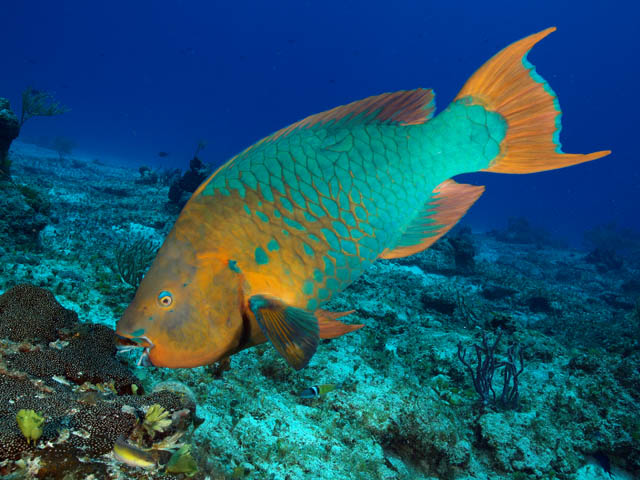
Parrotfish: Coral Reef Vegetarians

A rainbow parrotfish grazing on algae in the Caribbean
Photo source: CFMC, caribbeanfmc.com/fmp_reef_fish.html
Parrotfish are one of the most universally recognized reef fish, with their bright colors and beautiful varieties. If you've ever been snorkeling or SCUBA diving on a reef, you've probably easily spotted parrotfish swimming around, biting off pieces of coral - wait, biting coral? Isn't that bad for it? Aren't corals endangered?

Believe it or not, this "grazing" behavior is actually really good for coral reefs! Parrotfish are herbivores, which means that they eat only plant matter, not other fish, and when you see them biting at the coral, they are actually eating the algae that are growing there. This allows the living part of coral reefs, the polyps, to expand and grow, making the reef bigger and stronger. Without the parrotfish to remove the algae, the polyps would be smothered and eventually die! 

Parrotfish (along with snapper) for
sale in a Caribbean grocery store
Parrotfish are also important sources of food for many Caribbean islands. In the US Virgin Islands, the people of St. Croix especially love fishing and eating parrotfish. Managers must carefully assess the health of the parrotfish stock, due to this fishing demand.

On Leg 3 of our cruise, we are specifically targeting parrotfish larvae for the first time! We want to know where these fish are being spawned, retained, and/or transported, and what differences exist between the St. Thomas/St. John and St. Croix populations.

In the Virgin Islands, we mainly find two genera of parrotfish: Sparisoma and Scarus. Within these genera are more than a dozen different species, like midnight, rainbow, stoplight, queen, and princess parrotfish. Our taxonomists look at the fish's body shape, pigment patterns, and number of fin rays to determine which genus they find. Unfortunately we can't identify all these species at the larval stage with only a microscope (keep reading to find out how we can!). 

Taxonomists carefully collect the sample after a net tow and keep it on ice, then pick through the sample under a microscope, looking for fish larvae - live and on the ship! If we find any parrotfish larvae, they are identified to genus, measured, and then preserved based on the type of future analysis to be conducted. Some larvae are frozen in liquid nitrogen (about -340° F!) so that we can measure their stable carbon and nitrogen isotopes. Other larvae are preserved in refrigerated ethanol to keep their DNA pristine, which can be sequenced to identify the species of each fish, and what population it belongs to!
The two main genera in the Caribbean: Sparisoma (top), ~9mm SL, and Scarus (bottom), ~7mm SL.
Can you spot the differences between the two genera? (HINT: look at the pigments!)
So far, we've found over 300 parrotfish larvae in our samples! We can't wait to get back to the lab to see how many more we caught, and to discover more about the ecology and biology of these beautiful fish!